
STCrushers Is A Professional Minging Equipment Manufacturer since 2004, Providing High Quality Crushers, Sand Making Machines, Drying Equipment and more.
STCrushers Is A Professional Minging Equipment Manufacturer since 2004, Providing High Quality Crushers, Sand Making Machines, Drying Equipment and more.
If you are choosing between a ball mill and a rod mill, the first question should not be “which one is cheaper?”
The better question is: What kind of grinding result does your plant need?
Choose a rod mill when you need coarser grinding, more uniform particle size, and less over-grinding.
Choose a ball mill when you need finer grinding, stronger mineral liberation, and wider use in beneficiation plants.
Both machines are useful. But they are not interchangeable in every project. Choosing the wrong one may not stop your plant from running, but it can create unstable particle size, higher power consumption, poor separation performance, or unnecessary wear cost.
For mineral processing plants, the grinding stage directly affects the performance of flotation, magnetic separation, gravity separation, or other downstream processes. That is why the ball mill vs rod mill decision should be made based on material, feed size, target fineness, and process flow.
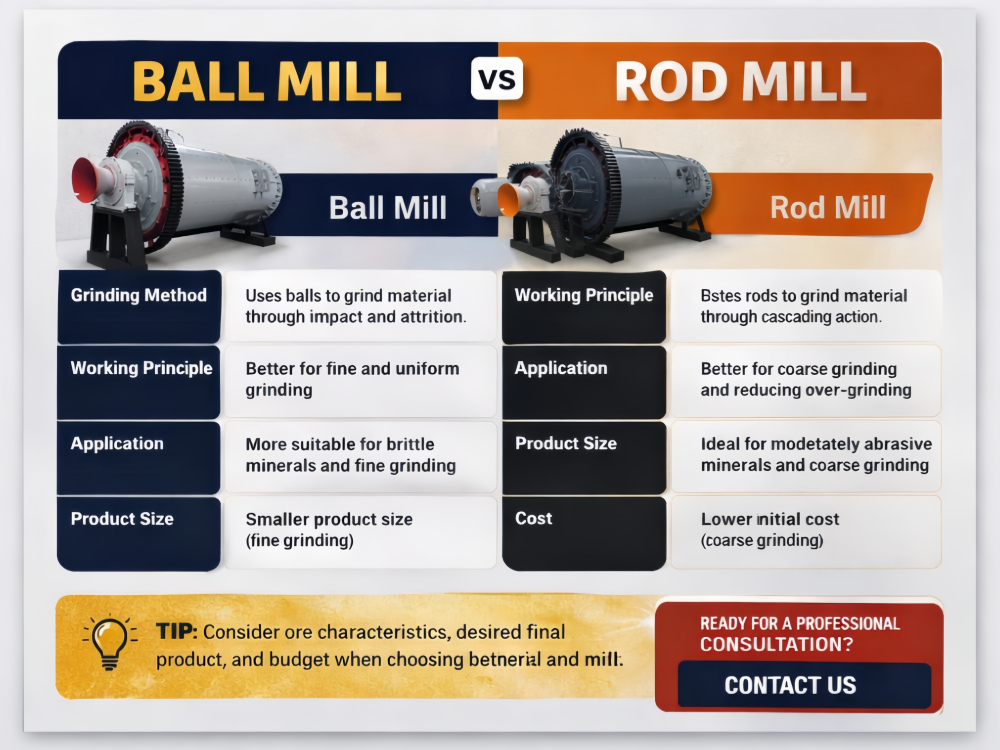
Item | Ball Mill | Rod Mill |
Grinding media | Steel balls | Steel rods |
Grinding action | Impact + grinding | Line contact grinding |
Typical product size | Finer discharge | Coarser and more uniform discharge |
Over-grinding risk | Higher if not controlled | Lower in many coarse grinding applications |
Common use | Mineral processing, ore grinding, fine grinding | Coarse grinding, sand making, certain ore grinding circuits |
Best for | Finer mineral liberation | Controlled coarse grinding |
Process flexibility | Very widely used | More specific applications |
Typical downstream use | Flotation, magnetic separation, beneficiation | Pre-grinding, coarse grinding, sand-related applications |
Selection focus | Fineness and liberation | Uniformity and reduced over-crushing |
This table gives the basic answer, but the real decision depends on your plant process.
The main difference between a ball mill and a rod mill is not just the grinding media. It is the final grinding behavior.
A ball mill uses steel balls as grinding media. During operation, the balls create strong impact and grinding action inside the cylinder. This makes a ball mill more suitable when the plant needs finer material and better mineral liberation.
A rod mill uses steel rods. Because rods create more line-contact grinding, the material is often ground in a different way. In many cases, rod mills produce a more uniform coarse product and reduce excessive fine particles.
This difference matters because not every plant wants the finest possible product. Sometimes the goal is enough grinding, not over-grinding; more uniform particle size; better preparation for the next stage; or reduced unnecessary fines. Other times, the goal is finer grinding, better mineral liberation, and better performance in flotation or separation.
That is why the machine should match the process, not just the buyer’s habit.
A ball mill is usually the better choice when your plant needs fine grinding or stronger liberation of valuable minerals.
This is common in many beneficiation plants, especially when the ore needs to be ground fine enough before separation.
gold ore processing
copper ore beneficiation
iron ore grinding
flotation preparation
magnetic separation preparation
wet grinding circuits
dry grinding applications in some materials
If your downstream process depends heavily on mineral liberation, the ball mill is usually the safer and more common option.
For example, in a flotation plant, if the copper or gold minerals are not sufficiently liberated from gangue, the flotation recovery may be poor. In this case, using a grinding system that cannot reach the required fineness may hurt the whole plant performance.
This is why ball mills are widely used in mineral processing plants. They are flexible, familiar to operators, and suitable for many ore grinding tasks.
A rod mill may be a better choice when the plant needs coarser grinding and better control of particle size distribution.
Because rods grind through line contact, they are often used where excessive fine particles are not desired.
coarse grinding before ball milling
sand making or artificial sand-related applications
materials where over-grinding should be avoided
certain ore grinding processes requiring more uniform output
plants where feed preparation needs controlled particle size
Rod mills are not “better” than ball mills in general. They are better in specific conditions.
For example, if the goal is to prepare a relatively uniform product instead of grinding everything very fine, a rod mill may reduce unnecessary fines and improve downstream stability.
This can be valuable when the plant does not want too much powder or when the next stage works better with more controlled particle size.
A common mistake is choosing a ball mill simply because it is more common.
Another common mistake is choosing a rod mill because someone says it produces less over-grinding.
Both ideas can be wrong if they ignore the actual process requirement.
The real question is not: “Which machine is more popular?”
The real question is: “What particle size does my downstream process need?”
A plant that needs fine grinding should not choose a rod mill just to reduce fines. A plant that needs controlled coarse grinding should not choose a ball mill only because it is widely used.
This is where many early-stage buyers lose money. The machine itself may be good, but it is placed in the wrong process position.
Plant Scenario | More Suitable Option | Why |
Ore needs fine grinding before flotation | Ball Mill | Better for mineral liberation |
Grinding before magnetic separation | Ball Mill | Common in beneficiation circuits requiring finer feed |
Coarse grinding before another grinding stage | Rod Mill | Helps control particle size before further grinding |
Sand making or controlled coarse product | Rod Mill | Can reduce excessive fines |
General mineral processing plant | Ball Mill | More flexible and widely used |
Project wants less over-grinding | Rod Mill | Better in certain coarse grinding conditions |
Unsure about ore liberation size | Test first, then select | Equipment should follow ore test result |
This is the kind of table buyers should use before making a decision. If the project only compares equipment price, the plant may save money at purchase but lose money in operation.
A ball mill or rod mill cannot perform well if the feed material is not properly prepared.
Before choosing either machine, you should confirm:
feed size after crushing
required discharge size
ore hardness
target capacity
wet or dry grinding requirement
downstream beneficiation method
whether classification is needed
For many plants, the grinding system also works with a classifier. The classifier controls the particle size returning to the mill and helps keep the grinding circuit stable.
If the feed is too coarse, the mill works harder and efficiency drops. If the target fineness is set unrealistically, energy cost rises and output may fall. If the classification system is mismatched, even a good mill may produce unstable results.
This is why grinding equipment should be selected as part of a full process, not as an isolated machine.
Some buyers compare only the price of a ball mill and a rod mill. That is too simple.
The real cost includes:
power consumption
grinding media consumption
liner wear
maintenance frequency
downtime
downstream recovery performance
plant stability
A cheaper machine is not always cheaper if it causes poor grinding results.
For example, if the grinding product is too coarse, flotation recovery may drop. If the product is too fine, the plant may waste power and create unnecessary slime. Both problems cost money.
The best grinding machine is the one that helps the whole plant make money, not just the one with the lowest quotation.
Before choosing between a ball mill and a rod mill, ask these questions:
1. What is the raw material?
2. What is the feed size after crushing?
3. What discharge size is required?
4. Does the ore need fine liberation?
5. Is the downstream process flotation, magnetic separation, gravity separation, or another method?
6. Is over-grinding a serious concern?
7. What is the target capacity?
8. Will the mill work in an open circuit or closed circuit?
If the answer points toward fine grinding and mineral liberation, a ball mill is usually more suitable.
If the answer points toward coarse grinding and controlled particle size, a rod mill may be worth considering.
Before making the final decision, do not just ask the supplier: “How much is the mill?”
Ask instead:
Can this mill reach my required discharge size?
Is it suitable for my ore hardness?
Will it match my classifier or separation equipment?
What grinding media will be used?
What is the expected wear condition?
How will it affect the whole beneficiation process?
These questions are much more useful than comparing model names only.
A ball mill and a rod mill are both useful grinding machines, but they serve different process needs.
A ball mill is usually the better choice for fine grinding and mineral processing applications where mineral liberation is important. A rod mill is more suitable for certain coarse grinding, controlled particle size, and sand-related applications where over-grinding should be reduced.
The right choice depends on the process goal.
At Sentai machinery, we help customers select grinding equipment based on raw material, feed size, capacity, required fineness, and downstream beneficiation process. A good grinding solution should not only match the machine model, but also match the whole plant.
Not sure whether your project needs a ball mill or a rod mill? Send Sentai machinery your raw material, feed size, target capacity, and required discharge size for a practical grinding equipment recommendation.
Related Articles
How to Choose a Ball Mill for Mineral Processing
Gold Ore Processing Plant Design: From Crushing to Separation
Iron Ore Beneficiation Plant: Key Equipment and Process Flow
 WhatsApp
 Email
Email
 +86 15538010601