
STCrushers Is A Professional Minging Equipment Manufacturer since 2004, Providing High Quality Crushers, Sand Making Machines, Drying Equipment and more.
STCrushers Is A Professional Minging Equipment Manufacturer since 2004, Providing High Quality Crushers, Sand Making Machines, Drying Equipment and more.
An Order Can Be Confirmed and Still Not Be Fully Clear
An order may be confirmed, the deposit may already be arranged, and both sides may feel ready to move forward.
But this is exactly where many avoidable project problems begin.
If important details are still vague when production starts, the equipment may be built around assumptions instead of confirmed requirements. In the early stage, this may not look serious. Later, however, it can create rework, delay, repeated clarification, accessory mismatch, shipment confusion, and installation trouble on site.
This is why the stage between order confirmation and production release matters more than many buyers expect.
A good supplier should not treat this stage as a formality. It is the last clean chance to reduce avoidable mistakes before steel is cut, motors are arranged, and drawings turn into physical equipment.
Why This Stage Is Often More Important Than It Looks
At quotation stage, both sides usually focus on the main picture: what machine is needed, what capacity is required, what the price will be, and how long delivery may take.
That is normal.
But a quotation is not always the same as a fully locked execution plan.
After the order is placed, the project still needs a more practical level of confirmation. This is where many hidden problems appear. The model name may be clear, but small technical details may still be uncertain. The supply scope may seem understood, but not fully written out. The customer may assume some items are included, while the factory assumes otherwise.
If production starts too early under that kind of uncertainty, the project may move fast at first and become inefficient later.
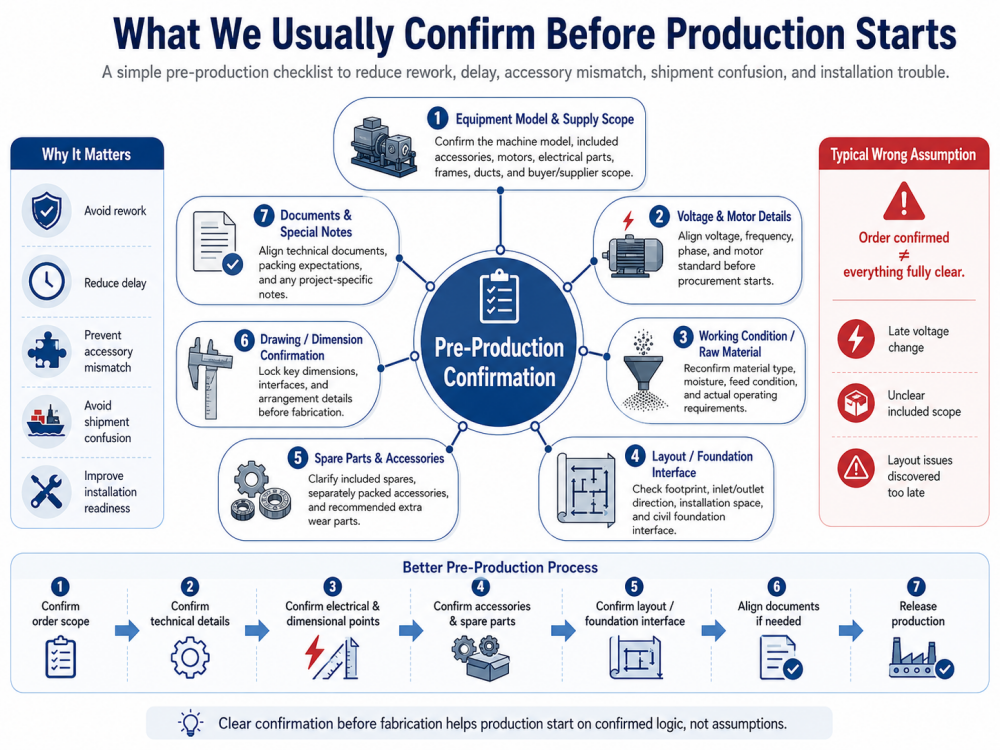
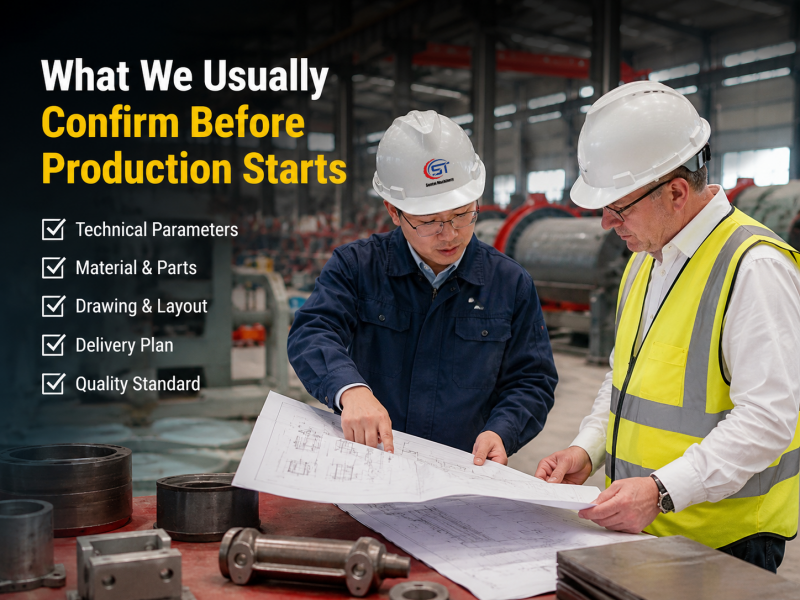
What We Usually Confirm Before Production Starts
Before production begins, a serious supplier should usually confirm several key points again, even if they were mentioned earlier.
1. Equipment model and supply scope
This is not only about the main machine model. It also includes which accessories are included, which spare parts are included, whether motors and electrical parts are included, whether support frames, ducts, or connecting parts are included, and what belongs to the supplier and what belongs to the buyer.
2. Voltage and motor details
Before production starts, motor specification should be clearly aligned: voltage, frequency, phase, and motor standard if relevant.
3. Working condition or raw material confirmation
For some equipment, the project should reconfirm the actual working condition before fabrication starts.
4. Layout or foundation interface
The supplier and buyer should at least be aligned on key interface points such as main machine footprint, inlet and outlet direction, whether civil foundation information is needed, whether installation space is limited, and whether shipment split affects layout.
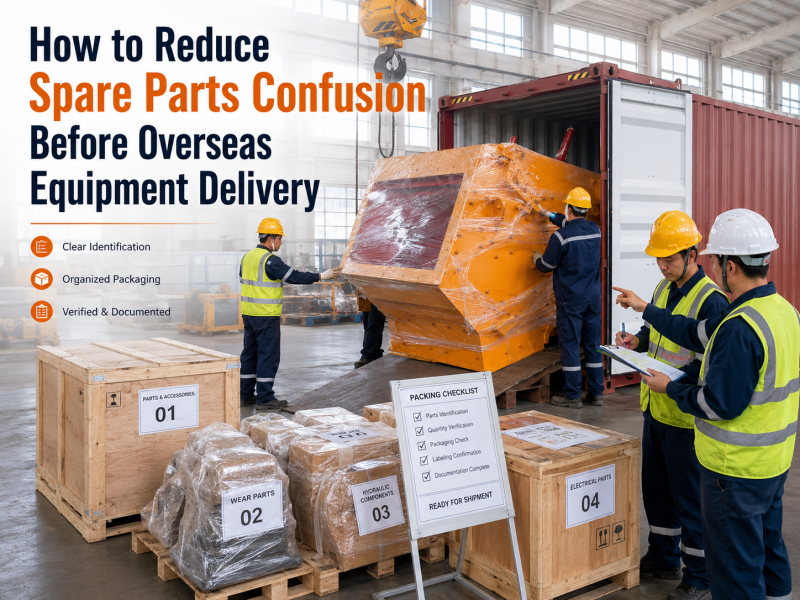
5. Spare parts and accessory scope
Before production starts, the supplier should confirm what spare parts are included with the order, what accessories will be packed separately, whether there are recommended extra spares, and whether any wear parts need early preparation.
6. Drawing or dimension confirmation when needed
When dimensions, interfaces, or arrangement matter, it is much better to confirm them before fabrication starts than after steel work is already moving.
Why Each Point Matters
What We Confirm | Why It Matters | What Can Go Wrong If Ignored |
Equipment model and scope | Defines what is really being produced | Customer and factory may understand the order differently |
Voltage and motor details | Affects procurement and electrical compatibility | Motor mismatch or delay may appear later |
Raw material or working condition | Keeps the machine aligned with real use | Equipment may be built for outdated assumptions |
Layout or foundation interface | Affects installation and arrangement | On-site fit and direction issues may appear |
Spare parts and accessories | Supports packing and later installation | Missing expectations or shipment confusion may occur |
Drawing or dimension confirmation | Helps lock execution details | Late changes may lead to rework |
A Typical Wrong Assumption
A customer places the order and feels that everything important is already settled.
The factory also feels confident and wants to move quickly.
So production begins.
A few days later, new questions appear: the customer asks for a different voltage, accessory scope is discussed again, foundation direction becomes important, one connecting part that seemed obvious was not actually included, and the customer’s site arrangement turns out to be tighter than expected.
Now the project starts to slow down.
The problem is not that the order was wrong. The problem is that the project moved into fabrication before the execution details were stable enough.
What a Better Pre-Production Process Looks Like
A better process is not necessarily a slow process. It is a clearer one.
A practical pre-production process usually looks like this:
1. confirm the order scope again
2. confirm key technical details
3. confirm electrical and dimensional points
4. confirm accessories and spare parts
5. confirm any layout or foundation interface that matters
6. align documents if needed
7. then release production
This sequence helps reduce avoidable backtracking later.
The goal is not to create paperwork for its own sake. The goal is to make sure fabrication starts on confirmed logic, not half-confirmed memory.
Buyer Checklist Before Saying Start Production
Before the supplier starts fabrication, buyers should check:
Is the equipment model fully clear
Is the included scope clearly written
Are voltage and motor details confirmed
Are important dimensions or directions understood
Are accessory and spare part expectations aligned
Has any raw material or project condition changed since quotation
Is there any point both sides are still assuming
If the answer to the last question is yes, production is probably being released too early.
Final Thought
Many equipment problems do not begin during fabrication. They begin before fabrication, when production starts under assumptions that were never fully confirmed.
That is why the stage between order confirmation and production release deserves more attention than it usually gets.
At Sentai machinery, we believe good production starts with clear confirmation. In many projects, one careful check before fabrication is worth more than one rushed correction later.
CTA
Planning an equipment order? Contact Sentai machinery to align technical details, supply scope, and pre-production confirmation before fabrication starts.
Related Articles:
What We Usually Confirm Before Quoting a Sand Making Plant
How We Check a Rotary Dryer Before Shipment
How to Reduce Spare Parts Confusion Before Overseas Equipment Delivery
Suggested Solutions:
 WhatsApp
 Email
Email
 +86 15538010601