
STCrushers Is A Professional Minging Equipment Manufacturer since 2004, Providing High Quality Crushers, Sand Making Machines, Drying Equipment and more.
STCrushers Is A Professional Minging Equipment Manufacturer since 2004, Providing High Quality Crushers, Sand Making Machines, Drying Equipment and more.
Why the Last Factory Check Matters
For many overseas buyers, production is not the point where concern ends. In fact, once the rotary dryer is finished, a different set of questions starts to matter. Has the drum been checked carefully? Are the riding rings and support rollers aligned? Are the motor and reducer protected for transport? Are the ducts, bolts and small accessories packed separately and clearly marked?
A rotary dryer is not a small machine that can simply be wrapped and moved. It is a long, heavy, project-based piece of equipment. If the final factory check is careless, the machine may arrive with missing accessories, damaged exposed parts, surface rust risk, or installation confusion. That is why pre-shipment inspection is part of delivery quality, not just logistics.
What We Confirm Before the Dryer Leaves the Factory
Before shipment, the first goal is to confirm that the machine matches the customer order exactly. This includes model, drum dimensions, drive arrangement, support structure, and major accessories. The second goal is to reduce transport risk. The third goal is to help the buyer receive the machine in a condition that is easier to inspect and install after arrival.
Check Area | What We Look At | Why It Matters |
Main drum body | Surface condition, welding, obvious deformation, paint coverage | Confirms the machine body is ready for transport |
Riding rings and rollers | Position, contact condition, visible damage | Avoids transport and installation confusion |
Motor and reducer | Nameplate, fixing position, protection | Protects key drive components |
Accessory parts | Bolts, ducts, seals, small components | Prevents missing parts at site |
Shipment photos | Overall machine, accessories, loading condition | Gives buyer confirmation before dispatch |
1. Drum Body and Main Structure Check
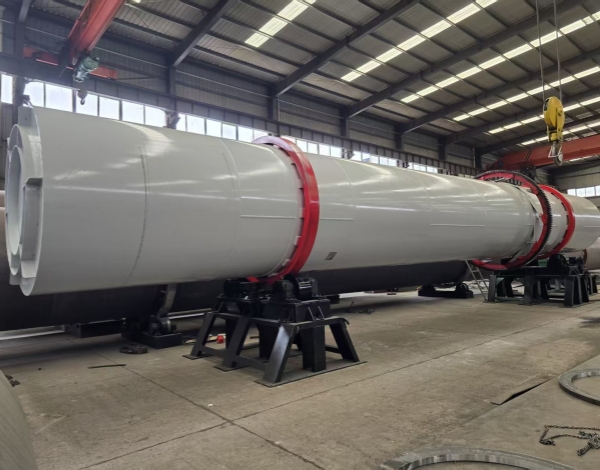
The drum body is the visual center of the dryer and usually the first thing a buyer checks in shipment photos. But the inspection should go beyond appearance alone. The factory team should confirm welding quality in visible areas, check for obvious transport-sensitive points, review paint condition, and make sure there is no visible deformation or assembly issue on the main body.
For long rotary dryers, overall straightness and support relationship matter. Even if the machine is strong, poor handling before shipment can create unnecessary trouble later. A final check before loading helps catch avoidable issues while the machine is still in the factory.
2. Support Rollers, Riding Rings and Drive Area
Many buyers focus on the drum and forget that the support and drive sections are equally important. Before shipment, we should check whether the riding rings, support rollers, bearing seats, and base areas are in proper condition for delivery. The motor and reducer also deserve separate attention because they are among the most sensitive parts during transport.
A motor or reducer is not usually damaged by production. It is more likely to be damaged by poor packing, poor protection, or rough loading. That is why the drive area should be photographed clearly and protected carefully before shipment.
3. Accessories and Loose Parts
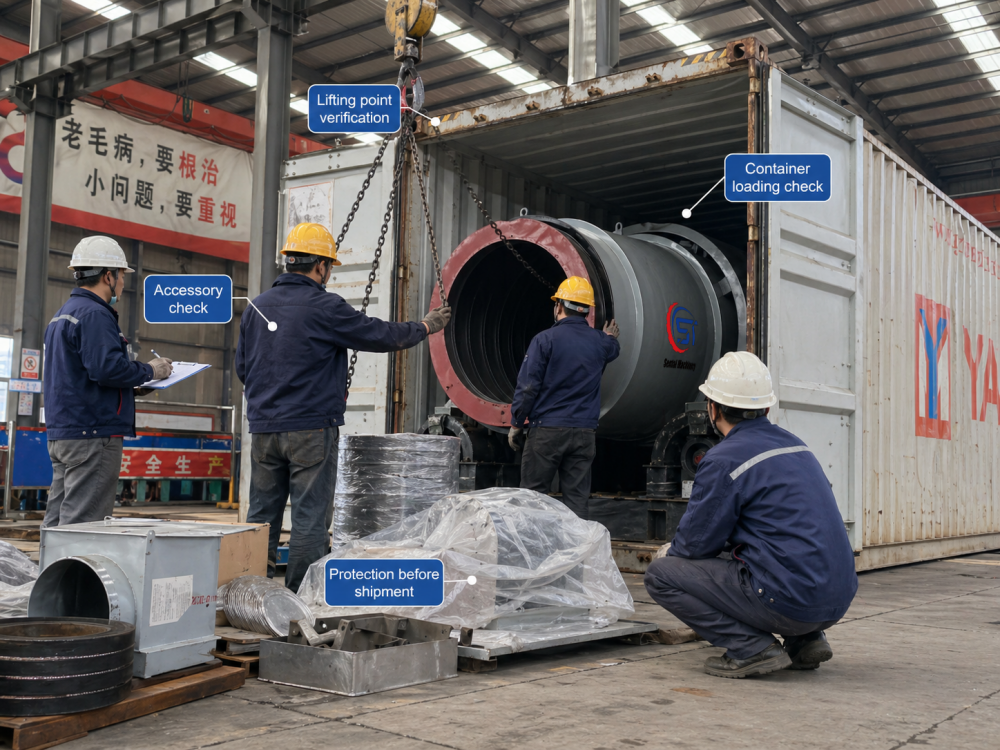
One of the most common overseas delivery problems is not damage to the main machine. It is confusion about loose parts. Rotary dryers may include ducts, connectors, fasteners, seals, electrical items, or other components that are packed separately. If these items are not sorted and labeled clearly, installation becomes harder for the buyer.
A good shipment routine should therefore include accessory counting, grouping and packing. Small parts should not be treated casually just because they are not heavy. On real sites, one missing small connection piece can delay the start of installation.
4. Surface Protection and Packing Logic
Not every part of a rotary dryer needs the same packing method. The main drum body may ship as a large exposed structure, while vulnerable items should receive stronger protection. The packing plan should be based on the real risk of moisture, impact, scratching and movement during transport.
For example, electrical parts, small accessories, and some detachable components should usually be protected more carefully than the drum shell itself. The point is not to over-pack everything. The point is to protect the parts that are more likely to create trouble if they arrive damaged.
5. Shipment Photos and Buyer Confirmation
For overseas projects, shipment photos are part of communication quality. A buyer cannot stand in the factory and inspect the equipment personally, so photos and short videos help reduce uncertainty. Useful pre-shipment photos usually include the whole machine, drive section, accessory packing, marked parts, and loading condition if the machine is already being prepared for transport.
This is not only for customer confidence. It also creates a record of the machine condition before dispatch.
Pre-Shipment Checklist
Question | Why It Matters |
Is the model and configuration correct | Confirms the machine matches the order |
Are motor and reducer details checked | Protects key power components |
Are all accessories counted and packed | Reduces installation delay |
Are exposed parts protected where needed | Helps avoid transport damage |
Are shipment photos prepared | Improves buyer confirmation |
Is the machine ready for safe loading | Supports smoother delivery |
Final Thought
A rotary dryer should not be treated as finished the moment fabrication ends. The last inspection before shipment is part of product quality, because it affects how the machine arrives, how easy it is to inspect, and how smoothly installation can begin later.
At Sentai machinery, we pay attention not only to production, but also to pre-shipment checking, accessory management, protection of sensitive parts, and shipment communication. Careful checking before dispatch helps reduce avoidable trouble after arrival.
If you are planning to buy a rotary dryer or another large industrial machine from China, contact Sentai machinery to discuss pre-shipment inspection, packing and delivery details before dispatch.
Related Articles:
How to Reduce Fuel Consumption in a Rotary Dryer
Why Is My Rotary Dryer Drying Efficiency Too Low? Common Causes and Solutions
Rotary Dryer for Sand Drying: Process, Capacity, and Advantages
Suggested Solutions :


 WhatsApp
 Email
Email
 +86 15538010601