
STCrushers Is A Professional Minging Equipment Manufacturer since 2004, Providing High Quality Crushers, Sand Making Machines, Drying Equipment and more.
STCrushers Is A Professional Minging Equipment Manufacturer since 2004, Providing High Quality Crushers, Sand Making Machines, Drying Equipment and more.
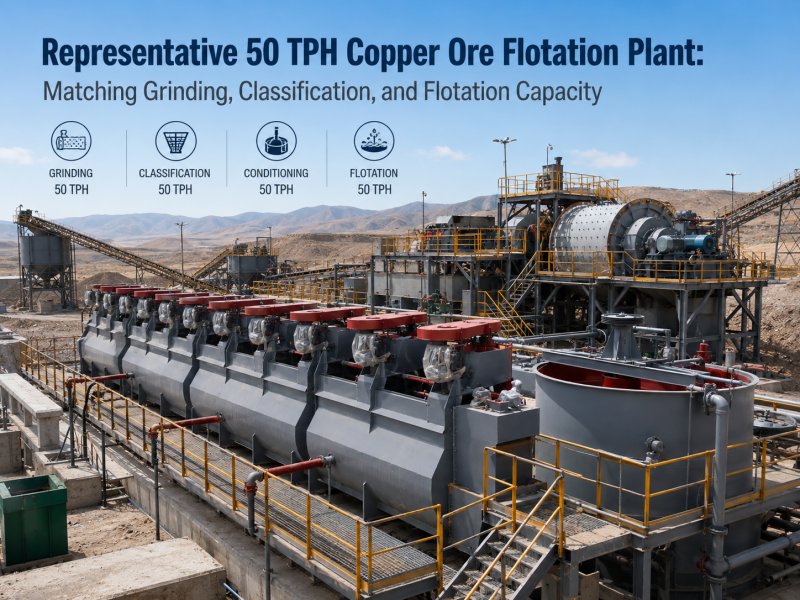
A quotation may show a 50 TPH crusher, a ball mill in a similar nominal range, and enough flotation tanks to look complete. That still does not prove the full plant can sustain 50 TPH.
Each section handles a different process load. Crushing handles dry rock, grinding adds water and circulating material, flotation receives slurry, and the final systems handle concentrate and tailings.
This is a representative process-planning configuration, not a specific customer project. It does not claim a verified recovery rate, concentrate grade, energy use, or final model.
The assumed ore has been tested and judged suitable for flotation. The dry-ore target is approximately 50 TPH. Raw ore is crushed before wet grinding, followed by conditioning and the flotation stages required by testwork.
Ore grade, liberation size, slurry concentration, reagent formula, and residence time are not fixed here. They must come from mineralogical work and flotation testing.
The first capacity check is the ball mill feed. A mill selected for controlled feed may lose output when crushing sends oversized or highly variable material.
Primary and secondary crushing prepare a consistent feed, generally below about 20 mm in this reference route. The exact limit depends on hardness and mill selection. Screening, buffering, and controlled feeding prevent short crushing fluctuations from reaching the mill.
Short 50 TPH peaks do not equal stable mill feed. Overload and underfeed then disturb classification, slurry density, and flotation feed.
Ball mill capacity changes with ore hardness, feed size, target fineness, media condition, pulp density, and circulating load.
Flotation needs sufficient mineral liberation. If finer grinding is required, the same mill may process less dry ore per hour; easier ore or coarser liberation can produce a different capacity.
The 50 TPH target must therefore be tied to the tested flotation feed size, not copied from a parameter table.
After grinding, classification sends qualified fine slurry forward and returns coarse material to the mill.
Return load is part of circuit capacity. Excess return material can keep the mill full while reducing the amount of new ore entering the circuit.
Overflow fineness, slurry flow, water addition, spiral speed, and return sand must be reviewed together. A poorly matched classifier can become the hidden bottleneck.
Flotation cells receive slurry, not only dry solids. Volumetric flow depends on water addition, pulp density, mineral density, and recycle streams.
Two 50 TPH plants can require different cell volumes. Dilute slurry increases flow, slower kinetics require more residence time, and staged circuits distribute volume differently.
Cell selection begins with stage duty: roughers recover, scavengers reduce losses, and cleaners improve grade. Tank volume alone does not define adequate time, air, mixing, or froth handling.
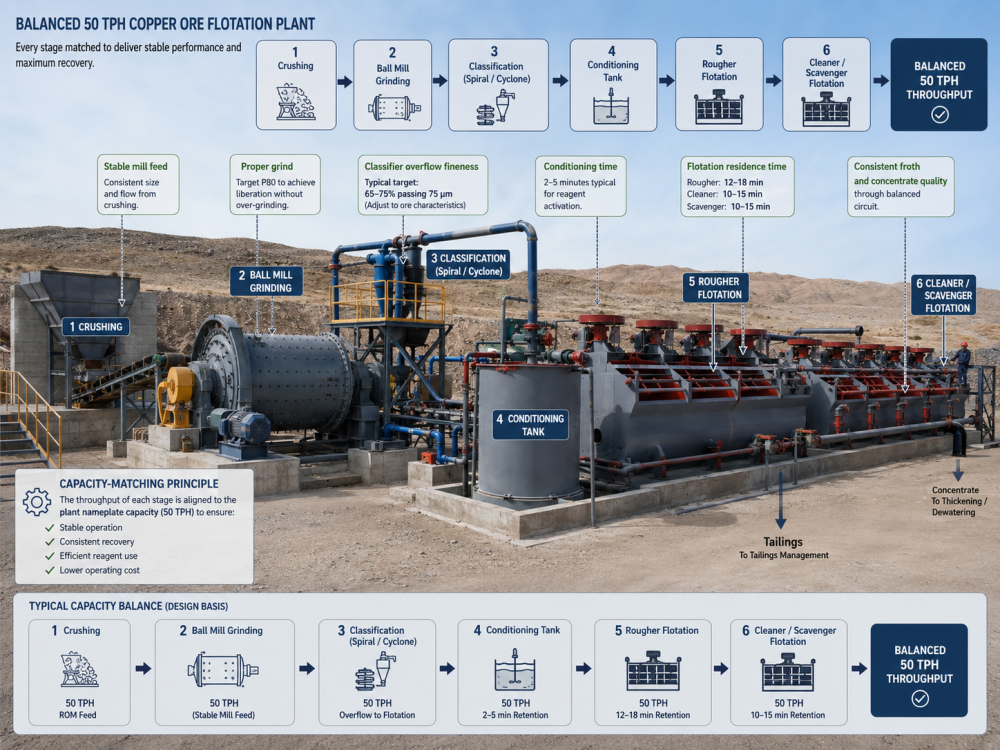
Conditioning provides mixing and contact time for reagents before flotation.
Changes in overflow fineness or concentration alter reagent conditions and make froth depth, air, level, and concentrate pull harder to control.
Flotation should not be used as a buffer for unstable grinding. It needs stable flow, solids concentration, size distribution, and reagent addition.
Grinding too coarsely can leave copper minerals locked with gangue. Grinding too finely can create excessive slime, increase energy use, change reagent response, and make froth behavior less predictable.
The target is not the finest possible product. It is the particle-size range that provides adequate liberation while maintaining workable flotation conditions. That target should come from testing, then guide the crusher feed size, ball mill selection, classifier arrangement, and flotation circuit.
A balanced line also needs pumps, launders, pipelines, concentrate dewatering, water return, and tailings handling sized for flotation output.
More flotation volume does not help when concentrate slurry cannot be removed or process water cannot return. Supporting systems decide whether operation can remain continuous.
Process stage | Main design basis | Risk if not matched |
Crushing and screening | Ore size, hardness, and stable mill feed | Oversize feed and fluctuating grinding load |
Ball milling | Grindability and required liberation size | Low practical throughput or unsuitable flotation feed |
Classification | Slurry flow, overflow fineness, and return load | High circulating load and unstable overflow |
Conditioning | Reagent contact, mixing, and slurry stability | Inconsistent chemical response before flotation |
Flotation | Slurry volume, stage duty, kinetics, and froth load | Insufficient residence or overloaded cells |
Concentrate and tailings | Slurry volume, water balance, and dewatering duty | Downstream bottleneck and interrupted operation |
Commissioning should confirm the material balance instead of checking each machine separately. Operators should record fresh ore feed, classifier return, overflow solids concentration, flotation feed flow, concentrate pull, tailings flow, and water return over the same time period.
These measurements show whether the nominal 50 TPH is moving through the circuit or accumulating in one section. If fresh feed falls while return load rises, the grinding circuit is limiting the plant. If flotation levels and froth conditions change with stable grinding feed, cell volume, air, reagent conditioning, or slurry distribution may need review. Early measurements provide a stronger basis for adjustment than judging one shift by appearance alone.
1. It does not prove that every copper ore is suitable for flotation.
2. It does not assign one fixed ball mill model to every 50 TPH project.
3. It does not assume a universal grinding fineness or slurry concentration.
4. It does not promise a concentrate grade or recovery percentage.
5. It does not replace mineralogical analysis, grindability testing, or flotation testwork.
6. It does not confirm whether oxide, sulfide, or mixed copper ore should use the same process.
1. Copper mineral type and available ore analysis.
2. Raw ore size, hardness, and crushing work index or comparable test information.
3. Required dry-ore throughput and working hours per day.
4. Target liberation size or flotation feed fineness from testwork.
5. Expected slurry concentration and water availability.
6. Flotation test results, including suggested stages and residence requirements.
7. Target concentrate and tailings handling method.
8. Site power, elevation, climate, layout, and foundation conditions.
9. Whether the buyer needs a complete plant or only selected equipment.
10. Local requirements for water recycling, tailings, dust, and reagent storage.
A copper flotation plant reaches its target only when crushing, grinding, classification, conditioning, flotation, and downstream handling exchange material at compatible rates.
The design basis changes from dry rock to circulating grinding load and then to slurry volume. Testwork must define flotation duty and residence requirements. A weak classifier, unstable slurry, or undersized downstream system can still limit the line.
Sentai Machinery can review ore information, capacity, feed size, grinding target, flotation test results, water balance, and site conditions before recommending a configuration. Send the available ore report and process requirements so the equipment can be matched as one beneficiation system rather than selected from isolated capacity numbers.
1. Flotation Machine Selection: Why Ore Type and Slurry Condition Matter Before Cell Configuration
2. What Buyers Often Miss When Matching a Ball Mill and Spiral Classifier
3. Why Crushing Size Before Ball Milling Affects Grinding Cost
4. What Affects Flotation Recovery in a Copper Ore Processing Plant
5. What Buyers Often Miss When Choosing Flotation Reagents for Copper Ore
1. Ball Mill
4. Jaw Crushers
 WhatsApp
 Email
Email
 +86 15538010601