
STCrushers Is A Professional Minging Equipment Manufacturer since 2004, Providing High Quality Crushers, Sand Making Machines, Drying Equipment and more.
STCrushers Is A Professional Minging Equipment Manufacturer since 2004, Providing High Quality Crushers, Sand Making Machines, Drying Equipment and more.
Low Recovery Is Usually a Process Problem, Not a Single Machine Problem
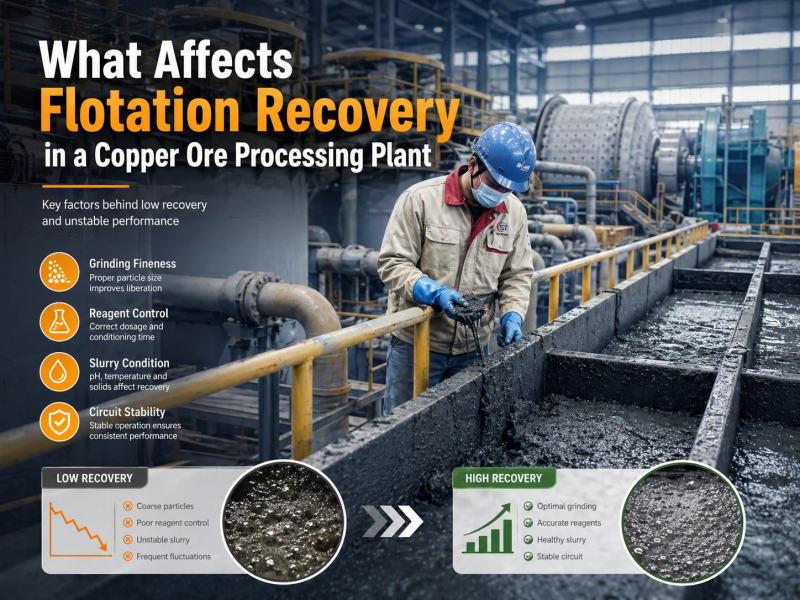
When flotation recovery drops in a copper ore processing plant, many people look at the flotation machine first. That is understandable, but in many plants the real problem starts earlier. Poor grinding, unstable slurry condition, inaccurate reagent dosing, changing ore properties, or weak process control can all reduce flotation recovery even when the flotation cells themselves are still running normally.
This is why low recovery should be treated as a process issue, not simply as a machine issue. The flotation section is where the result becomes visible, but the cause may begin long before the slurry enters the cells.
Quick Troubleshooting Table
Observed Problem | Possible Cause | What to Check First |
Recovery drops suddenly | Feed ore properties changed | Check ore source and recent feed condition |
Recovery unstable between shifts | Reagent dosing not consistent | Review dosing and operator control |
Concentrate grade or froth behavior changed | Grinding fineness unstable | Check mill discharge and classification |
Plant looks normal but recovery stays low | Slurry concentration or pH not well controlled | Check basic operating data before blaming equipment |
One flotation stage overloaded | Circuit balance weak | Check whether feed distribution is stable |
1. Grinding Fineness
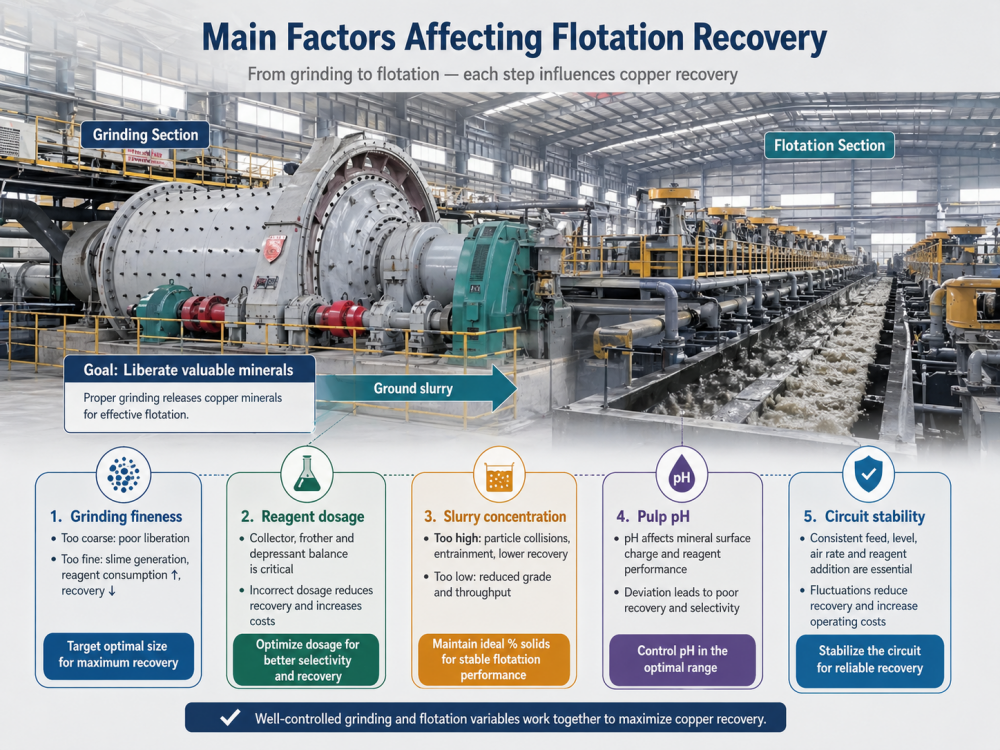
One of the most common reasons for poor copper flotation recovery is unsuitable grinding fineness. If the ore is under-ground, valuable copper minerals may remain locked with gangue, making flotation difficult. If the ore is over-ground, excessive slimes may appear and hurt recovery or selectivity.
This is why grinding should not be judged by habit alone. The plant should know what fineness is actually suitable for the ore body and the flotation target. A stable relationship between the ball mill, classifier and flotation feed is essential.
2. Ore Property Changes
Many plants operate as if the ore feed stays the same all the time. In reality, copper ore grade, mineral association, oxidation degree, and gangue composition can change. When feed changes, the flotation response may change even if the operators keep the same settings.
A plant that ignores feed variation may think the flotation machine is failing, when the real issue is that the ore itself now needs a different operating approach.
3. Reagent Dosing and Conditioning
Collectors, frothers and modifiers play a direct role in flotation recovery. If dosing becomes inaccurate, unstable or poorly matched to the ore condition, recovery can fall quickly. This problem is often hidden because the cells still produce froth, so the plant looks active even though the actual mineral recovery is weaker.
Good reagent control is not only about adding chemicals. It is about adding the right reagent, at the right point, in the right amount, under the right slurry condition.
4. Slurry Concentration and Process Stability
Flotation does not operate in isolation. Slurry density, pH, feed rate and aeration all affect the probability of copper minerals attaching to bubbles and reporting to concentrate. If the slurry condition is unstable, flotation recovery often becomes unstable as well.
This is why many experienced plant teams first check the basic operating condition before discussing mechanical replacement. Stable flotation usually needs stable feed, stable slurry condition and stable process control.
5. Circuit Balance
In some copper plants, recovery problems come from weak circuit balance rather than one obvious mistake. One stage may receive too much load, circulation may be uneven, or the plant may not be distributing feed as well as it should. The result is that one section becomes the hidden bottleneck of the flotation process.
A copper flotation line should be judged as a circuit. Recovery depends on how the stages work together, not only on the performance of one cell.
What Buyers and Plant Owners Often Miss
A common misunderstanding is that better flotation recovery can always be achieved by buying a stronger flotation machine. Sometimes equipment upgrade helps, but very often the plant first needs to check grinding, reagent logic, slurry condition and ore change. If those are ignored, a new machine may only move the same problem forward.
A Practical Recovery Checklist
Question | Why It Matters |
Has the ore feed changed recently | Ore variation can change flotation response |
Is grinding fineness still on target | Liberation strongly affects recovery |
Is reagent dosing stable and appropriate | Poor dosing quickly reduces flotation performance |
Is slurry concentration controlled well | Flotation stability depends on feed condition |
Is the circuit balanced | Overloaded or weak sections reduce total recovery |
Are operators watching trends, not just one shift | Recovery problems often build gradually |
Final Thought
Flotation recovery in a copper ore processing plant is shaped by the whole process. Grinding, feed condition, reagent control, slurry stability and circuit balance all influence the final result. That is why improving recovery starts with better process understanding, not only with replacing one machine.
At Sentai machinery, we help customers evaluate copper beneficiation projects based on ore characteristics, grinding condition, flotation targets and plant process logic. In many cases, recovery improves when the plant fixes the right process point first.
If your copper ore processing plant is facing unstable or low flotation recovery, contact Sentai machinery with your ore type, current process flow and operating condition for a more practical suggestion.
Related Articles:
How to Choose a Ball Mill for Mineral Processing
Ball Mill vs Rod Mill: Which One Should You Choose for Your Plant?
Suggested Solutions:
 WhatsApp
 Email
Email
 +86 15538010601