
STCrushers Is A Professional Minging Equipment Manufacturer since 2004, Providing High Quality Crushers, Sand Making Machines, Drying Equipment and more.
STCrushers Is A Professional Minging Equipment Manufacturer since 2004, Providing High Quality Crushers, Sand Making Machines, Drying Equipment and more.
The Wrong Comparison Starts with Machine Price Only
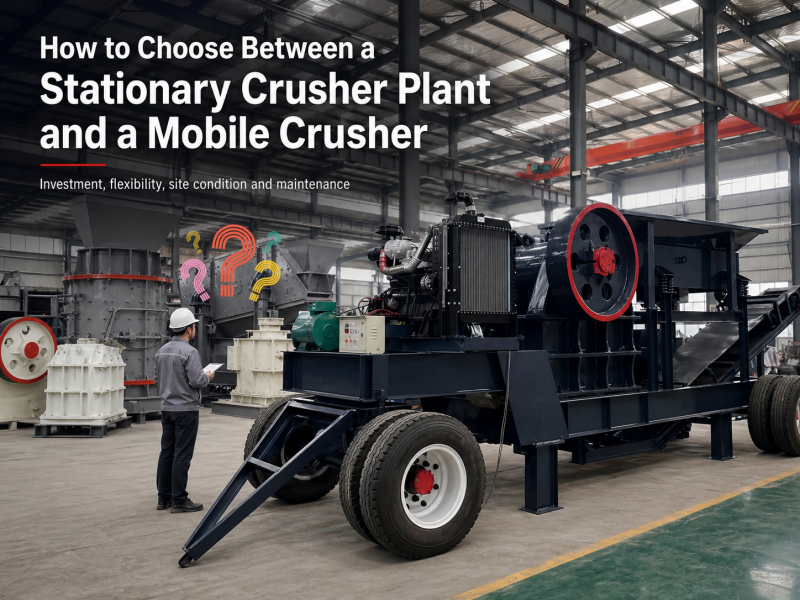
Many buyers compare a stationary crusher plant and a mobile crusher the wrong way. They ask only one question first: which one is cheaper?
That question is too narrow.
A crushing project is not only about the price of one machine. It is also about site condition, working period, transportation difficulty, installation time, production stability, and whether the line may need to move later.
This is why a stationary crusher plant and a mobile crusher are not direct replacements in every project. In some situations, a mobile unit is clearly the smarter choice. In others, a stationary line is the more practical long term solution.
The better question is this:
Which setup fits the actual project better?
Once the comparison starts from that point, the decision becomes much clearer.
Quick Answer
If the project is long term, the site is fixed, and stable production is the priority, a stationary crusher plant is often the better choice.
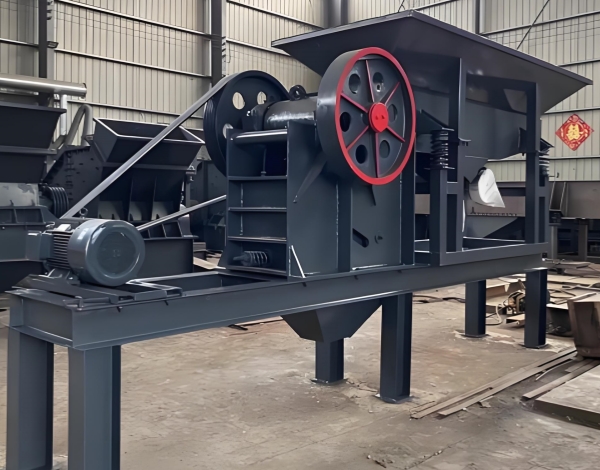
If the project site changes, foundation work should be minimized, or the buyer needs faster deployment, a mobile crusher may be the better solution.
But that short answer is only the beginning. The real choice depends on several practical factors.
Main Comparison Table
Comparison Point | Stationary Crusher Plant | Mobile Crusher |
Installation | Needs foundation and longer setup | Faster installation and less foundation work |
Mobility | Fixed in one place | Can move between working areas or sites |
Best for | Long term quarry or fixed aggregate production | Temporary work, changing sites, faster deployment |
Capacity stability | Usually stronger for continuous large output | Good for flexible projects, may depend on model and setup |
Layout flexibility | Can be designed as a complete process line | More compact but less expandable |
Transport | Equipment shipped and assembled on site | Main unit moves more easily after arrival |
Maintenance access | Depends on plant layout, usually easier to organize in fixed site | Convenient in some cases but space may be tighter |
Investment logic | Often better for long term production planning | Often better when mobility and time matter more |
1. Start with the Project Duration
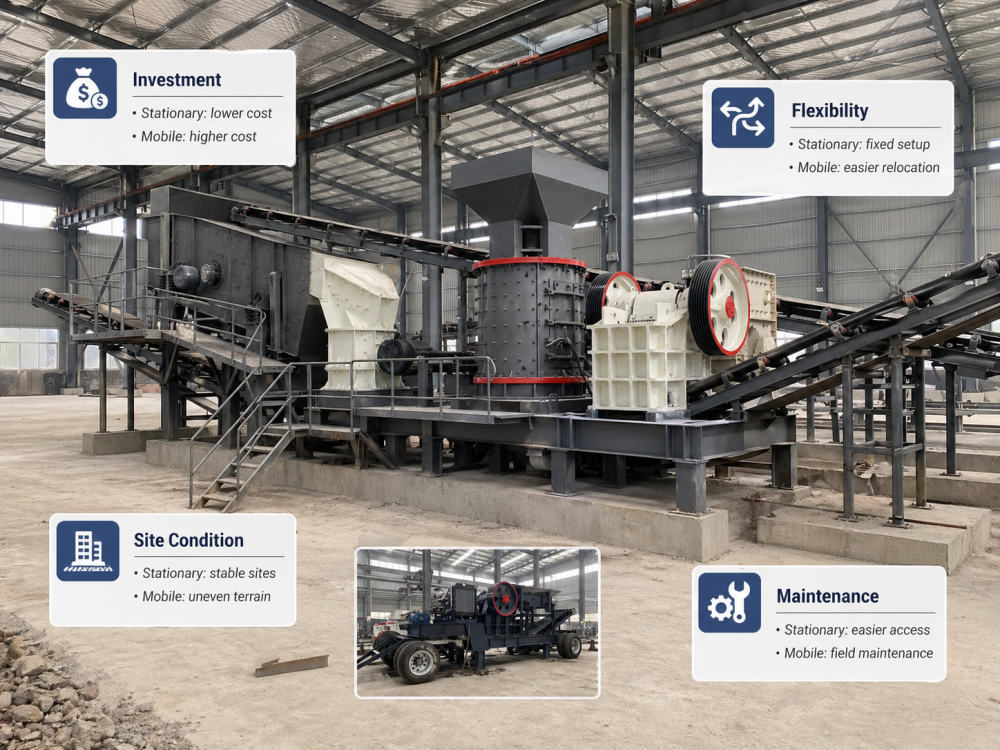
If the plant will stay in one location for many years, a stationary crusher plant usually deserves serious consideration.
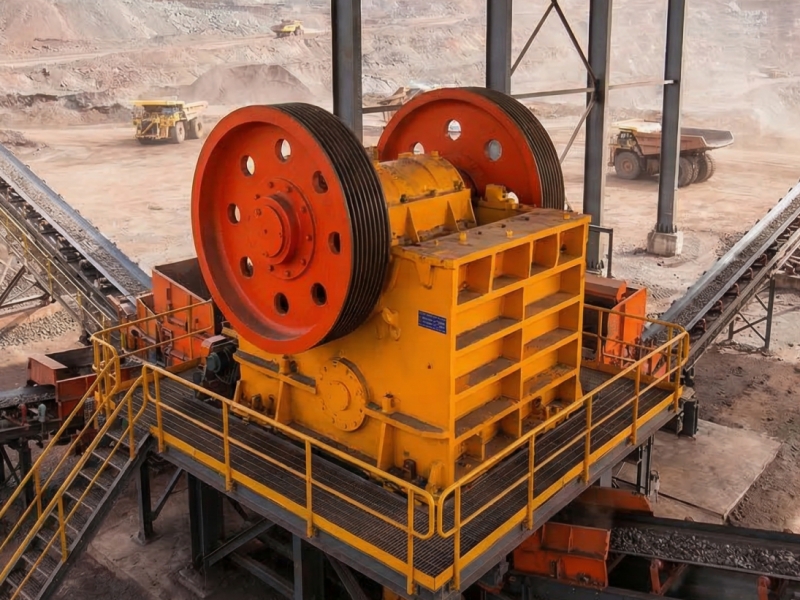
A fixed site allows the buyer to build a more complete crushing process. The line can be arranged around feeders, crushers, screens, conveyors, and stockpile space more comfortably. This often supports smoother long term production.
But if the project is short term, moves from site to site, or depends on changing construction demand, a mobile crusher may save time and trouble.
Better way to judge it:
Ask whether the project is truly fixed or temporary. A mobile crusher is not only about movement. It is about reducing the cost of relocation and setup repetition.
2. Look at the Site Condition, Not Just the Equipment
Some buyers want a stationary line because they think it looks more complete. Others want a mobile crusher because it looks more convenient. Both decisions can be wrong if the site itself is not considered carefully.
Important site factors include:
available space
road access
foundation condition
power supply
slope and terrain
material loading method
final product stockpile area
A narrow or changing site may strongly favor a mobile crusher. A wide quarry with long term production planning may favor a stationary plant.
Better way to judge it:
Choose the layout that fits the site, not the one that simply looks stronger on paper.
3. Do Not Confuse Fast Installation with Better Long Term Value
One reason buyers like mobile crushers is speed. This is understandable. A mobile machine can often be deployed faster and with less civil work.
That can be a major advantage when:
the project must start quickly
the site is temporary
foundation work should be minimized
labor and installation time are limited
But fast startup is not always the same as best long term value. A stationary crusher plant may take more preparation at the beginning, yet provide better process arrangement and easier expansion later.
Better way to judge it:
Separate short term convenience from long term operating logic. The best choice depends on which matters more in the actual project.
4. Capacity Should Be Judged at Plant Level, Not Machine Level
This is a mistake many buyers make. They compare one mobile machine capacity with one crusher in a stationary line and think the decision is clear.
That comparison is incomplete.
A stationary crusher plant should be judged as a full system, including feeding, primary crushing, secondary crushing, screening, return material control, and finished product handling. A mobile crusher should also be judged by the actual process it can support on site.
In real projects, capacity stability depends on:
raw material hardness
feed size
screening arrangement
return loop
operator control
site material flow
Better way to judge it:
Ask what the realistic project output will be under your material and site condition, not just what one machine model says in a catalog.
5. Expansion and Process Matching Matter
A stationary crusher plant usually gives the buyer more freedom to optimize or expand the process later. If the customer wants to add a screening stage, modify product size, or increase capacity in the future, the fixed line may offer more room for adjustment.
A mobile crusher is more compact by nature. That is one of its strengths, but it can also mean less flexibility when the buyer later wants a more complex process.
Better way to judge it:
Ask whether the project may grow. If future expansion is likely, the line should be judged with that possibility in mind.
6. Maintenance and Daily Operation Should Be Considered Early
Some buyers focus heavily on the first installation phase and do not think enough about daily maintenance.
In a stationary plant, maintenance can often be planned around a more stable and spacious layout. In a mobile crusher, the compact design may save space and simplify movement, but maintenance access and service routine still need to be judged realistically.
Better way to judge it:
Do not ask only how fast the machine can be installed. Ask how it will be serviced after months of daily operation.
A Practical Buyer Checklist
Question | Why It Matters |
Will the site stay fixed for years | Helps decide if a stationary line is worth the investment |
Will the equipment need to move later | Strongly supports a mobile crusher decision |
How much foundation work is acceptable | Affects installation and startup plan |
Is future capacity expansion possible | Favors more flexible fixed line planning |
What is the material and feed size | Affects realistic output and crusher selection |
How important is rapid deployment | May favor a mobile crusher |
How important is long term process optimization | May favor a stationary plant |
Final Thought
A stationary crusher plant and a mobile crusher are both useful solutions, but they serve different project needs.
A stationary line is often stronger for long term, fixed site, and process oriented production. A mobile crusher is often better when speed, relocation, and flexibility matter more.
The better decision does not come from asking which one is generally better. It comes from asking which one fits the actual site, timeline, and operating goal.
At Sentai machinery, we help customers compare crushing options based on material type, capacity target, site condition, and long term project logic. A smart decision early can save a lot of cost and trouble later.
If you are not sure whether your project should use a stationary crusher plant or a mobile crusher, contact Sentai machinery with your raw material, site condition, and target capacity for a practical recommendation.
Related Articles:
- How to Choose Equipment for a Stone Crushing Plant
- A 100 TPH Stone Crushing Plant for Hard Rock: Recommended Configuration and Why
- Why Is My Sand Production Line Output Too Low? 7 Common Causes and Fixes
Suggested Solutions:
- 40-60 tph Stone Crushing Plant
 WhatsApp
 Email
Email
 +86 15538010601