
STCrushers Is A Professional Minging Equipment Manufacturer since 2004, Providing High Quality Crushers, Sand Making Machines, Drying Equipment and more.
STCrushers Is A Professional Minging Equipment Manufacturer since 2004, Providing High Quality Crushers, Sand Making Machines, Drying Equipment and more.
The Liner Looks Like a Spare Part, But It Can Change Plant Performance
Many buyers focus on the ball mill body, motor, reducer, and capacity when choosing grinding equipment. The liner is often treated like a secondary detail. That is a mistake.
In real mineral processing work, liner choice can affect wear cost, downtime, grinding efficiency, discharge size stability, and even the performance of the downstream beneficiation process. A liner is not just a steel plate protecting the shell. It is part of how the grinding system actually works.
This is why two mills with similar main specifications may perform quite differently after they start operating. The liner arrangement, liner material, and replacement logic all matter more than many buyers expect.
What Buyers Commonly Get Wrong
The most common misunderstanding is simple: buyers assume the best liner is the one that lasts the longest.
Long service life matters, of course. But if the liner shape reduces grinding efficiency, creates poor lifting action, or causes unstable discharge, the plant may lose more money in performance than it saves in replacement interval.
A practical liner decision should balance several things at the same time:
wear life
maintenance convenience
grinding effect
ore characteristics
downtime cost
supplier support
That balance is what many buyers overlook.
Mistake 1: Choosing Only by Liner Material Name
Some buyers ask only one liner question: is it high manganese steel, alloy steel, rubber, or another material?
That is too narrow.
The material matters, but the liner should not be selected by material name alone. The real question is whether that liner design suits your ore hardness, grinding mode, impact level, and maintenance plan.
For example, a liner material that performs well in one ore processing plant may not perform the same way in another plant with different feed size, moisture, or grinding target.
Better way to judge it:
Ask how the liner material matches your actual ore and working condition, not just whether it sounds more advanced.
Mistake 2: Thinking Longer Wear Life Always Means Better Value
This is one of the most common buying errors.
A liner with longer wear life may still be the wrong liner if it hurts grinding action. In some cases, buyers choose a liner mainly because it promises longer service time, but later find that the mill becomes less efficient, the discharge gets less stable, or the power use does not improve.
That is because liner choice is not only about surviving inside the mill. It is also about how it lifts and moves grinding media and ore.
Better way to judge it:
Compare liner value by asking:
How does it affect grinding efficiency
How does it affect downtime
How often does it need replacement
How easy is it to install and remove
What is the total operating cost, not just liner life
Quick Buyer Comparison Table
Buyer Focus | What Often Goes Wrong | Better Way to Evaluate |
Lowest liner price | Short-term saving but weak overall value | Compare total cost over operating life |
Longest wear life only | Grinding performance may be ignored | Balance wear life with actual mill efficiency |
Material name only | Does not reflect real plant conditions | Match liner to ore and process |
Supplier promise only | Too little technical verification | Ask for working logic and similar application experience |
Replacement interval only | Downtime and installation difficulty may be ignored | Evaluate maintenance practicality as well |
Mistake 3: Ignoring Ore Characteristics
A liner that works in one plant may not be ideal in another because ore characteristics change everything.
Ore hardness, abrasiveness, feed size, and grinding requirement all affect liner behavior. A plant grinding hard and abrasive ore under heavy load may require a very different liner logic from a plant handling easier material.
If ore characteristics are ignored, buyers may later complain that liner wear is too fast or the expected performance was not achieved. In many of these cases, the issue was not poor manufacturing. It was poor matching.
Better way to judge it:
Start the liner discussion with the ore, not with the spare part catalog.
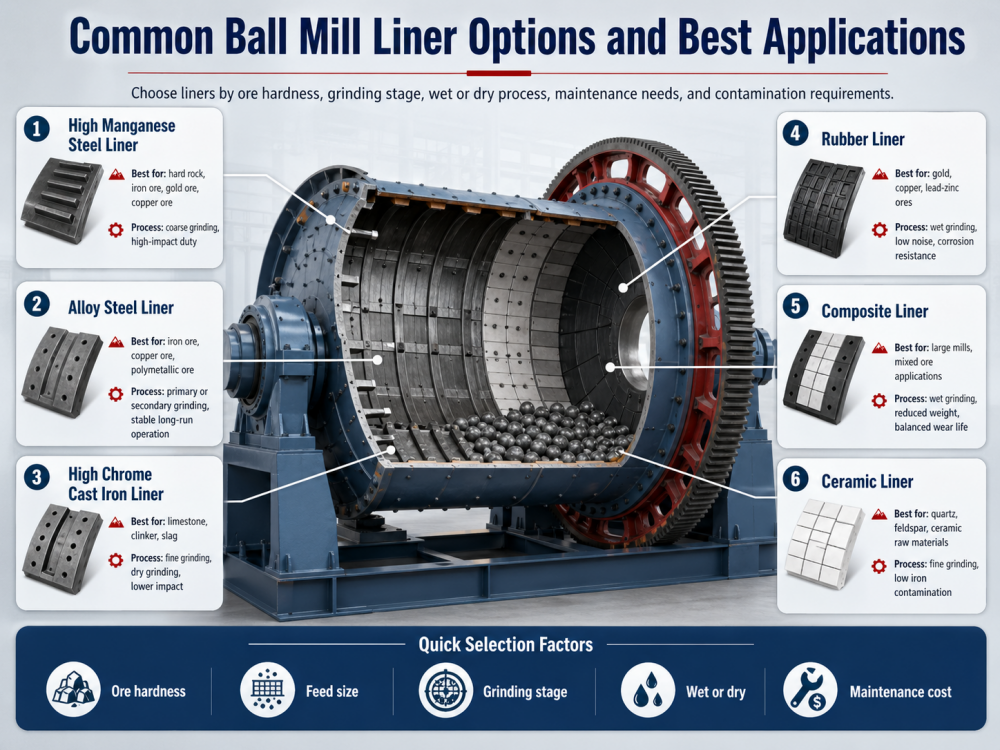
Mistake 4: Forgetting That Liner Shape Affects Grinding Action
Many buyers discuss liner material but never ask enough about liner shape.
That is a problem because liner profile affects how the grinding media and ore are lifted, dropped, and moved inside the mill. This directly affects impact, grinding efficiency, and discharge behavior.
A liner is not only protection. It is part of the mill working mechanism.
Better way to judge it:
Ask how the liner shape supports the grinding mode of your plant. If the answer is vague, the discussion is incomplete.
Mistake 5: Not Thinking About Downtime and Replacement Practicality
A liner decision should not end with purchase price and expected wear life. The replacement process also matters.
If liner replacement is difficult, slow, or requires too much shutdown time, the practical cost may become much higher than expected. Some buyers only realize this after the mill enters regular operation.
Better way to judge it:
Ask how the liner will be installed, how often replacement may be needed, and how much downtime should be expected in real operating conditions.
Mistake 6: Choosing a Supplier That Talks About Parts, Not Grinding Logic
A good liner supplier should not talk only about steel, hardness, and quotations. A useful supplier should also ask about:
ore type
feed size
grinding target
mill operating condition
maintenance habit
previous liner problem
If the supplier discusses only the spare part and not the process, the advice may stay too shallow.
Better way to judge it:
Choose a supplier that evaluates liners as part of mill performance, not just as warehouse inventory.
What a Better Liner Decision Looks Like
A better liner decision starts with practical questions:
What ore am I grinding
What feed size enters the mill
What discharge condition do I need
What wear problem do I have now
What matters more in my plant: longer wear life, easier maintenance, or better grinding performance
This kind of thinking leads to better results than simply asking for a popular liner material or the cheapest quotation.
Final Buyer Checklist
Before confirming a ball mill liner order, check these points:
Have I matched the liner to my actual ore
Am I evaluating wear life together with grinding efficiency
Do I understand the effect of liner shape
Have I considered downtime and replacement difficulty
Has the supplier asked enough technical questions
Am I buying for short-term price or long-term plant performance
Final Thought
Ball mill liner choice looks simple at first, but it affects much more than wear protection. It can influence grinding efficiency, maintenance planning, operating cost, and plant stability.
At Sentai machinery, we help customers evaluate liner selection based on ore condition, mill operation, and beneficiation goals. A good liner should not only last longer. It should also help the mill work better.
If you are planning a ball mill project or struggling with liner wear in an existing plant, contact Sentai machinery with your ore type, feed size, and current liner condition for a more practical recommendation.
Related Articles:
- Ball Mill vs Rod Mill: Which One Should You Choose for Your Plant?
- How to Choose a Ball Mill for Mineral Processing
- Iron Ore Beneficiation Plant: Key Equipment and Process Flow
Suggested Solutions Page Links:
 WhatsApp
 Email
Email
 +86 15538010601