
STCrushers Is A Professional Minging Equipment Manufacturer since 2004, Providing High Quality Crushers, Sand Making Machines, Drying Equipment and more.
STCrushers Is A Professional Minging Equipment Manufacturer since 2004, Providing High Quality Crushers, Sand Making Machines, Drying Equipment and more.
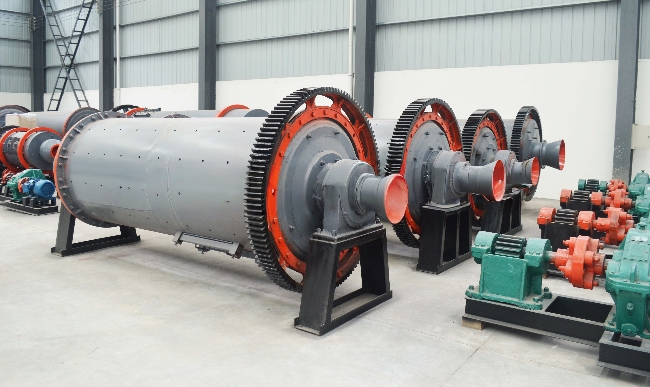
Many buyers begin a beneficiation project by asking one simple question: what ball mill model do I need?
This is normal, because the ball mill is one of the most visible machines in an ore processing plant. It is large, heavy, and directly related to grinding capacity. However, in real production, the ball mill is not working alone.
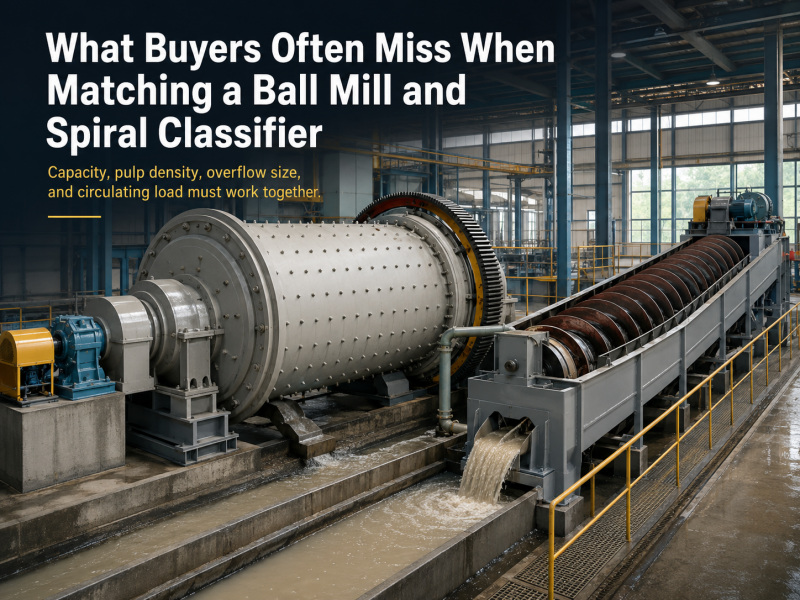
After grinding, the material usually needs classification before it enters the next process. In many small and medium mineral processing plants, a spiral classifier is used together with the ball mill to form a grinding and classification system. If these two machines are not matched well, the plant may face unstable fineness, excessive return sand, low processing efficiency, or poor performance in the next beneficiation stage.
That is why buyers should not only compare ball mill diameter, length, motor power, and price. They also need to understand whether the classifier can handle the slurry and separate the particles properly.
A common mistake is to treat the ball mill as the only key equipment in the grinding section.
For example, a buyer may say, "I need a ball mill for 5 tons per hour gold ore." This information is useful, but it is not enough. The supplier still needs to know the required discharge fineness, ore hardness, feeding size, slurry concentration, and the next beneficiation method.
If the ball mill can grind the ore, but the spiral classifier cannot classify the slurry efficiently, the system will not be stable. Fine particles may not move forward smoothly. Coarse particles may return too much. The ball mill may keep working, but the actual production result may still be poor.
In other words, the classifier may become the hidden bottleneck of the whole grinding section.
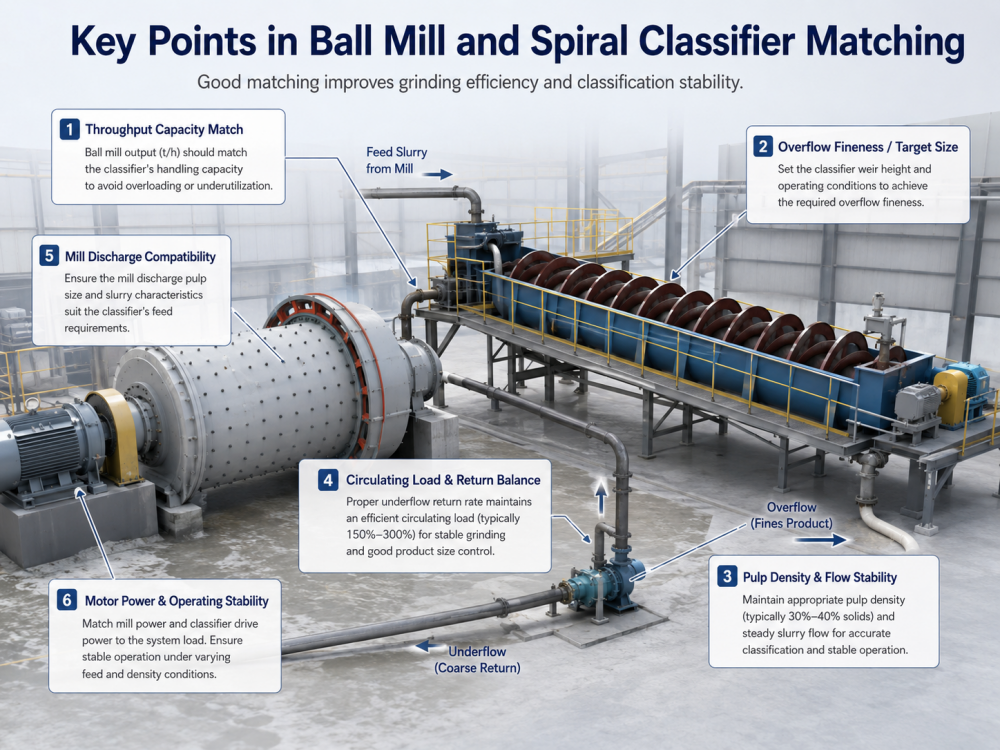
The spiral classifier is not just an accessory behind the ball mill. It helps separate fine particles from coarse particles in the slurry.
Fine particles can overflow and enter the next beneficiation stage. Coarse particles, often called return sand, go back to the ball mill for regrinding.
This circulation is important. If the classifier works properly, the grinding system can keep a more stable particle size. If the classifier is too small, overloaded, or poorly matched, the slurry flow becomes unstable. The ball mill may receive too much return material, which increases load and reduces real output.
For flotation, gravity separation, or magnetic separation, unstable grinding fineness can directly affect recovery and concentrate quality.
Return sand is one of the points that many buyers ignore.
A certain amount of return sand is normal in a closed grinding system. It means coarse particles are being sent back for further grinding. But if the return sand is too much, the ball mill may spend too much energy grinding the same material again and again.
This can cause lower practical processing capacity, higher power consumption, heavier load inside the ball mill, unstable slurry flow, more wear on liners and grinding media, and difficulty controlling final fineness.
So when choosing a ball mill and spiral classifier, the question is not only whether the classifier can run. The real question is whether it can control the return sand in a reasonable range.
Different beneficiation methods require different grinding fineness.
For flotation, the ore often needs to be ground fine enough to expose useful minerals. If particles are too coarse, valuable minerals may not separate well. If particles are ground too fine, slime may increase and flotation behavior may become worse.
For gravity separation, the required particle size may be different. Overgrinding may not improve recovery and may even reduce separation efficiency. For magnetic separation, particle size also affects liberation and separation result.
This is why a ball mill and spiral classifier should be selected according to the whole process, not only according to the grinding machine itself.
The table below shows several common matching problems and their possible effects.
Matching Problem | Possible Result | What Should Be Checked |
Classifier capacity is too small | Slurry overload and unstable overflow | Classifier size, spiral speed, tank area |
Too much return sand | Ball mill load increases | Ore hardness, feed size, grinding fineness |
Overflow is too coarse | Poor downstream separation | Required fineness and classifier setting |
Slurry concentration is unstable | Classification result changes | Water supply and feeding consistency |
Ball mill output and classifier do not match | System bottleneck | Whole grinding classification balance |
Feeding size is too large | Grinding load increases | Crushing stage before ball mill |
Before recommending a ball mill and spiral classifier combination, Sentai Machinery usually needs several basic details.
We need to confirm the ore type, feeding size before grinding, required capacity per hour, target grinding fineness, downstream beneficiation method, wet or dry grinding condition, expected slurry concentration, existing crushing or screening section, and whether the buyer needs a full ore processing line or only single machines.
These questions help avoid wrong equipment selection. For overseas buyers, this step is especially important because changing the system after shipment can be costly and difficult.
A reliable quotation should not only list the ball mill price. It should explain why the selected ball mill and classifier can work together for the required process.
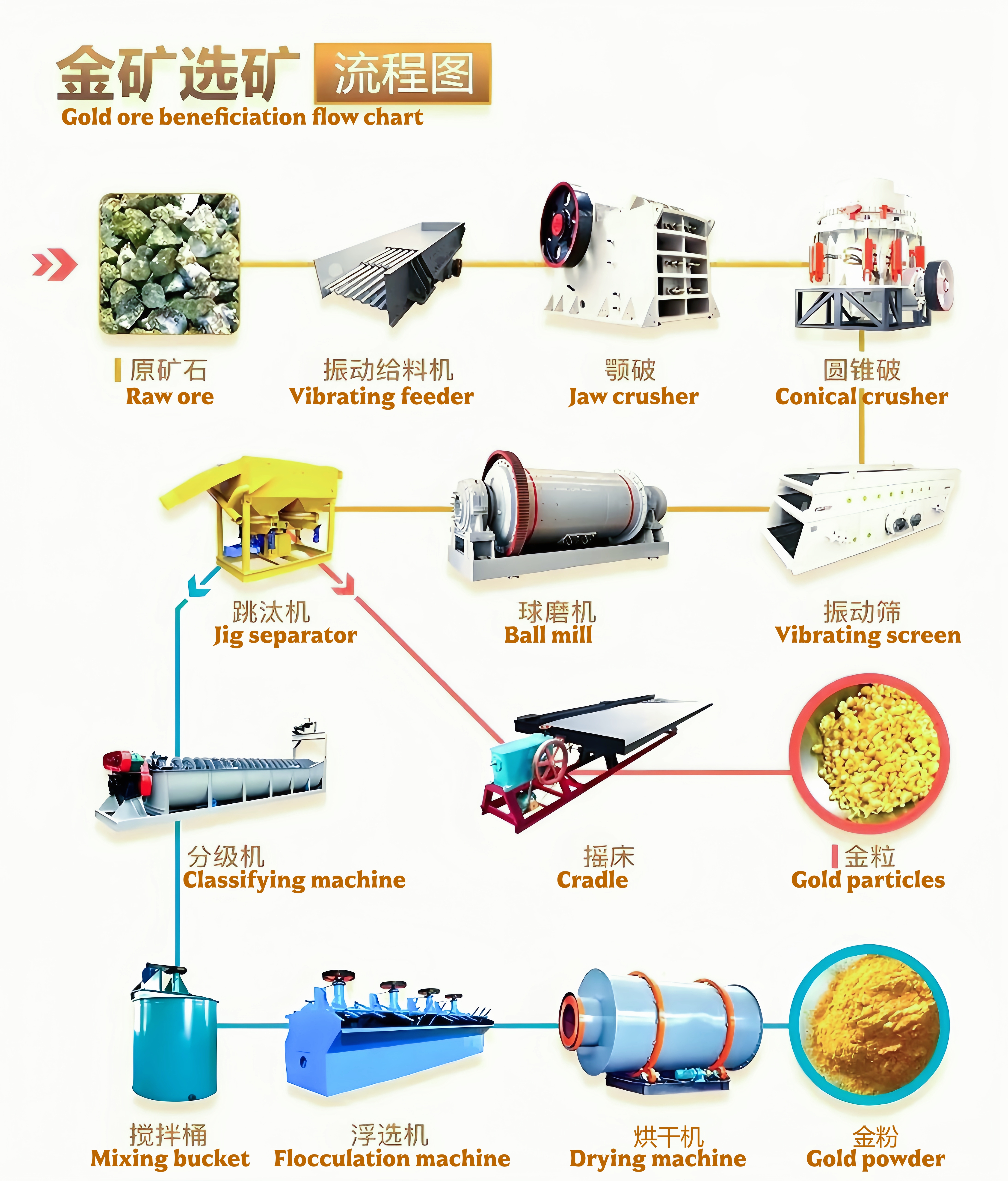
For a small gold ore processing plant, the buyer may need a ball mill, spiral classifier, flotation machine, and other supporting equipment.
If the ball mill is selected too large but the classifier is too small, the grinding section may not reach the expected capacity. The ball mill may have enough power, but the slurry cannot be classified smoothly.
If the classifier is selected without considering the required fineness, the overflow may not be suitable for flotation. The flotation machine may still work, but recovery may not be ideal because the minerals are not properly liberated.
This is why Sentai Machinery usually looks at the complete ore processing flow before confirming the grinding equipment. A single machine can be strong, but the production line only performs well when the machines are matched correctly.
A ball mill is important, but it should not be judged alone.
In a beneficiation plant, grinding and classification work together. The ball mill reduces particle size, while the spiral classifier controls which particles move forward and which particles return for further grinding.
If buyers only focus on the ball mill model, they may miss the real balance of the system. Classifier capacity, return sand, slurry flow, final fineness, and downstream beneficiation all affect the final production result.
A good grinding section is not simply a large ball mill plus a classifier. It is a matched system designed for the ore, capacity, fineness, and next process.
If you are planning a gold, copper, iron, or other ore processing project, Sentai Machinery can help evaluate the grinding and classification section based on your ore type, feeding size, required capacity, target fineness, and beneficiation method.
Send us your material information, process requirement, and site condition. Our team can help recommend a suitable ball mill, spiral classifier, and complete ore processing configuration.
Related Articles:
1. Ball Mill vs Rod Mill: Which One Should You Choose for Your Plant?
2. Ball Mill Liner Choice: What Buyers Often Overlook
3. How Grinding Stability Affects Flotation Performance
4. What Affects Flotation Recovery in a Copper Ore Processing Plant
5. Iron Ore Beneficiation Plant: Key Equipment and Process Flow
Suggested Solutions:
 WhatsApp
 Email
Email
 +86 15538010601