
STCrushers Is A Professional Minging Equipment Manufacturer since 2004, Providing High Quality Crushers, Sand Making Machines, Drying Equipment and more.
STCrushers Is A Professional Minging Equipment Manufacturer since 2004, Providing High Quality Crushers, Sand Making Machines, Drying Equipment and more.
Two buyers may both ask for a rotary dryer with the same capacity. On paper, the request looks simple: same output, same dryer type, maybe even similar drum size.
But in real production, the final dryer design can be completely different.
One buyer may need to dry loose river sand with relatively stable moisture. Another buyer may need to dry sticky coal slime, high-moisture sludge, sawdust, mineral powder, or organic fertilizer. Even if the required output looks similar, the way these materials move, disperse, heat, stick, and release moisture inside the drum is not the same.
That is why dryer model alone is never enough for a reliable selection.
For Sentai Machinery, when we discuss a rotary dryer project with an overseas buyer, we do not only ask, “What capacity do you need?” We also need to understand the real condition of the wet material before drying. The material condition often decides the heating method, drum length, internal lifting structure, residence time, feeding stability, dust control, and even the practical output of the whole system.
A rotary dryer is not just a rotating steel drum. It is a process machine. The material behavior inside the drum is what determines whether the drying process is stable.
Many buyers begin with a model question:
“What model do I need for 5 tons per hour?”
“How much is a rotary dryer for sludge?”
“Can this dryer handle 20% moisture?”
“Do you have a standard dryer for coal slime?”
These questions are normal, but they are not enough.
A dryer model can only be selected correctly after the material condition is clear. The same moisture percentage may create different drying difficulty depending on the material. For example, 30% moisture in sand is not the same as 30% moisture in sticky sludge. One material may flow easily, while another may form lumps, attach to the drum wall, or require stronger dispersion inside the dryer.
This is why a quotation based only on capacity and model can be misleading.
A cheaper-looking dryer may work for dry, loose, easy-flowing material, but it may perform poorly when the material is sticky, uneven, or difficult to disperse. In real production, the buyer may then face unstable output, wet discharge, excessive fuel consumption, blocked feeding, or frequent manual cleaning.
The problem is not always the dryer itself. Sometimes the real problem is that the wet material condition was not judged correctly before selection.
When engineers evaluate a drying project, the first question is not always “How large should the drum be?” The better question is:
What happens to this material when it enters the hot air and starts turning inside the drum?
Different wet materials behave differently.
Loose sand can usually be lifted, scattered, and dried more evenly. Sawdust may be light and fluffy, but its moisture distribution can be uneven. Coal slime may be sticky and difficult to break apart. Sludge may contain fine particles and organic content, making it easy to clump. Mineral powder may create dust and require careful air volume control. Organic fertilizer may need controlled drying to avoid damaging later granulation quality.
So before choosing a dryer model, the material should be understood from several angles:
Initial moisture content
Target final moisture
Stickiness
Lump size
Particle size distribution
Bulk density
Whether the material flows easily
Whether it sticks to metal surfaces
Whether the material is sensitive to temperature
What process comes after drying
These details are not small details. They directly affect dryer configuration.
A rotary dryer works by combining heat transfer, drum rotation, material lifting, hot air movement, and residence time. If the wet material condition changes, the design focus also changes.
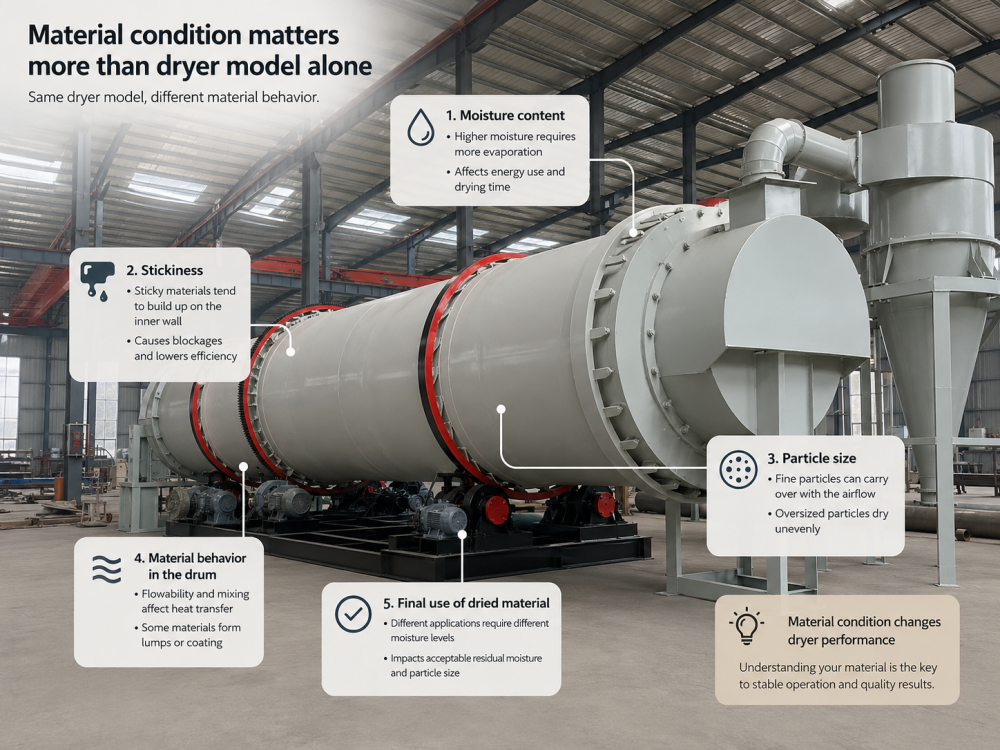
Some buyers assume that high moisture only means choosing a larger dryer. In reality, high moisture may also require better heat supply, longer residence time, stronger material dispersion, and a more stable feeding system.
If the material enters the dryer with very high moisture, it may be heavy, sticky, and difficult to scatter. If it cannot be lifted and dispersed properly, the hot air cannot contact the material evenly. The outside may look dry, while the inside of lumps remains wet.
In that case, simply increasing drum diameter may not solve the problem. The internal structure, hot air flow, and material residence time may be more important than size alone.
Sticky materials such as coal slime, sludge, some mineral concentrates, and wet organic materials create another challenge. They may attach to the drum wall, form balls, or move forward unevenly.
For this type of material, the dryer design must focus on how to break up and turn the material continuously. Internal lifting plates, chain systems, and suitable rotation speed can help the material fall, scatter, and contact hot air more effectively.
If sticky material is treated like ordinary sand, the drying result may be unstable. The dryer may appear to run normally, but the discharge moisture may fluctuate because some material is not fully opened during drying.
Mineral powder and fine materials have another issue. They may dry quickly, but they can also be carried away by airflow if the air volume is not controlled properly.
For fine powder drying, the system is not only about heat. It also needs reasonable dust collection, cyclone separation, induced draft control, and sealing. Too little airflow may reduce drying efficiency. Too much airflow may increase dust loss and burden the dust collection system.
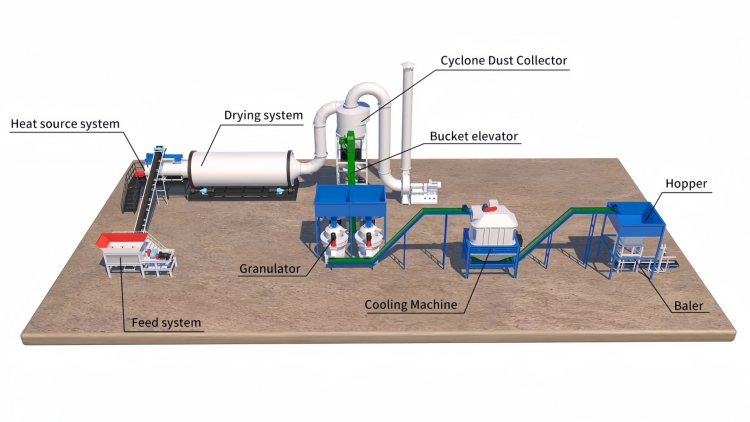
This is why dryer selection should consider not only the drum body, but also the complete drying system.
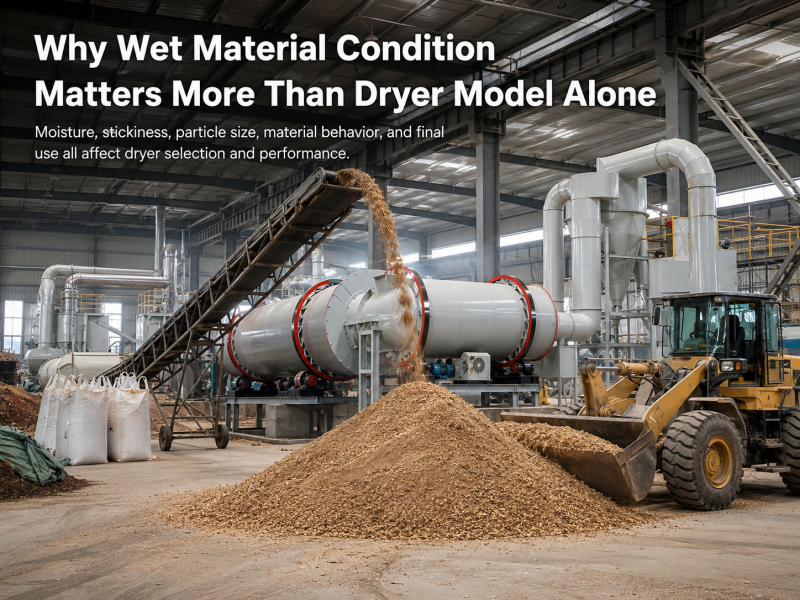
Sawdust and biomass materials are often lighter than mineral materials. They may contain uneven moisture and different particle sizes. Some parts may be dry and fluffy, while other parts may still hold high moisture.
For this type of material, stable feeding is very important. If wet sawdust enters the dryer unevenly, the discharge moisture may also become unstable. The dryer must keep material turning and spreading inside the drum so that hot air can pass through the material layer more effectively.
For biomass fuel, pellet production, or board material preparation, the final moisture is often important for the next process. If the dryer only reduces moisture roughly but cannot keep it stable, the later production step may still face problems.
The table below shows how different material conditions may influence rotary dryer design decisions.
Wet Material Condition | Possible Production Risk | Dryer Design Attention |
High initial moisture | Low output, high fuel consumption, wet discharge | Sufficient heat supply, proper drum length, longer residence time |
Sticky material | Material sticking, lump formation, uneven drying | Internal lifting structure, chain system, anti-sticking design |
Large wet lumps | Outside dry but inside wet | Better dispersion, crushing or breaking before drying if needed |
Fine powder | Dust loss, unstable airflow, collection pressure | Air volume balance, cyclone/dust collection, sealing |
Light biomass material | Floating, uneven feeding, unstable final moisture | Stable feeding, controlled airflow, enough contact time |
Heat-sensitive material | Material quality damage | Temperature control, suitable hot air method, process monitoring |
Very low target final moisture | Higher energy demand, longer drying requirement | More accurate residence time and heat balance |
Material used before calcination | Later kiln instability if drying is uneven | Moisture consistency before feeding into rotary kiln |
This is why a good rotary dryer project should not start from model number only. It should start from the material and the final process goal.
Drying is rarely the final purpose by itself. Most buyers dry material because the dried material will enter another process or be sold for a specific use.
For example:
Sand may be dried for dry mortar, foundry sand, or construction material preparation.
Sawdust may be dried before pellet production or biomass fuel processing.
Coal slime may be dried to improve fuel value and reduce handling difficulty.
Sludge may be dried for volume reduction or further treatment.
Mineral powder may be dried before storage, packing, grinding, or calcination.
Organic fertilizer may be dried before granulation, screening, cooling, and packing.
This means the target moisture should not be guessed casually. It should match the next process.
A buyer may say, “I just need it dry.” But for industrial production, “dry” is not a technical target. A better question is:
What final moisture does the next process require?
If the material will enter a rotary kiln, moisture stability may affect feeding and calcination performance. If the material will be pelletized, too much or too little moisture may affect forming quality. If the material will be packed, unstable moisture may cause caking, storage problems, or quality complaints.
A dryer should be selected according to the whole production purpose, not only the appearance of dried material.
Capacity is one of the most misunderstood points in rotary dryer selection.
When a buyer says “5 tons per hour,” it is important to know whether this means wet material input or dried material output. The difference can be large.
For example, if the material enters the dryer with high initial moisture, part of the input weight is water that must be evaporated. The actual dry material output will be lower than the wet input weight. If the buyer and supplier do not clarify this, the capacity expectation may be wrong from the beginning.
The dryer must be sized according to evaporation demand, not only material weight.
That is why initial moisture and final moisture are essential. Without them, capacity is only a rough number. It cannot support a serious dryer design.
A more useful way to discuss capacity is:
Wet material input per hour
Initial moisture content
Required final moisture content
Expected dry material output
Heat source condition
Working hours per day
Local fuel availability
These details help the supplier calculate the drying load more realistically.
Imagine two buyers both need a drying system for 5 tons per hour.
Buyer A wants to dry river sand. The material is granular, relatively loose, and easy to move inside the drum. Its moisture is mainly surface moisture. After entering the dryer, the material can be lifted and scattered by the internal plates, allowing hot air to contact the particles effectively.
Buyer B wants to dry coal slime. The material is sticky, fine, and contains uneven moisture. It may clump before entering the dryer. Inside the drum, it needs stronger turning, breaking, and dispersion. The dryer also needs more attention to feeding stability, drum internal structure, and discharge moisture control.
Both buyers may say “5 tons per hour,” but they do not need the same drying logic.
If both projects use the same simple model selection, one project may run smoothly while the other may struggle. This is exactly why wet material condition must be discussed before the dryer model is finalized.
Before recommending a rotary dryer, Sentai Machinery usually needs to confirm the following information:
What material will be dried?
What is the initial moisture content?
What final moisture is required?
Is the material sticky, loose, powdery, granular, or lumpy?
What is the approximate particle size?
What is the required capacity, wet input or dry output?
What heat source is available locally?
What is the next process after drying?
Is dust collection required by local working conditions?
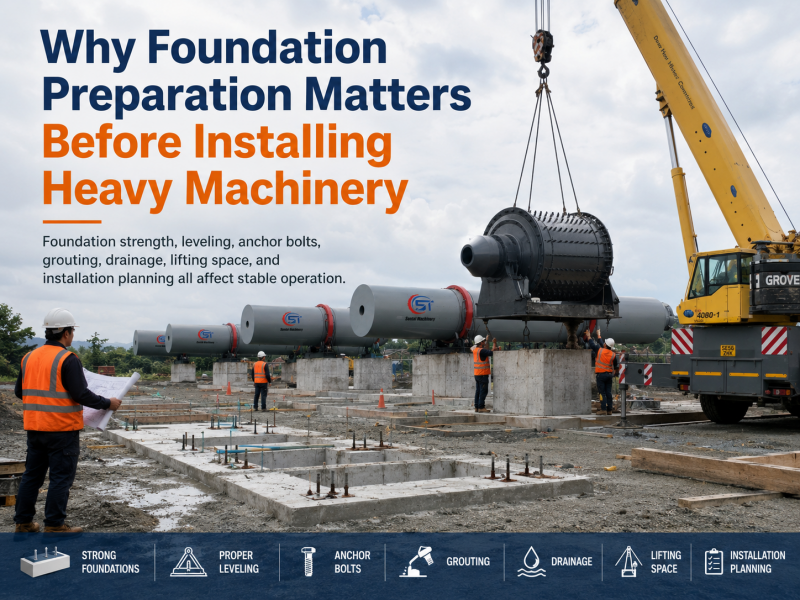
Are there site limitations for installation space, foundation, or layout?
These questions are not meant to slow down the quotation process. They help avoid wrong selection.
For overseas projects, this is especially important because the equipment must match the buyer’s actual material and site conditions before shipment. Once the equipment arrives at the project site, changing the main structure becomes difficult and costly.
A standard rotary dryer may be suitable when the material condition is simple and stable. For example, some sand, mineral particles, or easy-flowing materials may not require very complex internal treatment.
But when the material has high moisture, high stickiness, uneven lumps, fine powder, or strict final moisture requirements, the dryer should be configured more carefully.
The more difficult the material behavior is, the more important the process design becomes.
In these cases, the buyer should not only compare drum diameter and motor power. It is more important to compare whether the supplier understands the material and can explain the drying logic clearly.
A reliable supplier should be able to explain why the dryer needs a certain structure, why the residence time matters, why the hot air method is selected, and how the system will reduce moisture more evenly.
Instead of starting with “Which model is cheapest?”, buyers can get better results by starting with the material.
A more practical project discussion may look like this:
“We need to dry coal slime from about 35% moisture to around 12%. The material is sticky and sometimes forms lumps. The dried material will be used as fuel. We need about 5 tons per hour of wet material input.”
This kind of information allows the supplier to judge the process much more accurately.
For sand drying, the discussion may be different:
“We need to dry washed sand before packing or dry mortar use. The material is granular and loose. Moisture changes with the washing condition. We need stable final moisture and continuous production.”
For sawdust drying:
“We need to dry sawdust before pellet production. The material moisture is not always uniform, and we need stable final moisture for the next process.”
Each case leads to different dryer design priorities.
A rotary dryer should not be selected by model number alone.
The model is only the visible result. The real selection logic starts from the wet material condition: moisture, stickiness, particle size, flowability, temperature sensitivity, and final use after drying.
For buyers, understanding this point can help avoid one of the most common mistakes in dryer purchasing: comparing prices before confirming the drying difficulty.
A suitable dryer is not simply the largest drum or the lowest quotation. It is the system that matches the material behavior and keeps production stable in real working conditions.
For wet materials such as coal slime, sludge, sawdust, sand, mineral powder, and organic fertilizer, the better question is not only “Which dryer model do I need?”
The better question is:
What does my material need inside the dryer to dry evenly and move smoothly to the next process?
Related Articles:
How We Check a Rotary Dryer Before Shipment
What We Usually Confirm Before Production Starts
What We Usually Confirm Before Quoting a Sand Making Plant
How to Reduce Spare Parts Confusion Before Overseas Equipment Delivery
Rotary Kiln for Limestone Calcination: Process and Equipment
 WhatsApp
 Email
Email
 +86 15538010601