
STCrushers Is A Professional Minging Equipment Manufacturer since 2004, Providing High Quality Crushers, Sand Making Machines, Drying Equipment and more.
STCrushers Is A Professional Minging Equipment Manufacturer since 2004, Providing High Quality Crushers, Sand Making Machines, Drying Equipment and more.
The Same Sand Making Plant Can Behave Very Differently
Two sand making plants may use similar equipment configurations, yet show very different wear conditions, sand quality, circulation pressure, washing demand, and production stability.
In many cases, the difference does not begin with the machine itself, but with the raw material entering the line.
River stone and limestone are both common materials in sand and aggregate production. However, they behave very differently during crushing, shaping, screening, and washing.
Some buyers focus mainly on production capacity or machine model. But experienced operators usually pay equal attention to raw material characteristics because material behavior directly affects how the entire plant operates.
Why River Stone Behaves Differently from Limestone
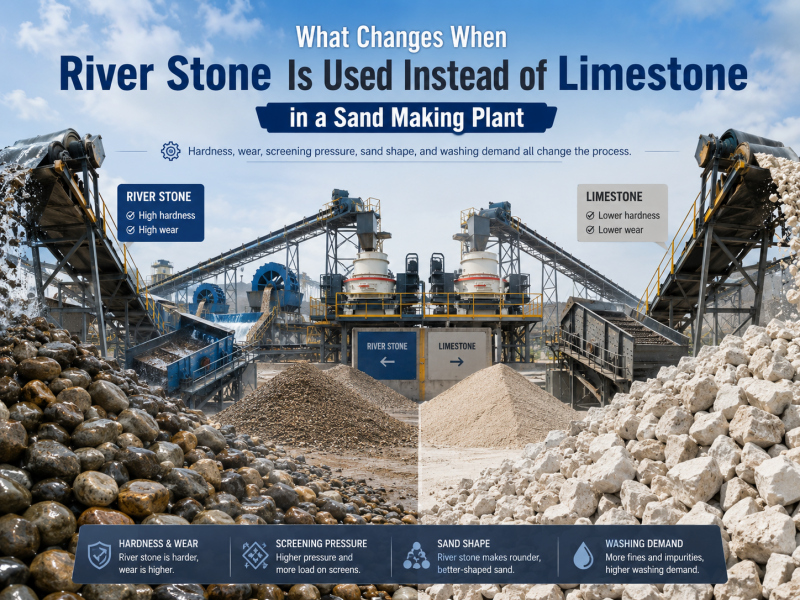
River stone is usually harder, denser, smoother in surface texture, and more abrasive.
Limestone is often softer, easier to crush, less abrasive, and more stable during shaping.
Because of these differences, the same sand making line may react very differently depending on which material enters the system.
This affects crushing pressure, equipment wear, discharge stability, screening efficiency, washing requirement, and energy consumption.
How Hardness Changes Crushing Pressure
River stone usually creates higher crushing pressure than limestone.
In many sand making plants, river stone requires stronger crushing force, creates heavier chamber pressure, and generates more wear during repeated crushing.
Limestone, by comparison, often breaks more easily and creates smoother crushing behavior.
River stone plants often require stronger wear protection, more stable feeding control, and closer monitoring of circulation load.
Why River Stone Usually Creates Higher Wear
River stone commonly causes faster liner wear, shorter hammer life, increased sand making chamber wear, and heavier screen surface wear.
The reason is not only hardness. River stone is also highly abrasive because of its dense and compact structure.
This often means more frequent replacement intervals, higher spare parts consumption, and greater maintenance attention.
Limestone generally creates lower wear pressure, especially in shaping and fine crushing stages.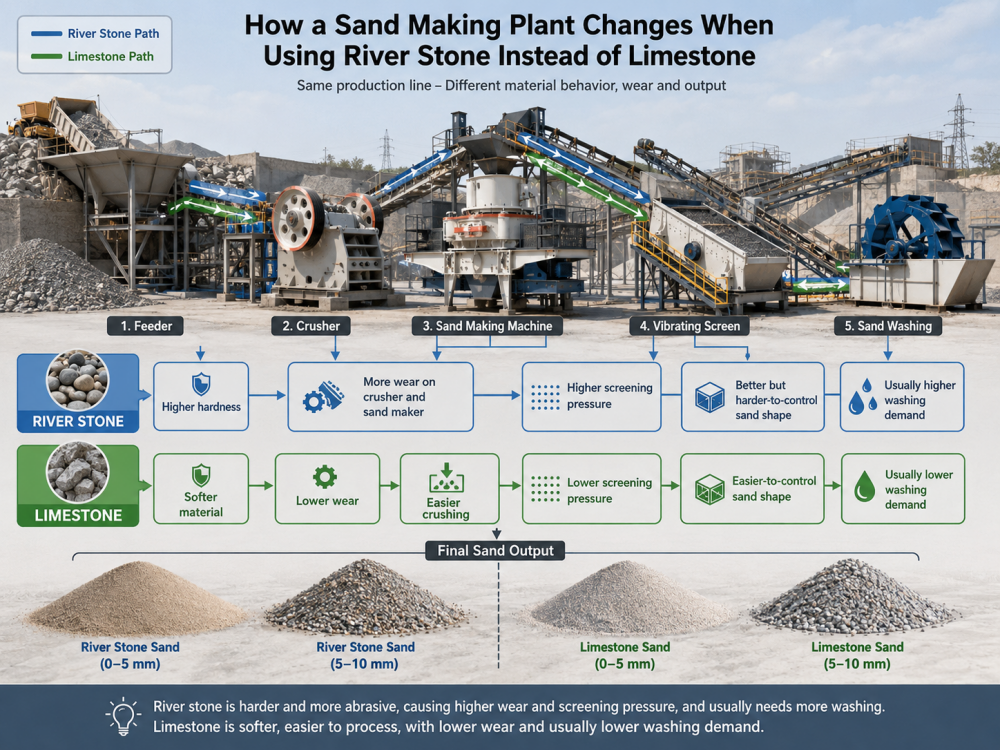
Material Shape Also Changes Finished Sand Behavior
River stone often creates stronger particle strength, more durable aggregate, and better resistance in some construction applications.
But because river stone is naturally smoother and harder, shaping pressure becomes more important.
Without proper shaping configuration, the finished sand may show unstable particle shape, insufficient cubic content, and uneven grading.
Limestone may naturally create more fines, softer edges, and smoother shaping behavior.
Screening and Washing Conditions Also Change
River stone plants often experience heavier screening pressure, stronger circulation behavior, more stable particle separation, and relatively cleaner material surface.
Limestone production may experience higher powder content, more fine material accumulation, stronger dust influence, and higher washing sensitivity.
This is why screening and washing systems should not be copied blindly from one material type to another.
The Process Configuration May Also Need Adjustment
River stone plants may require stronger wear-resistant parts, more stable feeding systems, more powerful shaping stages, and closer circulation control.
Limestone plants may require better dust handling, more careful powder control, adjusted washing configuration, and finer moisture management.
Choosing Equipment Based on Material Behavior
Raw material characteristics strongly affect equipment wear, energy use, circulation stability, maintenance frequency, and finished sand quality.
Understanding these differences helps reduce operating instability, improve long-term efficiency, avoid excessive wear, and maintain more stable sand quality.
Final Thought
Different raw materials do not simply change production difficulty. They change how the entire sand making process behaves.
River stone and limestone may require different crushing pressure, wear protection, shaping logic, screening balance, and washing strategy.
At Sentai machinery, we help customers evaluate sand making solutions according to raw material behavior, production targets, and long-term operating stability rather than simply recommending equipment by capacity alone.
Related Articles:
What Determines Finished Aggregate Shape in an Impact Crushing Process
 WhatsApp
 Email
Email
 +86 15538010601