
STCrushers Is A Professional Minging Equipment Manufacturer since 2004, Providing High Quality Crushers, Sand Making Machines, Drying Equipment and more.
STCrushers Is A Professional Minging Equipment Manufacturer since 2004, Providing High Quality Crushers, Sand Making Machines, Drying Equipment and more.
A Jaw Crusher Can Be Powerful and Still Perform Poorly
A jaw crusher may have sufficient motor power and enough nominal capacity on paper, yet still struggle with:
unstable output
excessive wear
fluctuating discharge size
poor plant balance
In many crushing plants, one overlooked reason is not the crusher itself, but the condition of the feed entering it.
Some operators focus mainly on whether the material can physically enter the crusher opening. But in real production, feed condition affects much more than simple material entry.
Feed size influences:
chamber utilization
crushing rhythm
discharge stability
return material pressure
downstream screening balance
overall plant efficiency
This is why experienced operators pay close attention not only to crusher settings, but also to feeding behavior.
Quick Answer
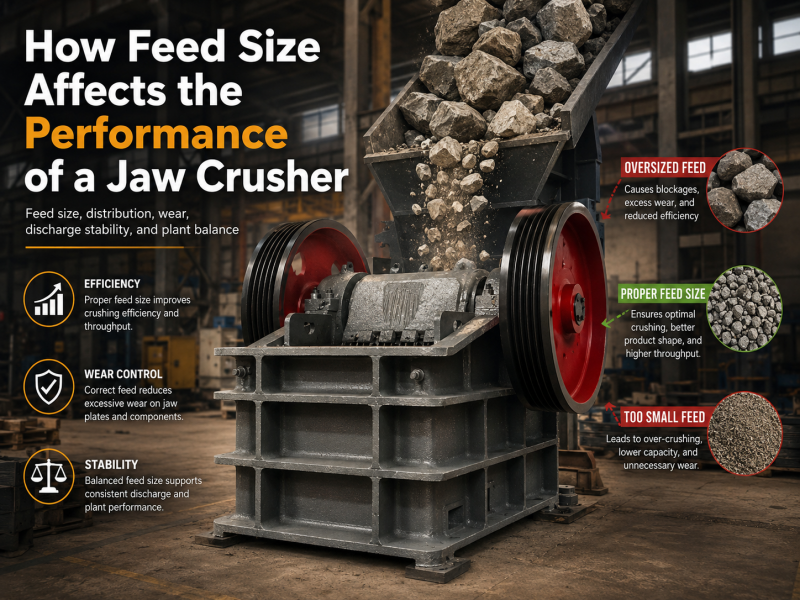
Feed size affects much more than whether material can physically enter the jaw crusher.
It directly affects:
crushing efficiency
chamber utilization
discharge stability
wear condition
circulation pressure
downstream process balance
A jaw crusher usually performs best with stable and reasonably controlled feed conditions, not simply with the largest material it can theoretically accept.
Why Feed Condition Matters More Than Many Buyers Think
Many buyers compare:
feed opening
motor power
capacity range
Those specifications matter.
But actual plant performance often depends just as much on feed consistency and feeding stability.
If the feed entering the crusher changes too aggressively throughout the day, the crusher may struggle to maintain:
stable crushing pressure
stable discharge size
smooth material flow
balanced downstream circulation
This instability can spread through the whole line.
It affects chamber utilization
Uneven feeding may leave part of the crushing chamber overloaded while another part works inefficiently.
It affects discharge behavior
Unstable feed often creates fluctuating discharge size distribution.
It affects downstream balance
If discharge becomes inconsistent, screens and return loops may experience unstable circulation pressure.
It affects wear
Aggressive feeding conditions may increase liner and jaw plate wear much faster than expected.
This is why feeding condition should be treated as part of crusher performance, not as a separate issue.
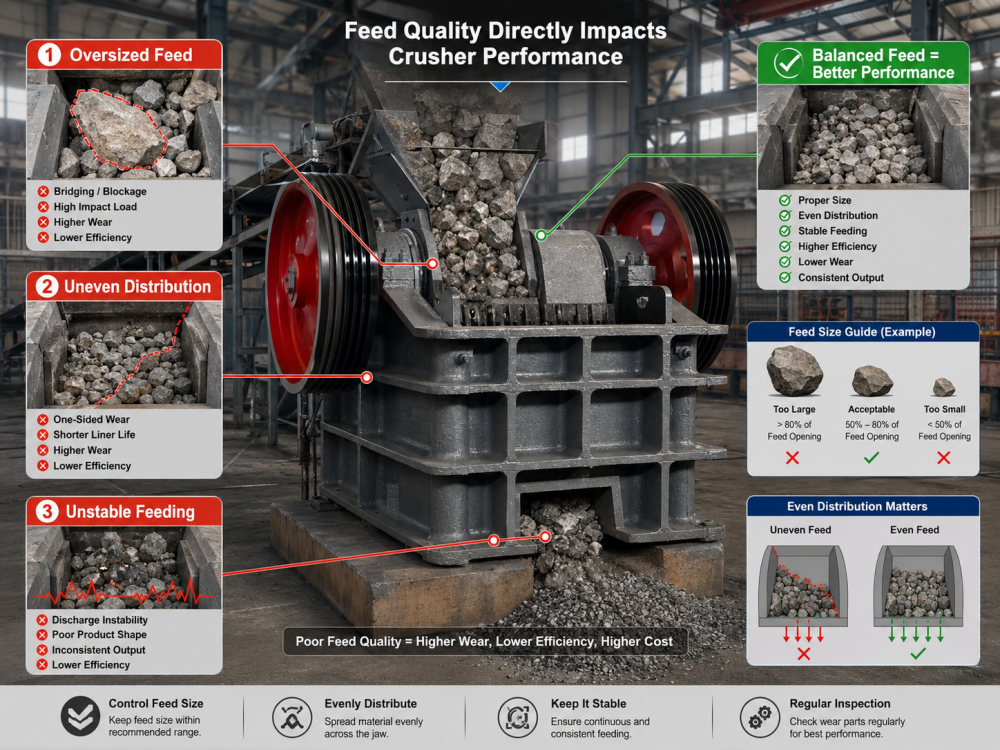
1. Oversized Feed Creates Unstable Crushing Pressure
This is one of the most common problems in jaw crusher operation.
Some plants continuously feed material close to the crusher’s maximum allowable feed size. Technically, the crusher may still accept the material. But long-term operation under oversized feeding conditions often creates unstable crushing pressure.
This may lead to:
uneven chamber loading
unstable crushing rhythm
higher mechanical stress
fluctuating discharge behavior
Common misunderstanding
Many operators assume:
If the stone fits into the feed opening, the feed condition is acceptable.
In reality:
maximum feed size is not always ideal operating feed size
oversized fluctuation may reduce crushing stability
Practical point
A crusher usually works more smoothly when feed size stays within a stable and controlled range instead of constantly approaching the upper limit.
2. Uneven Feed Distribution Reduces Chamber Efficiency
Jaw crushers work most efficiently when material enters the crushing chamber evenly.
If feeding becomes uneven:
one side of the chamber may receive excessive material
another side may remain underutilized
crushing force becomes less balanced
Over time, this may reduce:
crushing efficiency
liner life
discharge stability
Feed distribution problems often come from:
unstable feeder behavior
poor chute design
inconsistent upstream material flow
irregular operator feeding
Practical point
A jaw crusher should not only receive enough material. It should receive material evenly.
3. Inconsistent Feed Size Affects Discharge Stability
A stable feed usually helps create a more stable discharge.
But if feed size fluctuates heavily:
crushing pressure changes continuously
chamber behavior becomes less predictable
discharge size distribution may become unstable
This instability may then affect:
screening efficiency
return material ratio
aggregate classification consistency
What often happens
The plant may appear to have a “screening problem” or “circulation problem,” while the deeper issue actually begins upstream with unstable feeding.
4. Poor Feed Control Increases Return Material Pressure
Jaw crusher discharge directly affects downstream screening behavior.
If feed condition becomes unstable:
discharge may become coarser
oversized material may increase
screen return flow may rise
That increases:
circulation pressure
re-crushing load
internal material movement
Over time, the whole plant may start spending more energy recirculating material instead of producing finished aggregate efficiently.
Practical point
Return material pressure often begins earlier than many operators realize. Sometimes it starts with feeding condition.
5. Aggressive Feeding May Increase Wear Faster Than Expected
Some operators try to maximize throughput by continuously pushing aggressive feed into the crusher.
Short-term output may increase temporarily.
But over time:
jaw plate wear may accelerate
liner stress may rise
maintenance frequency may increase
crusher stability may weaken
This is especially common when:
oversized material enters too frequently
feeding rhythm becomes uneven
the chamber experiences repeated heavy impact
Practical point
A crusher running aggressively is not always a crusher running efficiently.
Quick Diagnosis Table
Feed Problem | What It Causes | What to Check First |
Oversized feed fluctuation | Unstable crushing pressure | Check actual feed size distribution |
Uneven feeding | Poor chamber utilization | Check feeder and material flow |
Inconsistent feed size | Discharge becomes unstable | Check upstream feeding control |
Excessive coarse discharge | Return material pressure rises | Check feed condition and chamber loading |
Rapid wear increase | Maintenance frequency rises | Check aggressive feeding behavior |
A Common Wrong Assumption
Some buyers believe:
Maximum feed size means ideal operating feed size.
That is not always true.
A crusher may technically accept very large material occasionally, but long-term stable production usually depends on:
feed consistency
controlled size distribution
balanced chamber loading
stable feeding rhythm
“Can enter the crusher” and “ideal feeding condition” are not the same thing.
What Plant Owners Should Check Before Increasing Feed Size
Before trying to increase feed size aggressively, plant owners should check:
Is feed size distribution stable
Is oversized material entering too frequently
Is chamber loading balanced
Has discharge stability changed recently
Is return material pressure increasing
Is jaw plate wear accelerating
Is upstream feeding properly controlled
These questions often reveal more useful information than simply comparing crusher capacity numbers.
Final Thought
Feed size affects much more than material entry into a jaw crusher.
It influences:
crushing efficiency
chamber balance
discharge stability
circulation pressure
wear condition
downstream plant performance
In many crushing plants, stable feeding conditions help create more stable production results than simply pushing larger material into the crusher.
At Sentai machinery, we help customers evaluate jaw crusher performance together with feeding condition, process balance, and downstream screening behavior to achieve more stable crushing efficiency.
Related Articles:
Why Return Material Ratio Matters in a Stone Crushing Plant
What Buyers Often Ignore When Choosing a Vibrating Screen
Why Is My Sand Production Line Output Too Low?
Suggested Solutions:

 WhatsApp
 Email
Email
 +86 15538010601