
STCrushers Is A Professional Minging Equipment Manufacturer since 2004, Providing High Quality Crushers, Sand Making Machines, Drying Equipment and more.
STCrushers Is A Professional Minging Equipment Manufacturer since 2004, Providing High Quality Crushers, Sand Making Machines, Drying Equipment and more.
A Serious Quotation Should Start with Questions, Not Price
Some buyers send a short message like this:
I need a sand making plant. Please send your quotation.
That is a normal way to start a conversation. But for a serious supplier, that message is only the beginning.
A sand making plant is not a standard shelf product. It is a project-based configuration. If a supplier gives a price too quickly, without first confirming the key working conditions, the quotation may look fast but still be misleading.
In many real projects, early mistakes do not begin in production. They begin in communication. The supplier assumes too much. The buyer explains too little. The quotation is built on unclear information. Later, when the project moves forward, the configuration starts to drift away from the actual need.
That is why a good quotation process should begin with questions.
Why Sand Making Plant Quotations Go Wrong So Easily
Compared with a single machine inquiry, a sand making plant quotation is more sensitive to missing information.
That is because the final price depends on more than one machine. It depends on raw material, feed size, target capacity, final product requirement, moisture and fines, process layout, whether washing is required, and whether the site is fixed or temporary.
If just one of these points is misunderstood, the recommended plant may already be moving in the wrong direction.
For example, two buyers may both say they want a 100 tph sand making plant, but one may mean 100 tph feed capacity while the other may mean 100 tph finished sand output. Those are not the same thing. And if the supplier does not ask, the quotation may be wrong from the first page.
What We Usually Confirm First
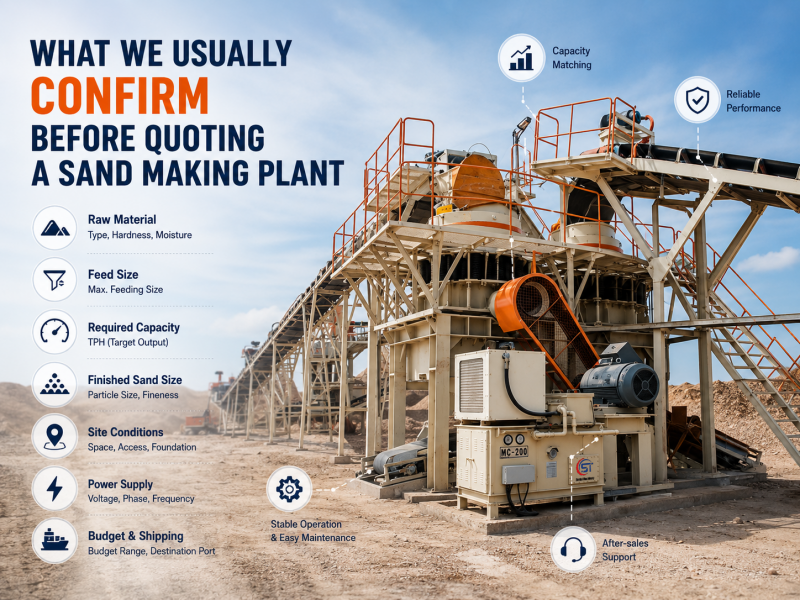
Before quoting a sand making plant, we usually try to confirm the following key information.
1. Raw material type
This is one of the first and most important questions.
A sand making plant for limestone is different from one for granite, basalt, or river stone. Material hardness, abrasiveness, and natural shape all affect crusher choice, sand making machine choice, wear cost, and realistic output.
2. Maximum feed size
Feed size directly affects process design.
If the raw material is already small and controlled, the line may be simpler. If the feed is large and mixed, the line may need stronger primary crushing before the sand making stage.
3. Moisture and fines content
Some buyers do not mention this, but it matters a lot.
Wet material, muddy fines, or clay can reduce screening efficiency, affect sand quality, and change whether washing is required.
4. Capacity target
When a buyer says I need 100 tph, we still need to confirm whether that means feed capacity or finished sand output, and under what working condition.
5. Final product requirement
A serious supplier should not only ask how much output is needed. They should also ask what kind of final sand is required.
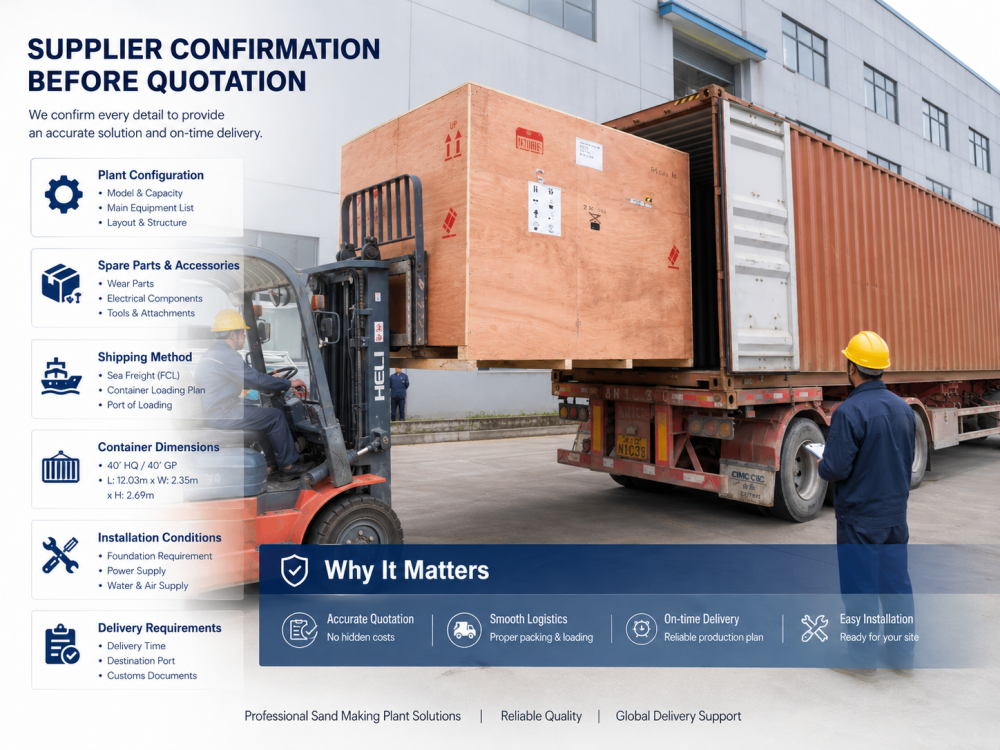
Why Each Question Matters
What We Confirm | Why It Matters | What Can Go Wrong If Ignored |
Raw material type | Affects process difficulty and machine selection | Wrong crusher or sand maker may be recommended |
Maximum feed size | Decides whether pre-crushing is needed | The line may be undersized from the start |
Moisture and fines | Affects screening and possible washing stage | Output and product quality may be overestimated |
Capacity target | Must be clearly defined | Feed tph and final tph may be confused |
Final product requirement | Changes process layout and screen logic | The plant may not match the market need |
Site condition | Affects layout, installation, and flow | Quoted line may not fit the real site |
Power and local limits | Affects equipment arrangement and operation | The plant may be hard to run locally |
A Common Quoting Mistake
A buyer asks for a 100 tph sand making plant quotation.
The supplier quickly sends a list including a jaw crusher, sand making machine, vibrating screen, conveyors, and total price.
At first glance, everything looks efficient.
But the supplier did not confirm whether 100 tph means feed or finished sand, whether the material is dry limestone or wet river stone, whether the buyer wants one finished size or several, whether washing is needed, and whether the site has enough room for the proposed layout.
That quotation may still look professional. But in reality, it is incomplete.
What a Better Quotation Process Looks Like
A better quotation does not always mean a slower quotation. It means a more logical one.
A serious quotation process usually looks like this:
1. confirm material and feed condition
2. confirm capacity target clearly
3. confirm final sand requirement
4. confirm site and layout constraints
5. decide whether washing or additional stages are needed
6. then recommend the plant configuration
7. then provide the quotation based on that configuration
This order matters. A plant should not be quoted first and understood later. It should be understood first and quoted after.
What Buyers Can Prepare Before Requesting a Quotation
To get a more accurate quotation, buyers can prepare these details in advance:
raw material type
maximum feed size
approximate moisture condition
required output
final product sizes
whether sand washing is needed
site photos or layout if available
local power condition if relevant
Even a simple list like this helps the supplier give a more realistic proposal.
Final Thought
A sand making plant quotation should not begin with a price number alone. It should begin with the right questions.
When a supplier asks about material, feed size, moisture, final product, and site condition, that is not a delay. It is part of doing the job properly.
At Sentai machinery, we usually confirm project details carefully before recommending a sand making plant configuration. In many cases, one good question early can prevent a wrong plant proposal later.
Planning a sand making plant project? Send Sentai machinery your raw material, feed size, target output, and final product requirement for a more practical quotation and configuration suggestion.
Related Articles:
How to Choose Equipment for a Sand Making Plant
What Buyers Often Get Wrong About Sand Making Plant Capacity
Why Is My Sand Production Line Output Too Low? 7 Common Causes and Fixes
Suggested Solutions:
 WhatsApp
 Email
Email
 +86 15538010601