
STCrushers Is A Professional Minging Equipment Manufacturer since 2004, Providing High Quality Crushers, Sand Making Machines, Drying Equipment and more.
STCrushers Is A Professional Minging Equipment Manufacturer since 2004, Providing High Quality Crushers, Sand Making Machines, Drying Equipment and more.
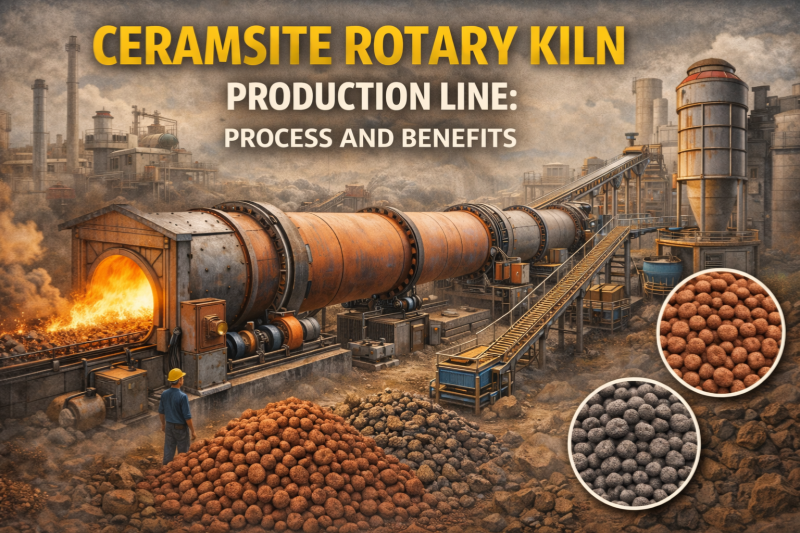
Ceramsite is a lightweight aggregate widely used in construction materials, insulation products, landscaping, and other building-related applications. Because of its low density, good strength, and useful structural properties, it has become an important material in many markets. To produce ceramsite efficiently and consistently, many manufacturers rely on a ceramsite rotary kiln production line.
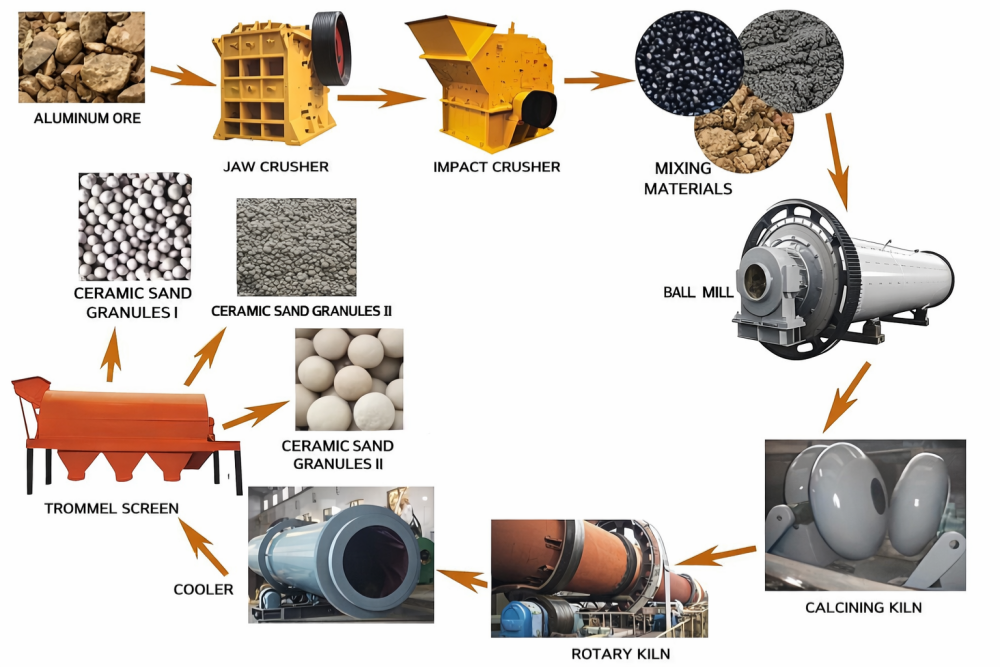
A ceramsite production line is not just one kiln. It is a complete system that includes raw material preparation, granulation or shaping, drying, calcination, cooling, and product screening. The overall quality of the final ceramsite depends on how well each part of the line is matched.
The process usually begins with raw material preparation. Depending on the production route, the raw materials may include clay, sludge, shale, or other suitable mineral-based materials. These materials are first crushed, mixed, and adjusted to meet the required composition and moisture conditions.
The next step is often granulation or pellet formation. This stage shapes the raw material into particles that can be processed more effectively in the kiln. Stable pellet quality is important because it directly affects calcination behavior and the final product structure.
After shaping, the material may go through a drying stage if moisture reduction is needed before entering the rotary kiln. Proper drying helps improve thermal stability and reduces unnecessary energy loss during the later heating process.
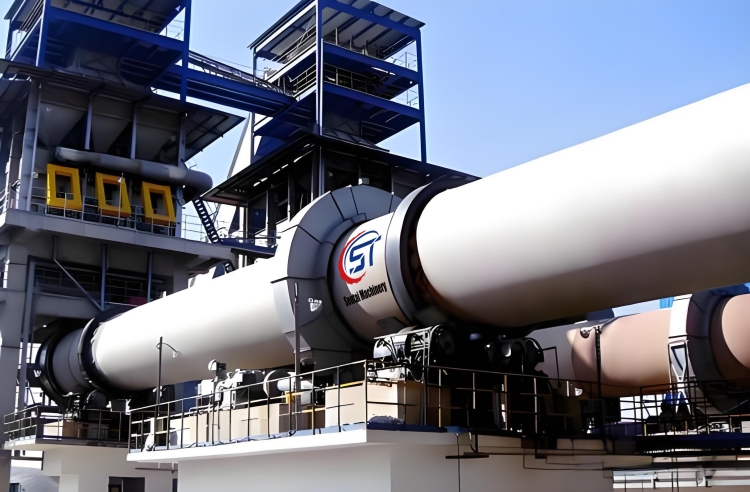
The core part of the line is the rotary kiln. Inside the kiln, the pellets are heated under controlled temperature conditions while the cylinder rotates continuously. During this stage, the material undergoes thermal changes that determine the final ceramsite properties. Proper temperature control and retention time are essential for achieving stable expansion, strength, and product consistency.
After kiln processing, the material moves to the cooling stage. Cooling is important because it helps stabilize the product and prepare it for storage or further handling. The cooled ceramsite is then screened to separate qualified product from oversized or undersized fractions.
A typical ceramsite rotary kiln production line may include:
Raw material crushing equipment
Mixing equipment
Granulator or pelletizing equipment
Dryer (if needed)
Cooling system
Screening equipment
Conveying and electrical control system
One of the main benefits of a ceramsite rotary kiln production line is continuous and stable production. Compared with less integrated systems, a well-designed production line provides better consistency in product quality and supports larger industrial output.
Another important benefit is better product control. When raw material preparation, granulation, calcination, and cooling are properly matched, the final ceramsite is more likely to meet target requirements in particle size, density, and strength.
A rotary kiln line also offers good process adaptability. Different raw materials and production targets may require different thermal conditions, retention times, or auxiliary equipment. A properly engineered line can be adjusted according to specific project goals.
From an investment perspective, the greatest value of a ceramsite production line comes from system coordination. A strong kiln alone is not enough. The entire process must be planned around material characteristics, production capacity, and final product standards. Good process matching helps reduce energy waste, improve product quality, and increase long-term production stability.
In summary, a ceramsite rotary kiln production line is a complete thermal processing system designed for lightweight aggregate production. Its main value lies in stable continuous operation, better product control, and the ability to support industrial-scale ceramsite manufacturing.
At Sentai machinery, we provide ceramsite production line solutions based on raw material type, process target, and plant capacity. A suitable kiln line design helps customers improve final product quality and reduce production uncertainty.
Need a ceramsite production line solution? Contact Sentai machinery with your raw material information and capacity target for a suitable rotary kiln recommendation.
Related Articles:
What Is a Rotary Kiln and How Does It Work?
Gold Ore Processing Plant Design: From Crushing to Separation


 WhatsApp
 Email
Email
 +86 15538010601