
STCrushers Is A Professional Minging Equipment Manufacturer since 2004, Providing High Quality Crushers, Sand Making Machines, Drying Equipment and more.
STCrushers Is A Professional Minging Equipment Manufacturer since 2004, Providing High Quality Crushers, Sand Making Machines, Drying Equipment and more.
A small magnetite project may look simple because the crusher, ball mill, and magnetic separator each show a suitable catalogue capacity. Once connected, however, the plant may only maintain a lower stable feed rate because crushing size, circulating load, slurry volume, magnetic loading, and downstream handling were calculated separately.
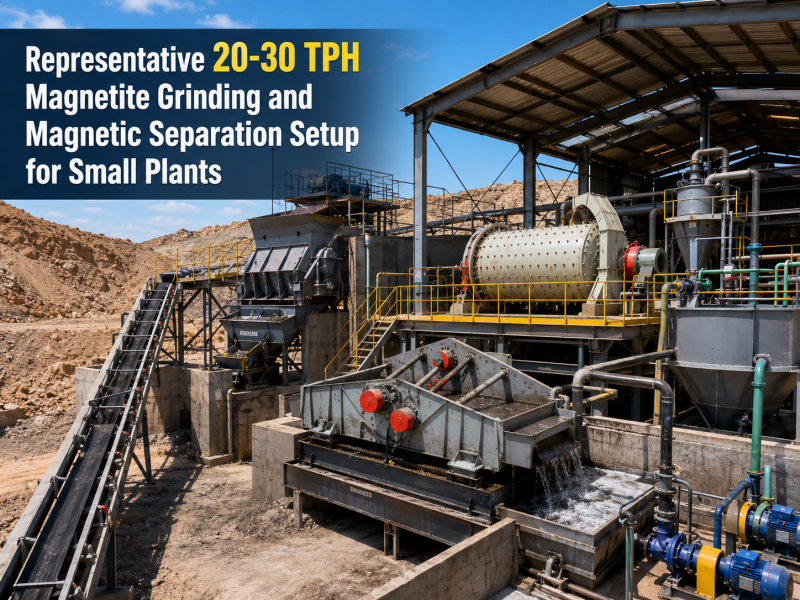
For this representative scenario, the target is approximately 20-30 metric tons per hour on a dry-solids basis at the grinding-circuit feed. The ore is assumed to be strongly magnetic magnetite, with preliminary test work supporting wet grinding followed by wet low-intensity magnetic separation.
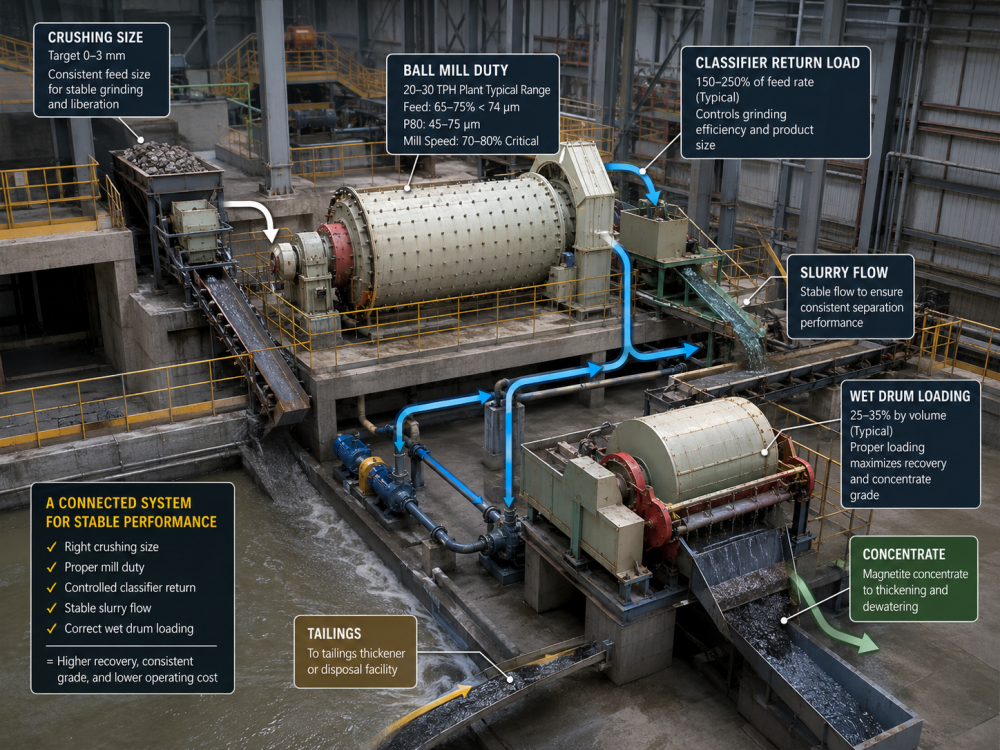
A compact circuit may include primary crushing, optional secondary crushing or screening, controlled feeding, a wet ball mill, spiral classification, slurry transfer, one or more wet drum magnetic stages, and concentrate and tailings handling. This is a process sequence, not a fixed equipment list; each section depends on ore testing and site conditions.
Maximum feed size and size distribution after crushing affect how much useful grinding the ball mill can complete each hour. Oversized or highly variable feed raises mill load and may force operators to reduce fresh feed to control current and discharge fineness.
A bin and controlled feeder help reduce surges, while screening or secondary crushing may be required when a jaw crusher cannot maintain the selected feed range. The aim is a consistent feed that balances crushing cost, mill capacity, and wear.
Magnetic separation depends on sufficient liberation of magnetite from gangue. The required size must come from mineralogical analysis or beneficiation testing, not from a standard mesh value used for every iron ore.
Finer grinding generally requires more residence time and lowers the dry-solids throughput a mill can maintain. Ore hardness, feed size, media condition, slurry density, liners, and operating speed all matter, so a model should not be promised at 20-30 TPH before the feed and liberation target are confirmed.
In a closed circuit, the classifier sends sufficiently fine slurry forward and returns coarse particles for regrinding. That return sand is not new ore, but it still uses mill capacity.
A coarse overflow can send inadequately liberated particles to separation, while an overloaded or overly fine classification target can raise circulating load sharply. Ball mill and classifier selection must therefore use one circuit balance based on overflow target, slurry flow, settling behavior, and return sand.
Pumps, tanks, pipes, and wet drum separators handle slurry volume rather than dry ore tonnage. The same solids rate can create very different flow depending on percent solids and ore density.
More dilution increases hydraulic load, while excessive concentration can increase viscosity, particle interaction, and entrainment. The transfer system must therefore be selected from a complete water and slurry balance.
A wet drum magnetic separator must be checked for both hydraulic loading and magnetic loading. Hydraulic loading relates to slurry volume and flow conditions. Magnetic loading relates to the mass of magnetic material that must be captured, transported, and discharged across the effective drum width.
Two feeds at the same dry ore tonnage can create different separator duties. A feed containing more magnetite places a higher magnetic load on the drum. A more dilute feed creates a larger slurry volume. Either limit can be reached before the nominal dry-solids target is achieved.
Feed distribution also matters. If slurry enters mainly at the center or one side, part of the drum may be locally overloaded while the remaining width is underused. Feedbox design and stable upstream pumping are part of separator capacity.
Some magnetite ores can reach the target with one roughing stage. Other ores may need cleaning, scavenging, or regrinding of an intermediate product. The decision depends on liberation, magnetic susceptibility, gangue association, and the required balance between recovery and concentrate grade.
Adding stages without test evidence can increase pumps, tanks, water demand, control points, and operating cost. Using only one stage when cleaning is required can leave the product below specification. The process route should follow test work rather than a standard diagram.
Concentrate pumps, dewatering equipment, tailings lines, settling capacity, and return-water systems must handle the actual slurry volume. Restrictions here can force the plant to reduce feed even when crushing and grinding equipment remain available. Plant capacity is the stable output of the complete circuit, not the highest rating on one machine.
Process stage | Main design basis | Typical bottleneck |
Crushing and feeding | Raw size, hardness, selected mill feed range, surge control | Oversized or unstable mill feed |
Ball milling | Ore hardness, feed size, liberation target, media and slurry condition | Insufficient grinding capacity at target fineness |
Classification | Overflow size, slurry flow, settling behavior, circulating load | Excessive return sand or coarse overflow |
Slurry transfer | Flow volume, percent solids, pump head, tank retention | Pump restriction or tank overflow |
Magnetic separation | Hydraulic loading, magnetic loading, drum width, feed distribution | Magnetite loss or unstable concentrate |
Concentrate handling | Concentrate slurry volume and required final moisture | Thickening, filtering, or discharge delay |
Tailings and water | Total slurry volume, settling, disposal, and return-water demand | Water imbalance that restricts plant feed |
This configuration does not prove that every iron ore is suitable for wet magnetic separation. Hematite, limonite, mixed iron ores, oxidized zones, and weakly magnetic minerals may require different separation methods or additional process stages.
It also does not prove that 20-30 TPH corresponds to one fixed ball mill, classifier, or magnetic separator model. Recovery, concentrate grade, media consumption, power use, and water demand cannot be guaranteed without representative samples and test results.
1.Ore type, mineral composition, and representative sample information.
2.Magnetic response and available beneficiation test results.
3.Raw ore grade and target concentrate specification.
4.Required recovery target, if already defined by testing.
5.Maximum raw feed size and expected crushed feed size.
6.Ore hardness, abrasiveness, and bulk density.
7.Liberation size or target grinding fineness.
8.Required capacity stated clearly on a wet-feed or dry-solids basis.
9.Available process water and water-quality restrictions.
10.Expected roughing, cleaning, scavenging, or regrinding stages.
11.Concentrate dewatering and tailings-disposal method.
12.Local voltage, frequency, altitude, and power limitations.
13.Site dimensions, elevation differences, and preferred layout.
14.Required quotation boundary, installation support, and automation level.
A 20-30 TPH magnetite plant should not be created by shrinking the equipment list from a large iron ore project. Small circuits have the same mass-balance, slurry-flow, liberation, and magnetic-loading relationships as larger plants.
The most common bottlenecks appear at equipment interfaces: crusher to mill, mill to classifier, classifier to pump, and pump to magnetic separator. Designing these stages together provides a more realistic capacity than selecting each machine from a separate catalogue range.
Sentai Machinery can review representative ore data, crushing size, grinding target, slurry conditions, magnetic response, water supply, and site requirements before preparing a balanced equipment proposal for a small magnetite processing plant.
1. Wet Drum Magnetic Separator Feed Loading: Why Higher Throughput Can Increase Magnetite Losses
2. Iron Ore Processing Plant Design: Confirm Ore Type Before Choosing the Process Route
3. What Buyers Often Miss When Matching a Ball Mill and Spiral Classifier
4. Why Crushing Size Before Ball Milling Affects Grinding Cost
5. Why Is Magnetic Separator Recovery Lower Than Expected
1. Jaw Crushers
2. Ball Mill

 WhatsApp
 Email
Email
 +86 15538010601