
STCrushers Is A Professional Minging Equipment Manufacturer since 2004, Providing High Quality Crushers, Sand Making Machines, Drying Equipment and more.
STCrushers Is A Professional Minging Equipment Manufacturer since 2004, Providing High Quality Crushers, Sand Making Machines, Drying Equipment and more.
When buyers discuss a kaolin calcination project, the first question is often about the rotary kiln.
What kiln model is suitable?
What temperature can it reach?
What capacity can it produce?
These questions are important, but they do not cover the full problem. In many kaolin projects, the real difficulty starts before the material enters the kiln.
Kaolin is not like large stone or ordinary granular material. It is often fine, moisture holding, and easy to form uneven material conditions. If the material enters the kiln with unstable moisture, lumps, poor dispersion, or too much uncontrolled fine powder, the kiln may still run, but the final calcined product may become unstable.
For Sentai Machinery, a kaolin calcination line should be considered as a complete preparation and calcination process, not only as one rotary kiln.
Kaolin can hold moisture in a way that is not always visible from the surface. Sometimes the outside looks dry, but the inside of small lumps still contains moisture. If this material goes directly into the kiln, part of the heat must first remove water before real calcination becomes stable.
This can create several problems.
The kiln temperature may fluctuate. Fuel consumption may increase. Some material may move differently inside the kiln because it is wetter and heavier. In some cases, wet kaolin may form lumps or stick during feeding.
This is why drying before calcination is not just a simple preparation step. It is part of quality control.
A rotary dryer can help reduce moisture before the kiln, but the drying target should be based on the actual kaolin condition and final product requirement. The goal is not only to make the material look dry. The goal is to make the feeding condition stable enough for calcination.
In real production, one common mistake is judging kaolin only by appearance.
A pile of kaolin may look dry on the outside, but if the material is not evenly dried, the kiln will feel the difference during operation. Wet spots and dry spots do not heat in the same way. Fine material and small lumps do not move in the same way. This can lead to uneven calcination results.
For buyers, the useful question is not only "Is the material dry?" A better question is "Is the material dry and uniform enough for stable kiln feeding?"
This difference matters because rotary kiln operation depends on continuous and predictable material behavior.
Kaolin lumps are another point that buyers often ignore.
If lumps enter the kiln, the outside of the lump may receive enough heat, but the inside may not be fully treated at the same speed. This can create uneven calcination. Some material may be under-calcined, while other material may be overtreated.
Lumps can come from wet material, storage condition, poor drying, or handling before feeding. In some projects, breaking, screening, or better feeding preparation may be needed before the kiln.
The purpose is not to make every particle exactly the same. That is not realistic in most industrial projects. The purpose is to avoid extreme material differences that make kiln control difficult.
Kaolin is often fine, and fine powder has its own challenges.
Fine material can be carried by airflow more easily. If the kiln system, dryer system, or dust collection system is not matched properly, powder loss and dust load may increase. This affects both working environment and material recovery.
Too much uncontrolled fine powder can also affect feeding stability. Material may bridge, flow unevenly, or become difficult to control in the feeding system.
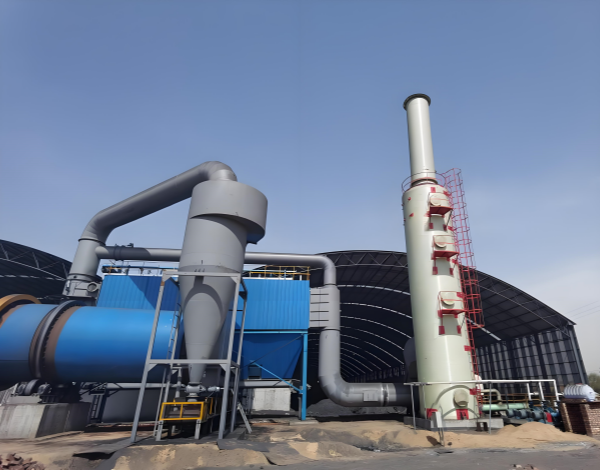
This is why a kaolin calcination plant should consider dust collection, sealing, airflow, and discharge handling from the beginning. The kiln body is important, but the surrounding system decides whether the plant can run cleanly and steadily.
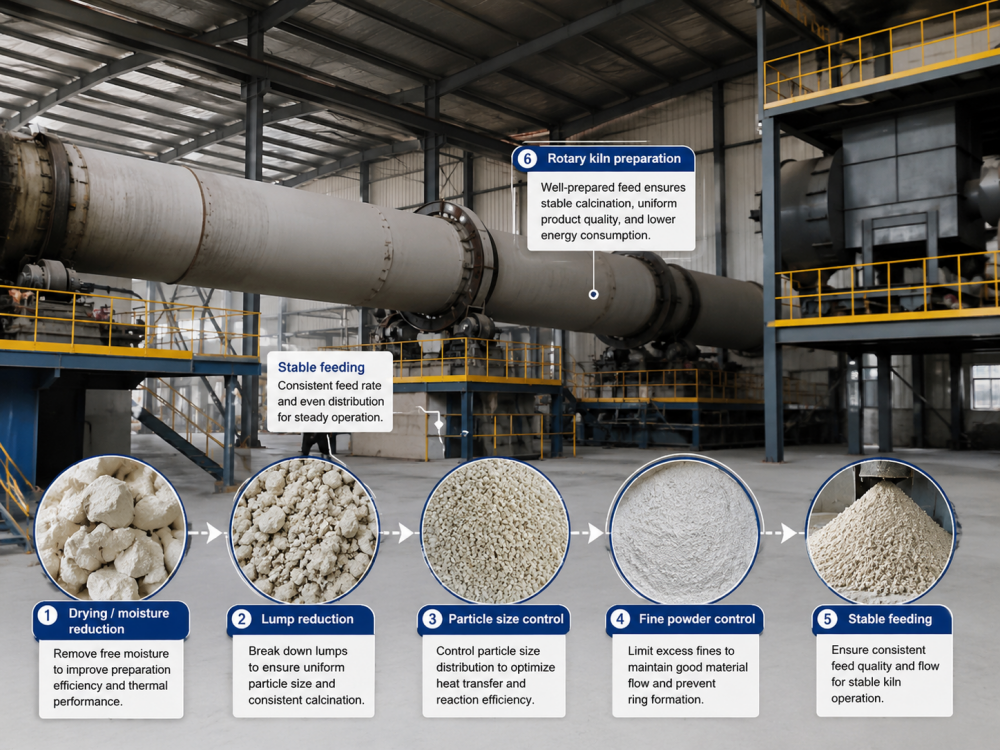
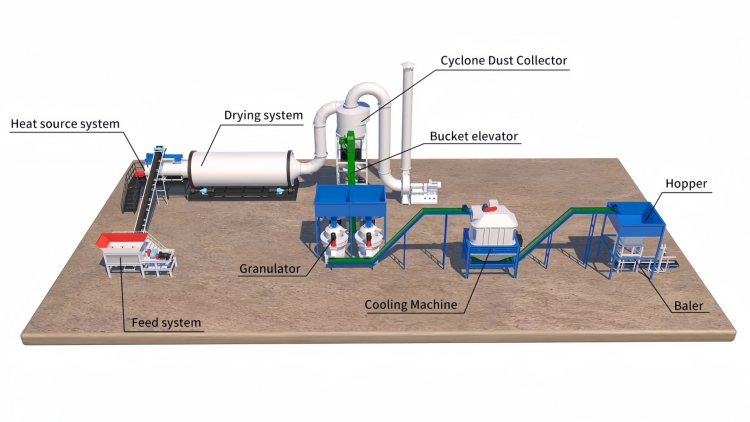
For kaolin calcination, drying, screening, and feeding should not be designed as separate unrelated steps.
Drying reduces moisture and helps improve material condition. Screening or simple particle control helps reduce oversized lumps and unstable feed. A suitable feeding system helps the material enter the kiln continuously instead of entering in sudden heavy batches.
If these steps are not matched, the rotary kiln operator may need to keep adjusting fuel, air, speed, and feeding rate. This makes product quality harder to control.
A stable kaolin calcination line should make the kiln receive material in a condition it can handle.
A weak project discussion sounds like this:
"I need a rotary kiln for kaolin. Please give me price."
A better project discussion sounds like this:
"The material is kaolin. The current moisture is around a certain range. The material sometimes forms small lumps after storage. We need calcined kaolin for a specific final use. We want to know whether drying, screening, and rotary kiln should be designed together."
The second discussion gives the supplier a better starting point. It helps avoid a simple kiln quotation that does not match the real material condition.
For overseas buyers, this early communication is especially important because changing the system after shipment is costly and slow.
Before recommending equipment for a kaolin calcination project, Sentai Machinery usually needs to confirm these details.
1. What is the initial moisture of the kaolin?
2. Is the moisture stable or changing by batch?
3. Does the material contain lumps after storage or transport?
4. What is the approximate particle size condition?
5. Is pre-drying required before the rotary kiln?
6. Is screening or lump control needed before feeding?
7. What final calcined kaolin quality is expected?
8. What capacity is required per hour or per day?
9. What fuel is available locally?
10. Does the buyer need only a rotary kiln or a complete material calcining plant?
These questions help the supplier judge whether the project needs rotary dryer, vibrating screen, feeder, rotary kiln, cooling system, dust collection, and related conveying equipment.
None of this means the rotary kiln is less important.
The kiln is still the core equipment for kaolin calcination. Its size, temperature control, residence time, rotation speed, slope, sealing, and support system all matter.
But the kiln performs better when the material preparation is stable. If the kiln receives uneven, wet, lumpy, or dusty material without proper control, the operator has to solve too many problems inside the kiln.
A good kaolin calcination project should reduce these problems before the material enters the hot zone.
Kaolin calcination does not begin when the material enters the rotary kiln. It begins with drying, particle control, and stable feeding before the kiln.
For buyers, the better question is not only "Which rotary kiln model should I choose?" A more useful question is "Is my kaolin prepared well enough for stable calcination?"
When moisture, lumps, fine powder, feeding, and kiln process are considered together, the calcination line becomes easier to operate and the final product quality becomes more stable.
If you are planning a kaolin calcination project, Sentai Machinery can help evaluate the process according to your kaolin moisture, particle condition, required capacity, fuel condition, final product requirement, and site layout.
Send us your material photos, moisture information, capacity requirement, and project goal. Our team can help recommend a suitable rotary dryer, rotary kiln, dust collection, and material calcining plant configuration.
1. Why Raw Material Preparation Matters Before Rotary Kiln Calcination
2. What Affects Calcined Product Quality in a Rotary Kiln
3. Why Wet Material Condition Matters More Than Dryer Model Alone
4. How Different Materials Change Rotary Dryer Design
5. Why Rotary Kiln Output Is Not Only Decided by Kiln Size
 WhatsApp
 Email
Email
 +86 15538010601