
STCrushers Is A Professional Minging Equipment Manufacturer since 2004, Providing High Quality Crushers, Sand Making Machines, Drying Equipment and more.
STCrushers Is A Professional Minging Equipment Manufacturer since 2004, Providing High Quality Crushers, Sand Making Machines, Drying Equipment and more.
Many buyers ask a direct question when planning a rotary kiln project: what is the capacity of this kiln?
This question is important, but the answer is not always decided by kiln size alone.
A larger rotary kiln may have more potential capacity, but it does not automatically mean stable output in real production. The same kiln diameter and length may give different results when processing different materials, different moisture levels, different particle sizes, different fuels, or different final product requirements.
For Sentai Machinery, when we discuss a rotary kiln project with an overseas buyer, we do not only look at the kiln model. We also need to understand the raw material, target product, heat source, feeding method, and complete calcining system.
Kiln size is the visible part. Real output comes from process balance.
Some buyers compare rotary kiln quotations mainly by diameter, length, motor power, and price. This is understandable because these parameters are easy to see.
However, rotary kiln production is not only a steel shell calculation. A kiln must heat the material, keep it moving, provide enough residence time, support stable reaction or calcination, and discharge the product properly.
If the material is difficult to heat, contains high moisture, has uneven particle size, or needs longer calcination time, the actual output may be lower than expected. If the heat supply is not stable or the feeding system changes too much, the kiln may not reach its designed capacity.
This is why two kilns with similar size may not have the same real production result.
Raw material is one of the first factors that affects rotary kiln output.
If the material has uniform particle size, suitable moisture, and stable feeding condition, the kiln can work more smoothly. Heat transfer is easier to control, and the material can move through the kiln in a more predictable way.
If the material size is too large, the inside of the particles may not calcine fully within the planned residence time. The operator may need to reduce feeding speed or increase heat, which affects output and fuel cost.
If there are too many fine particles, dust may increase and airflow control may become more difficult. Fine powder can also create more load for dust collection and gas treatment equipment.
For materials such as limestone, kaolin, bauxite, cement raw material, ceramsite material, or mineral material, the condition before entering the kiln can directly change the practical capacity.
Moisture is often underestimated.
When wet material enters the kiln, part of the heat is used first to evaporate water. This means less heat is available for calcination. If moisture is high or unstable, the kiln temperature may fluctuate, fuel consumption may rise, and output may become harder to keep stable.
In some projects, pre-drying is necessary before calcination. A rotary dryer may be used before the rotary kiln to reduce moisture and make feeding more stable.
If the buyer only asks for kiln capacity without confirming moisture content, the capacity judgment may be inaccurate from the beginning.
A rotary kiln needs enough and stable heat supply. The fuel type, fuel quality, burner system, air supply, and temperature control all affect output.
If the fuel has low heat value, unstable supply, or poor combustion control, the kiln may not maintain the required temperature. In that case, the operator may need to slow down feeding to protect product quality.
For some materials, higher temperature is not the only answer. The kiln also needs proper heat distribution and residence time. If the temperature is high but the material does not stay long enough, calcination may still be incomplete.
This is why kiln capacity should be judged together with the available fuel and heating system.
Some buyers focus only on how many tons can be fed into the kiln per hour. But feeding more material does not always mean higher qualified output.
The material must stay inside the kiln long enough to complete the required process. Residence time is affected by kiln length, slope, rotation speed, internal movement, material size, and feeding amount.
If the kiln is overloaded, the material may move too fast or form a thick material layer. Heat contact becomes weaker, and product quality may drop.
Stable output means qualified product output, not just high feeding volume.
A rotary kiln needs continuous and stable feeding. If the feeding amount changes sharply, the material layer inside the kiln also changes. This affects temperature, residence time, fuel adjustment, and discharge quality.
Unstable feeding may come from wet material, poor storage, blockage, uneven particle size, or unsuitable feeding equipment.
For a real calcining plant, the feeding system is part of capacity. Belt feeder, screw feeder, bucket elevator, storage bin, and control system should be matched with the material condition and kiln requirement.
A strong kiln with poor feeding can still have unstable output.
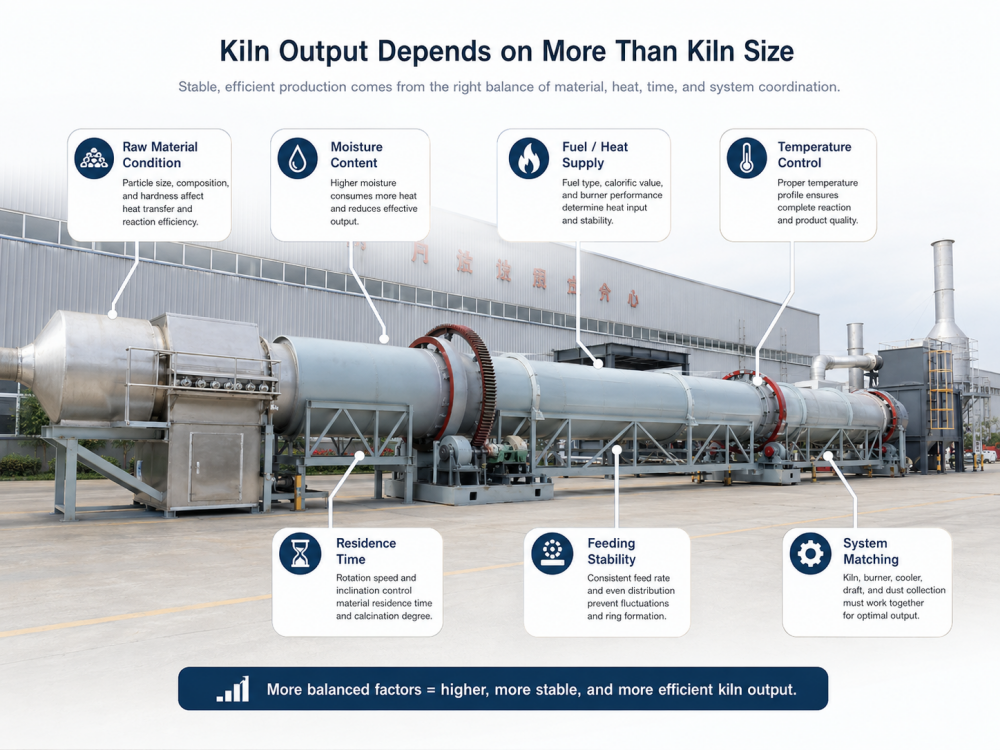
The rotary kiln is the core machine, but the whole system decides the final production result.
If the crusher or screen before the kiln cannot prepare suitable material size, kiln output may be affected. If the dryer before the kiln cannot reduce moisture properly, the kiln must handle extra water. If the cooler, dust collector, fan, or discharge conveyor after the kiln is too small, the system may not support higher output.
In many projects, the bottleneck is not always the kiln shell. It may be the supporting equipment around the kiln.
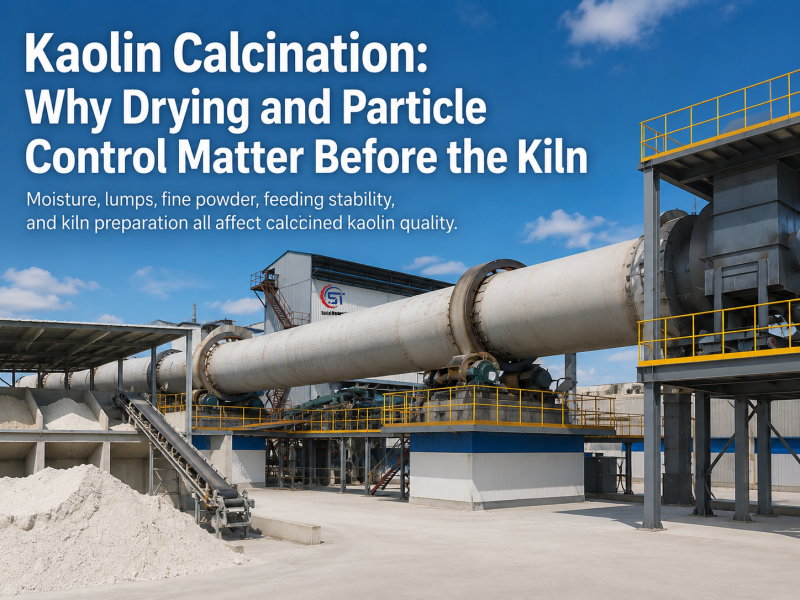
That is why Sentai Machinery usually evaluates a rotary kiln project as a complete calcining plant, not only as one machine.
The table below shows several factors that may change real rotary kiln output.
Factor | How It Affects Output | What Should Be Checked |
Kiln size | Provides basic capacity potential | Diameter, length, slope, speed |
Raw material size | Affects heat transfer and calcination time | Particle size range |
Moisture content | Uses heat before calcination | Initial moisture and moisture stability |
Fuel condition | Affects temperature stability | Fuel type and heat value |
Residence time | Decides whether calcination is complete | Kiln speed and material movement |
Feeding stability | Affects process balance | Feeder and material flow |
Supporting equipment | May limit whole line capacity | Dryer, cooler, fan, dust collector |
Before giving a serious rotary kiln capacity recommendation, Sentai Machinery usually needs to confirm the following details.
1. What material will be calcined?
2. What is the required final product?
3. What is the feeding particle size?
4. What is the initial moisture content?
5. What capacity is required per hour or per day?
6. Is the capacity based on raw material input or final product output?
7. What fuel is available locally?
8. Is pre-drying needed?
9. What temperature and residence time are required?
10. Does the buyer need a single kiln or a complete calcining plant?
Rotary kiln output is not only decided by kiln size.
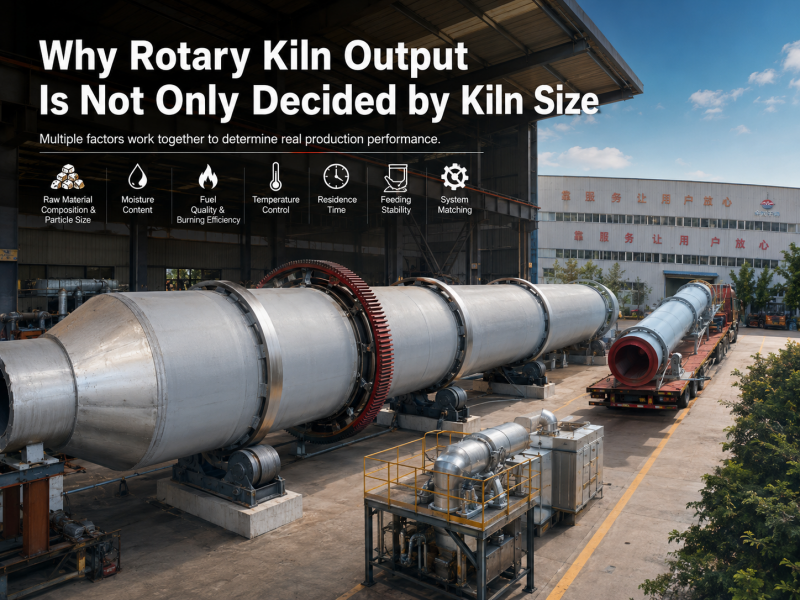
Kiln diameter and length are important, but they are only part of the answer. Real capacity depends on raw material condition, moisture, fuel, temperature control, residence time, feeding stability, and supporting equipment.
For buyers, the better question is not only "What is the capacity of this kiln?" A more useful question is "Can this kiln and the complete system produce qualified material at the required capacity?"
When kiln size and process conditions are considered together, the calcining plant becomes more stable, more practical, and easier to operate.
If you are planning a rotary kiln calcination project, Sentai Machinery can help evaluate capacity based on your raw material, particle size, moisture, fuel condition, target product, and site layout.
Send us your material information, required output, photos or test data if available, and project requirements. Our team can help recommend a suitable rotary kiln configuration and supporting equipment for your calcining plant.
1. Rotary Kiln for Limestone Calcination: Process and Equipment
2. 5 Common Mistakes Buyers Make When Choosing a Rotary Kiln
3. Why Raw Material Preparation Matters Before Rotary Kiln Calcination
4. Why Wet Material Condition Matters More Than Dryer Model Alone
5. What Photos and Documents Should Be Prepared Before Overseas Equipment Shipment
 WhatsApp
 Email
Email
 +86 15538010601