
STCrushers Is A Professional Minging Equipment Manufacturer since 2004, Providing High Quality Crushers, Sand Making Machines, Drying Equipment and more.
STCrushers Is A Professional Minging Equipment Manufacturer since 2004, Providing High Quality Crushers, Sand Making Machines, Drying Equipment and more.
Many Rotary Kiln Problems Start Before the Machine Is Built
When buyers choose a rotary kiln, they often think the main risk is buying a machine with poor manufacturing quality.
That risk exists, of course. But in many real projects, the bigger problem starts earlier:
the buyer uses the wrong logic when judging the kiln project.
A rotary kiln is not like buying a standard warehouse item. It is not enough to ask for a model, compare a few quotations, and pick the cheapest or fastest supplier. A kiln project depends on raw material, process goal, retention time, fuel condition, temperature control, supporting equipment, and long-term operating logic.
That is why many expensive problems are not caused by one bad bearing, one poor weld, or one delayed delivery. They are caused by wrong decisions made before the order is confirmed.
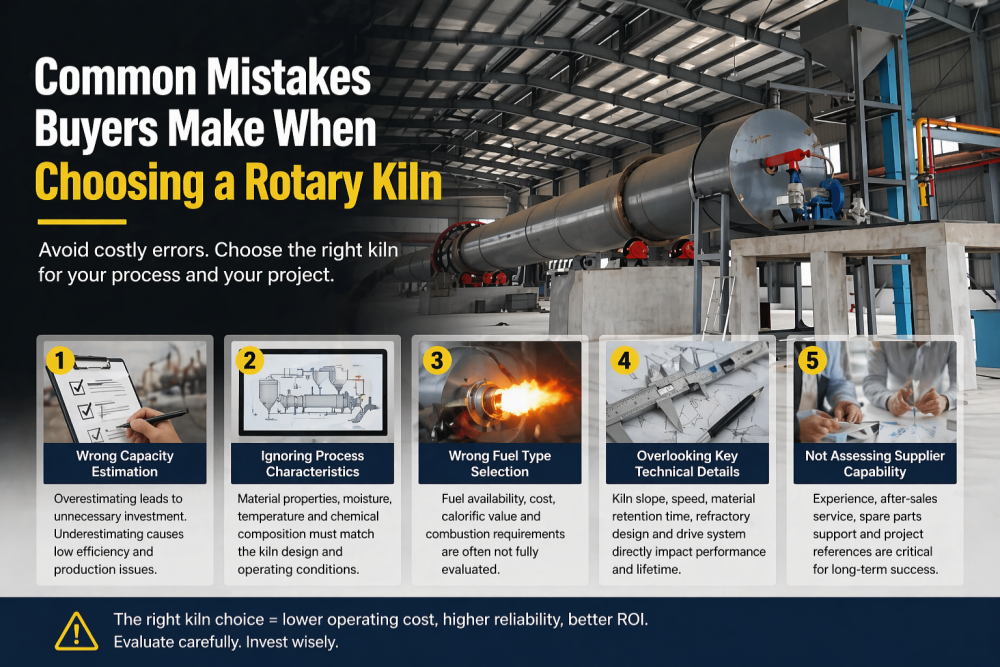
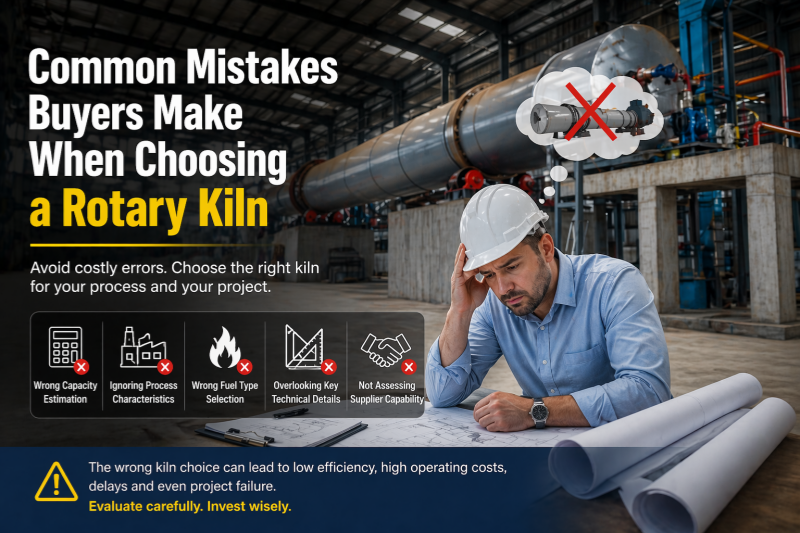
Below are 5 common mistakes buyers make when choosing a rotary kiln — and the better way to think about each one.
Mistake 1: Choosing the Kiln Mainly by Diameter and Length
This is one of the most common buying mistakes.
Many buyers begin with a simple idea: “If another project used a 3.5×54 m kiln, I can use the same.” Or: “My target output is larger, so I just need a longer kiln.”
This sounds logical, but it is incomplete.
A kiln’s diameter and length matter, but they only make sense when connected to:
raw material characteristics
required processing temperature
feed size
retention time
fuel condition
final product target
A larger kiln is not automatically a better kiln. In some projects, the kiln is oversized and difficult to operate efficiently. In others, the kiln looks large enough on paper but still fails to deliver stable results because the process itself was not properly understood.
Better way to evaluate
Instead of asking only for kiln size, start with:
What material am I processing?
What thermal change do I need?
What output target is realistic?
What retention time is required?
A kiln should match the process. It should not be selected like a generic steel shell.
Mistake 2: Focusing on the Main Kiln Body but Ignoring the Full System
Some buyers compare only the kiln itself:
shell thickness
tire size
motor power
reducer brand
But the kiln body is only one part of the project.
A rotary kiln line also depends on:
feeding system
burner or heat source
sealing
cooling
dust collection
control system
material preparation before the kiln
discharge handling after the kiln
This is where many projects get into trouble.
A kiln may be well manufactured, but if the feeding is unstable, the burner is poorly matched, or the dust and airflow system is not well designed, the whole line may perform badly.
Better way to evaluate
Ask not only: “What is the kiln specification?”
Also ask:
What supporting system is required?
How will fuel and temperature be controlled?
How is the seal designed?
What cooling and dust handling are included?
How does the supplier view the full process, not just the kiln shell?
A strong kiln with a weak system is still a weak project.
Mistake 3: Assuming the Lowest Price Is the Most Practical Option
This mistake appears in almost every equipment industry, but it is especially costly in kiln projects.
A low quotation often looks attractive because rotary kilns are high-value equipment and buyers naturally want to control investment.
But in kiln selection, a low price can hide expensive problems later:
higher fuel consumption
unstable temperature
premature wear
weak sealing
lower product consistency
more maintenance downtime
A kiln project is not a machine you want to “buy twice.” If the first choice is made only to reduce initial budget, the operating cost may punish the project for years.
This does not mean the most expensive offer is always best. It means the comparison standard should be broader than price.
Better way to evaluate
Compare quotations using these questions:
What is included and not included?
What is the sealing design?
What is the expected fuel efficiency?
What is the refractory arrangement?
What parts are easy to maintain or replace?
What is the supplier’s real experience with similar materials?
The best kiln is not the cheapest one. It is the one that keeps the project stable and economical over time.
Mistake 4: Treating All Materials as If They Behave the Same
This is a technical mistake, but it often starts from a commercial assumption.
Some buyers think: “A rotary kiln is a rotary kiln. If it works for lime, it can probably work for my material too.”
That is risky.
Different materials behave very differently in a kiln:
limestone
ceramsite raw pellets
bauxite
kaolin
Each one has its own:
moisture behavior
reaction temperature
heat sensitivity
residence time requirement
product quality requirement
If the material characteristics are not properly considered, the project may face:
incomplete calcination
unstable discharge quality
ring formation
poor heat efficiency
difficult operation
Better way to evaluate
Start from the material, not from the machine.
The supplier should ask:
What exactly is the material?
What is the feed size?
What is the moisture?
What product do you want after calcination?
What temperature range is required?
Are there any known process difficulties?
If these questions are not being discussed, the project may be judged too roughly.
Mistake 5: Choosing a Supplier That Sells Equipment but Does Not Think Like a Process Partner
This is the mistake buyers often discover too late.
Some suppliers are very fast at sending quotations. They can provide drawings, prices, and delivery promises quickly. But when the buyer asks deeper questions — about process logic, raw material suitability, temperature control, supporting equipment, site layout, or future operating issues — the answers become vague.
That is a warning sign.
A rotary kiln project is not only about fabrication. It is also about whether the supplier understands:
the process goal
the material
the matching equipment
the practical operating risks
A supplier that thinks only like a seller may still deliver a kiln. But a supplier that thinks like a process partner is more likely to help the buyer avoid expensive mistakes before production even starts.
Better way to evaluate
Before choosing a supplier, ask:
Have you worked on similar material or similar process goals?
What risks do you see in my project?
What supporting equipment do you recommend and why?
What factors may affect final product quality?
What information do you need from me before finalizing the design?
A serious supplier should not answer everything too easily. Some hesitation, clarification, and process discussion are often a good sign.
Quick Buyer Checklist
Check Point | Why It Matters |
Material type is clearly defined | Different materials require different kiln logic |
Capacity target is realistic | Prevents oversizing or undersizing |
Supporting system is considered | Kiln body alone does not decide performance |
Fuel and heat control are discussed | Strong effect on operating cost and stability |
Supplier asks process questions | Shows whether they understand the project |
Quotation is compared beyond price | Helps avoid hidden operating cost |
Product target is clearly defined | Determines real design direction |
A Better Way to Start a Rotary Kiln Project
If you are planning to buy a rotary kiln, a better starting question is not:
“What is your lowest price?”
A better starting question is:
“Based on my material and target, what kiln system do I actually need?”
That question leads to a very different conversation.
It shifts the project from “buying a machine” to “building a process solution.” And that shift is often what separates a stable kiln project from a frustrating one.
Final Thought
Buyers do not usually fail because they asked too many questions. They fail because they ask too few of the right ones.
When choosing a rotary kiln, the biggest risks often come from early judgment mistakes:
focusing too much on size
ignoring the full system
choosing by low price
oversimplifying the material
working with a supplier who thinks only like a seller
A good kiln project starts with correct thinking, not only correct steel fabrication.
At Sentai machinery, we help customers evaluate rotary kiln projects based on process requirements, material properties, target output, and long-term operating stability. In many cases, avoiding one wrong assumption early is worth more than any small discount later.
Planning a rotary kiln project for lime, ceramsite, bauxite, kaolin, or other calcining materials? Contact Sentai machinery with your material, capacity target, and process requirements for a practical kiln recommendation.
Related Articles:
What Is a Rotary Kiln and How Does It Work?
Lime Production Line: Equipment and Working Process
Rotary Kiln for Limestone Calcination: Process and Equipment
Suggested Solutions :
Lime Rotary Kiln Production Plant
Ceramsite Rotary Kiln Production Plant
Bauxite Rotary Kiln Production Plant

 WhatsApp
 Email
Email
 +86 15538010601