
STCrushers Is A Professional Minging Equipment Manufacturer since 2004, Providing High Quality Crushers, Sand Making Machines, Drying Equipment and more.
STCrushers Is A Professional Minging Equipment Manufacturer since 2004, Providing High Quality Crushers, Sand Making Machines, Drying Equipment and more.
Lime is an important industrial material widely used in metallurgy, construction, environmental treatment, chemical processing, and many other fields. To produce lime efficiently and consistently, manufacturers usually rely on a complete lime production line rather than a single machine. A well-designed lime production line allows limestone to move through crushing, screening, calcination, cooling, and final handling in a stable and controlled process.
The purpose of a lime production line is to convert suitable limestone into quicklime through thermal treatment. This process requires not only a kiln, but also a coordinated system of supporting equipment that ensures stable feed preparation, controlled heating, and efficient discharge.
The process usually begins with raw material preparation. Limestone is first crushed or screened so that the feed entering the kiln is within a suitable size range. Stable feed size is important because it affects heat penetration and calcination quality inside the kiln. If the limestone size varies too much, product consistency may decline.
After raw material preparation, the material enters the calcination stage, which is the core part of the whole process. In many industrial lime plants, a rotary kiln is used as the main thermal equipment. The kiln rotates continuously, and the limestone moves gradually from the feed end to the discharge end while being heated under controlled conditions. During this process, the limestone undergoes thermal decomposition and becomes quicklime.
The performance of the calcination stage depends on several factors, including kiln temperature, retention time, feed stability, heat source condition, and material characteristics. Good control of these factors is essential for efficient lime production and stable final product quality.
After calcination, the product moves into the cooling stage. Cooling is important because it stabilizes the product, improves handling conditions, and helps prepare it for storage or downstream use. Depending on the project design, the line may also include dust collection and airflow control systems to improve environmental performance and heat utilization.
A typical lime production line may include: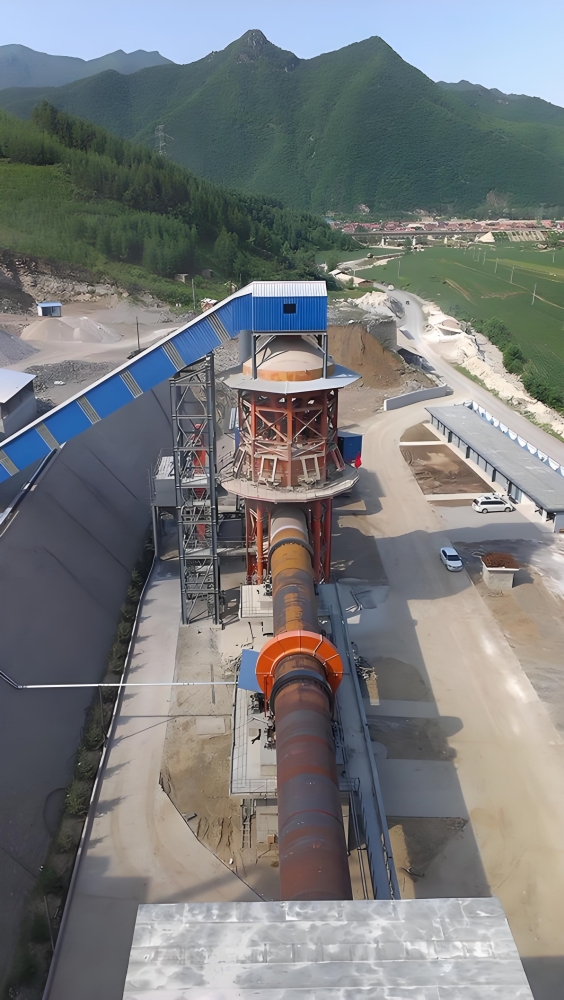
Limestone crushing or screening equipment
Feeding system
Rotary kiln or other calcination equipment
Cooling system
Dust collection equipment
Conveying system
Electrical and control system
One of the key advantages of a complete lime production line is continuous operation. Instead of treating material in isolated steps, the full line allows limestone processing to move from one stage to the next more efficiently. This supports larger industrial output and more stable product quality.
Another important benefit is better process control. When crushing, feeding, calcination, cooling, and discharge are properly matched, the final quicklime quality becomes more consistent. This is especially important in industries where the product must meet specific standards.
The choice of heat source also affects the performance of the line. Depending on local energy conditions and operating cost, different fuels may be used. A suitable heat source helps maintain stable kiln temperature and improve calcination efficiency.
When planning a lime production line, buyers should prepare the following information:
Limestone size and characteristics
Capacity requirement
Heat source condition
Final product requirement
Working hours
Site layout and environmental requirements
A successful lime plant is not built by selecting equipment separately without process coordination. The real value comes from a properly designed line where each section supports the next one. Crushing affects feed stability, feed stability affects calcination, and calcination affects final product quality.
In summary, a lime production line is a complete thermal processing system designed for continuous limestone calcination and quicklime production. Its main value lies in stable operation, better product consistency, and more efficient process control.
At Sentai machinery, we provide lime production line solutions based on material characteristics, production target, and site conditions. A suitable process design helps customers improve calcination efficiency and reduce long-term operating uncertainty.
Planning a lime production line project? Contact Sentai machinery with your limestone size, target capacity, and fuel condition for a practical equipment recommendation.
Related Articles
- What Is a Rotary Kiln and How Does It Work?
- Ceramsite Rotary Kiln Production Line: Process and Benefits


 WhatsApp
 Email
Email
 +86 15538010601