
STCrushers Is A Professional Minging Equipment Manufacturer since 2004, Providing High Quality Crushers, Sand Making Machines, Drying Equipment and more.
STCrushers Is A Professional Minging Equipment Manufacturer since 2004, Providing High Quality Crushers, Sand Making Machines, Drying Equipment and more.
A remote crushing site may need only 20 to 30 tons per hour, yet it still requires careful equipment matching. Limited grid power, irregular road access, a small operating team, and several aggregate sizes can make a compact mobile crushing and screening setup more practical than a permanent line.
The configuration below is a representative application scenario based on common limestone processing conditions. It is intended to explain equipment matching and process logic. It does not describe one specific Sentai Machinery customer project, and the final model selection must still be based on actual material, capacity, product, and site information.
The assumed project handles relatively dry limestone at a temporary or remote work site. The raw stone is generally below about 200 to 250 mm, with limited clay and no large amount of sticky fines. A loader or small excavator feeds the plant.
The target is approximately 20 to 30 tons per hour, depending on feed size, limestone strength, crusher setting, screen performance, and operating continuity. The proposed finished sizes are 0-5 mm, 5-10 mm, and 10-20 mm. Material larger than 20 mm is either returned for another crushing pass or discharged separately, depending on the selected conveyor arrangement.
Design item | Representative assumption |
Raw material | Relatively dry limestone with limited clay |
Maximum feed size | Generally below about 200-250 mm |
Target capacity | Approximately 20-30 TPH |
Finished products | 0-5 mm, 5-10 mm, and 10-20 mm |
Main crusher | Compact jaw crusher |
Power | Diesel engine or diesel generator |
Screening | Multi-deck vibrating screen |
Oversize | Returned for re-crushing or discharged separately |
A jaw crusher is a practical primary crusher for this type of setup because it can accept uneven stone feed and reduce it through compression. The discharge opening can be adjusted within the machine's operating range, allowing the operator to balance output size and capacity.
For a compact mobile line, this direct crushing method keeps the process simple. Limestone is generally easier to crush than granite or basalt, so a small jaw crusher can suit road base, construction aggregate, and general stone-processing duties when the feed is controlled.
The jaw crusher should not be expected to produce every final size by itself. A very small discharge setting can lower capacity, increase wear, and create more fine material. The crusher's job is to provide a suitable size distribution for the screening section that follows.
After crushing, a belt conveyor transfers the material to a multi-deck vibrating screen. The screen separates the mixed crusher discharge into different size ranges. A three-deck screen can be arranged to produce three finished products while the largest oversize stream is returned or handled separately.
The screen openings must follow the local product requirement. For 0-5 mm, 5-10 mm, and 10-20 mm products, the screen needs suitable mesh sizes and enough effective area for the real crusher discharge.
Screening performance changes when the material becomes wet, contains clay, or arrives in an uneven layer. A screen that is adequate for dry limestone may lose efficiency after rain. The feed should spread across the screen width, and blocked mesh should be cleaned before oversize begins entering the wrong product pile.
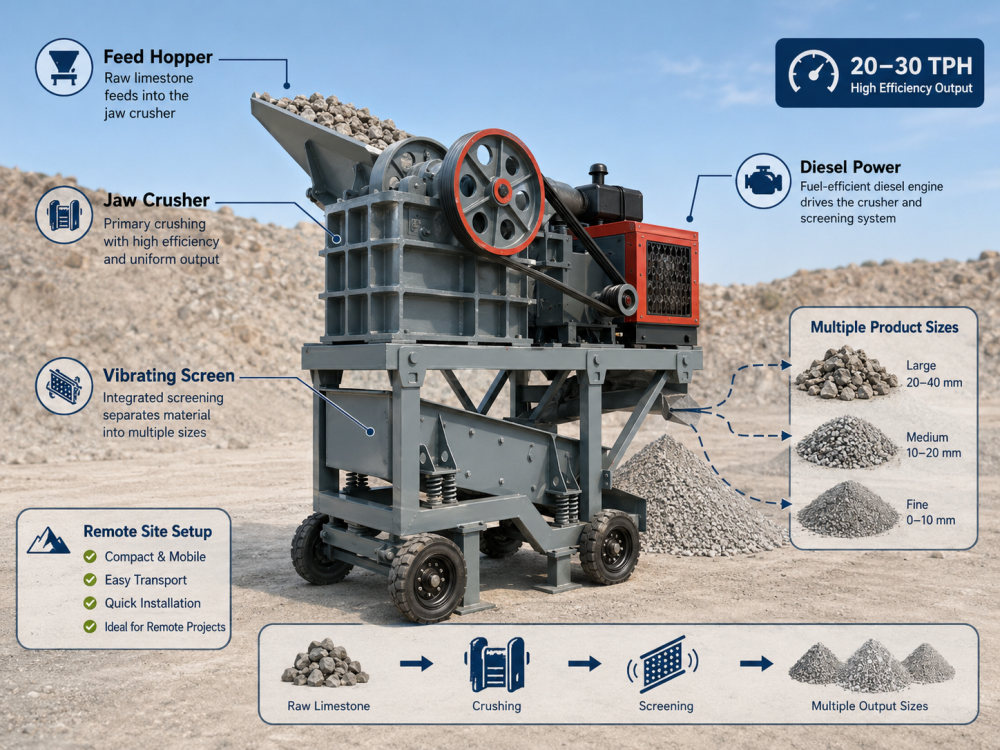
The basic process is: loader feeding, receiving hopper, controlled feeding, jaw crushing, belt conveying, multi-deck screening, and separate product discharge.
When the project requires tighter control of the top size, the oversize stream can return to the jaw crusher. This creates a small closed circuit. The return conveyor and crusher must then be sized for fresh feed plus returned material, not fresh feed alone.
When the project accepts a coarse product above 20 mm, the oversize may be stockpiled instead. This simplifies the layout and reduces circulating load, but it changes the commercial product plan. The decision should be made before the conveyor arrangement is finalized.
Remote sites often lack a stable transformer or practical grid connection. A diesel engine or generator lets the plant operate without permanent electrical infrastructure and supports projects that move between short-term work areas.
Diesel power does not remove operating requirements. Fuel quality, daily fuel supply, cooling, filters, lubrication, battery condition, and routine engine service must be planned. The plant also needs enough ventilation and safe clearance around hot components.
Where reliable grid power is available and the project will remain in one location for a long period, an electric configuration may offer a different operating-cost profile. The power choice should follow site conditions rather than a fixed preference.
The 20 to 30 TPH target is a reference range, not a guaranteed result under every condition. Actual production can fall when raw stones are larger than expected, the loader feeds in large batches, the crusher opening is set too small, or screen mesh becomes blocked.
High return material can also hide the real bottleneck. If too much oversize repeatedly returns, the jaw crusher spends part of its capacity processing the same stone again. The operator may see constant machine movement but less finished product.
Wet clay creates another limit. It can stick in the hopper, interrupt feeding, coat the screen, and mix with fine aggregate. In this situation, the solution may require feed preparation, a different screen arrangement, washing, or a different process rather than simply increasing engine power.
Site condition | Likely effect | First planning response |
Oversized or batch feeding | Crusher load and output fluctuate | Control feed size and feeder rate |
Crusher setting too small | Lower capacity and more fines | Balance discharge target with throughput |
Wet or clay-rich feed | Hopper and screen blockage | Improve feed preparation or process design |
High oversize return | Circulating load consumes crusher capacity | Review screen mesh and product target |
Blocked screen mesh | Product sizes mix and return load rises | Clean mesh and check screen loading |
Poor diesel maintenance | Unstable power or unexpected shutdown | Plan fuel, filters, cooling, and service |
A mobile frame reduces permanent foundation work, but the machine still needs firm and level ground. Soft soil can affect stability, conveyor alignment, and safe loader access. Drainage is important because water collecting below the plant can weaken the working area.
The route into the site must also be checked. Road width, turning radius, slopes, bridge capacity, and overhead clearance may decide whether the unit can enter complete or whether conveyors need separate transport.
Enough space should be reserved for feeding, product piles, maintenance, refueling, and safe movement around the plant. A compact machine placed in a crowded site can still become difficult to operate.
This setup can suit small limestone quarries, road base preparation, rural infrastructure work, temporary construction projects, and scattered material sources. It is useful when several aggregate sizes are needed but a large fixed plant is not justified.
It can also suit contractors who value quick relocation and integrated power. Mobility creates value when it reduces hauling distance, foundation work, or delays caused by unavailable grid power.
The same configuration should not be copied for every rock. Hard and abrasive granite or basalt may require different crusher selection and wear planning. A project requiring high-quality particle shaping may need an impact crusher, VSI sand making machine, or an additional shaping stage.
The setup is also not intended for large continuous quarry production, heavy clay feed, or projects requiring highly precise multi-product classification. A larger stationary line may provide better expansion space, stronger screening, longer conveyors, and more stable stockpile management.
1.Raw material name, photos, and approximate hardness.
2.Maximum and typical feed size.
3.Required hourly capacity.
4.Required finished product sizes and final use.
5.Moisture, clay, and fine content.
6.Whether oversize should return or become a separate product.
7.Available diesel fuel, grid power, or both.
8.Road access, working area, and relocation frequency.
9.Loading method and expected working hours per day.
10.Local dust, noise, and safety requirements.
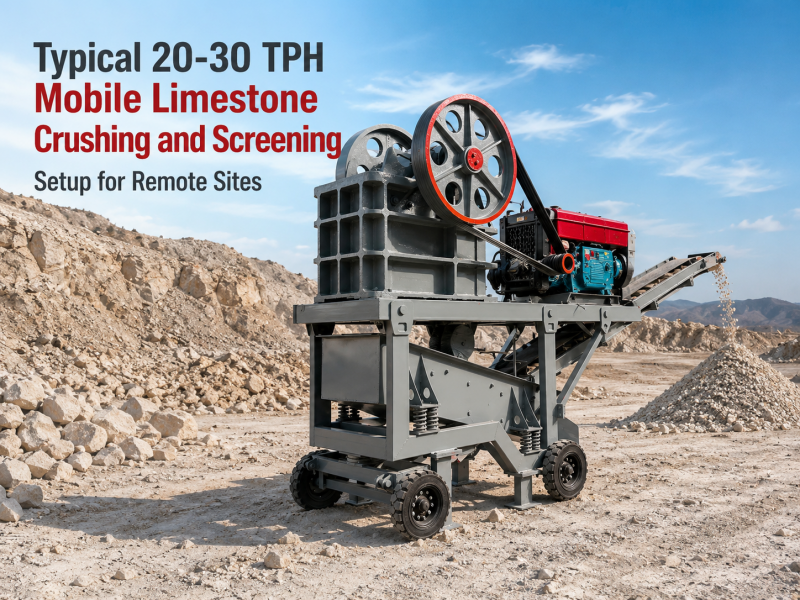
A compact mobile limestone plant can combine feeding, jaw crushing, screening, and product discharge on a transportable structure. For a representative 20 to 30 TPH remote-site project, diesel power and multi-deck screening can provide three aggregate sizes.
The useful design work begins after the reference flow is understood. Feed size, stone condition, product sizes, return load, road access, power, and site layout must be checked before models and conveyor positions are fixed.
Sentai Machinery can review these conditions and prepare a mobile crushing and screening configuration based on the actual project. Send the material photos or video, feed size, capacity, required products, site information, and power condition for a more accurate recommendation.
1. Mobile Crusher Project Planning: When a Portable Crushing Setup Makes More Sense
2. How to Match Jaw Crusher and Vibrating Screen in a Stone Crushing Plant
3. How Feed Size Affects the Performance of a Jaw Crusher
4. Why Does Jaw Crusher Discharge Size Become Unstable
5. What Site Information Should Buyers Provide Before Plant Layout Design
2. Jaw Crushers
 WhatsApp
 Email
Email
 +86 15538010601