
STCrushers Is A Professional Minging Equipment Manufacturer since 2004, Providing High Quality Crushers, Sand Making Machines, Drying Equipment and more.
STCrushers Is A Professional Minging Equipment Manufacturer since 2004, Providing High Quality Crushers, Sand Making Machines, Drying Equipment and more.
In many stone crushing plant projects, the first sign of a problem is not seen on the control cabinet. It is seen on the discharge belt.
The jaw crusher is running. The motor sounds normal. Material is coming out continuously. But the discharge size keeps changing during the day.
Sometimes the crushed material is close to the expected size. Sometimes it becomes too coarse. Sometimes more oversized material reaches the vibrating screen. The return material increases, the secondary crusher load rises, and the whole line becomes harder to control.
At this moment, many operators first check the discharge opening. That is correct, but it is not enough.
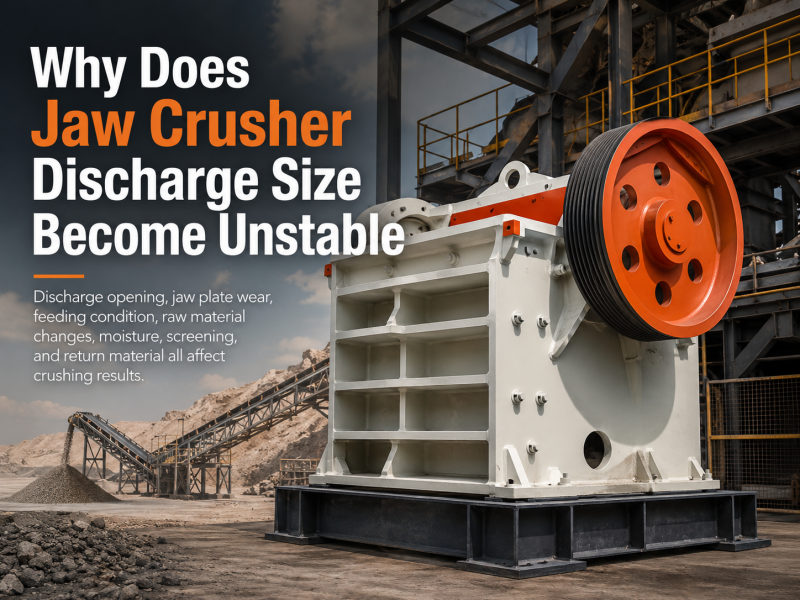
Jaw crusher discharge size is affected by more than one setting. The discharge opening matters, but jaw plate wear, feeding condition, raw material changes, moisture, clay, screen performance, and production rhythm can also make the final output unstable.
For Sentai Machinery, this kind of problem should be diagnosed from the discharge belt backward, not only from the machine nameplate forward.
Before adjusting the crusher, the site team should define the problem clearly.
Does the discharge become coarse after several hours of operation? Does it change when the raw material changes? Does the problem appear only when feeding becomes faster? Does the vibrating screen show more oversized material? Does the secondary crusher current rise at the same time?
These details help separate a machine setting problem from a process balance problem.
If the operator only says "the size is not stable," the cause is hard to judge. But if the site records feed size, discharge opening, jaw plate condition, screen oversize, return material, and hourly output, the problem becomes much clearer.
The discharge opening is the first point to check.
If the setting is too large, the output will naturally become coarser. If the setting is adjusted but not locked properly, the discharge size may change during operation. If the adjustment mechanism is worn or not maintained, the real opening may not match the expected setting.
Some buyers only remember the original setting from the quotation stage. But real production may require adjustment according to material hardness, feed size, required product size, and downstream equipment.
The discharge opening should be checked under actual site conditions, not only based on the model specification.
Jaw plate wear is another common reason for unstable or gradually coarser discharge.
When jaw plates are new, the tooth profile grips and breaks material more effectively. As the plates wear, the crushing surface changes. The material may slip more easily, crushing efficiency may drop, and discharge size may become less controlled.
This change is often slow, so operators may not notice it immediately. They may feel that the same crusher setting no longer gives the same result as before.
If the discharge size becomes worse over time, jaw plate wear should be checked before blaming the whole crusher.
A jaw crusher needs stable feeding.
If too much material enters suddenly, the crushing chamber may become overloaded. The material layer becomes thick, and some particles may pass through with less effective crushing. This can make discharge size unstable.
If feeding is too low or intermittent, the chamber may not stay full enough for steady crushing. The crusher may still run, but the material movement inside the chamber becomes inconsistent.
Good feeding is not only about tons per hour. It is also about feeding rhythm, feed size distribution, and whether the material enters the chamber evenly.
This is why a vibrating feeder or proper feeding control can help improve jaw crusher performance in many stone crushing plants.
Feed size is directly connected with discharge stability.
If the raw material contains pieces that are too large for the jaw crusher opening, the crusher has to work harder. Oversized rocks may block the chamber, create uneven crushing pressure, or force the operator to reduce feeding speed.
Even if the crusher can accept some large pieces, too much oversized feed will reduce stable output and make discharge size harder to control.
This is especially common when raw material comes from blasting or mixed quarry stockpiles. The feed may look normal in general, but occasional large rocks can disturb the whole process.
The same jaw crusher may behave differently with different materials.
Limestone, granite, basalt, river stone, and ore do not break in the same way. Some materials are harder. Some have natural cracks. Some break into flaky pieces. Some contain clay or wet fines that affect movement inside the chamber.
If the raw material changes during the day, discharge size may also change. A crusher setting that works for one material may not produce the same result for another material.
For this reason, buyers should not judge jaw crusher performance without considering raw material behavior.
Moisture and clay are often underestimated.
Wet or muddy material can stick to the chamber, reduce smooth material flow, and affect screening after crushing. When the screen becomes less efficient because of wet fines or clay, more material may return or accumulate. The operator may think the jaw crusher discharge size is unstable, but part of the problem may be after the crusher.
In this case, only adjusting the jaw crusher may not solve the issue. The site may need better feeding control, screening condition improvement, or material stockpile management.
The vibrating screen after the crusher also affects how the problem is seen.
If screen mesh is blocked, worn, or not matched with the required product size, the plant may show more oversize material. The jaw crusher may be blamed, but the screen may be part of the reason.
In a stone crushing plant, crusher and screen should be checked together. If the screen cannot separate material properly, discharge size problems will be amplified in the whole line.
A sudden increase in return material is a useful warning sign.
It may mean the jaw crusher discharge is too coarse. It may also mean the screen is not working efficiently, the secondary crusher is overloaded, or the raw material has changed.
Instead of looking at the jaw crusher alone, the site team should look at the return material ratio and downstream load. This gives a more realistic picture of whether the whole crushing circuit is balanced.
Before making major adjustments, buyers can record these site details.
Site Check | What It Shows | Why It Helps |
Discharge opening | Actual crusher setting | Confirms whether setting has changed |
Jaw plate condition | Wear level and tooth profile | Shows whether crushing grip is reduced |
Feed size | Largest and average raw material size | Helps judge chamber load |
Feeding rhythm | Continuous or uneven feeding | Shows whether the chamber is stable |
Material condition | Hardness, moisture, clay, cracks | Explains behavior changes |
Screen condition | Mesh wear or blockage | Checks downstream separation |
Return material ratio | Oversize load in the circuit | Shows system balance |
Motor current | Crusher load change | Helps identify overload or unstable feed |
This record is more useful than adjusting the crusher blindly.
Jaw crusher discharge size is not controlled by one setting alone.
The discharge opening is important, but unstable output may also come from jaw plate wear, oversized feed, uneven feeding, raw material changes, moisture, clay, screen condition, and return material pressure.
For buyers, the better question is not only "How do I adjust the jaw crusher discharge opening?" A more useful question is "What is changing from feeding to screening that makes the discharge size unstable?"
When the problem is checked from the discharge belt backward, the site team can find the real cause faster and keep the stone crushing plant more stable.
If your jaw crusher discharge size is unstable, Sentai Machinery can help review the problem according to your raw material, feed size, jaw plate condition, discharge opening, screen performance, return material ratio, and production target.
Send us your material photos or videos, crusher model, current discharge size, required product size, and site running condition. Our team can help analyze the possible cause and recommend a suitable crushing and screening solution.
1. How Feed Size Affects the Performance of a Jaw Crusher
2. How to Match Jaw Crusher and Vibrating Screen in a Stone Crushing Plant
3. Why Return Material Ratio Matters in a Stone Crushing Plant
4. What Buyers Often Ignore When Choosing a Vibrating Screen
5. What Determines Finished Aggregate Shape in an Impact Crushing Process

 WhatsApp
 Email
Email
 +86 15538010601