
STCrushers Is A Professional Minging Equipment Manufacturer since 2004, Providing High Quality Crushers, Sand Making Machines, Drying Equipment and more.
STCrushers Is A Professional Minging Equipment Manufacturer since 2004, Providing High Quality Crushers, Sand Making Machines, Drying Equipment and more.
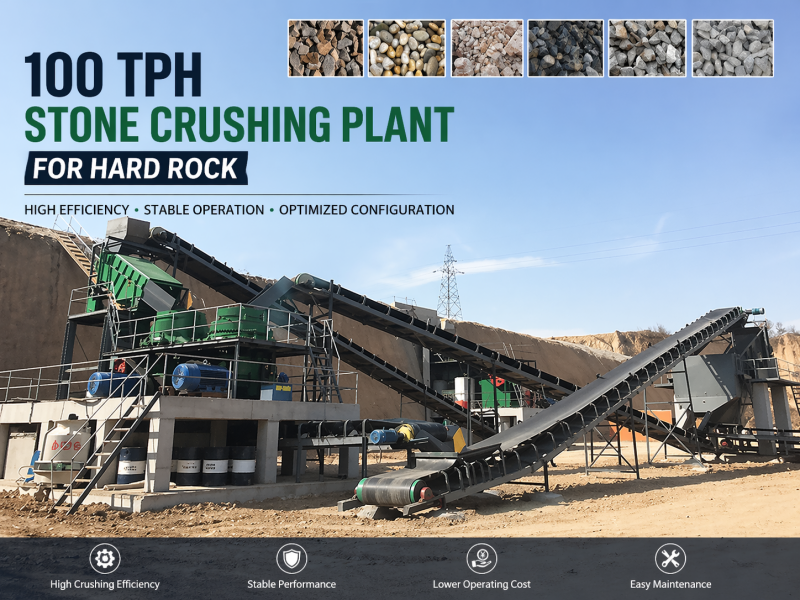
Many buyers start a project discussion by saying, "I need a 100 TPH stone crushing plant" or "I need a sand making line."
This information is important, but it is not enough for plant layout design.
A production line is not only a list of machines. It must fit into a real site. The raw material needs to enter from one direction. Finished products need space for storage or truck loading. Belt conveyors need enough length and height. Power supply, foundation, roads, water, and dust control all affect the final layout.
For Sentai Machinery, when we design a plant layout for an overseas buyer, we need to understand not only capacity and material, but also the project site. A good layout should make the equipment easier to install, operate, maintain, and expand if needed.
Some buyers only provide material name and required capacity. For example, they may say they need to process limestone at 100 tons per hour or make sand from river stone.
This is a good start, but layout design needs more information.
Two buyers may need the same capacity, but their layouts may be completely different. One site may be long and narrow. Another may be square. One site may have raw material stored on the left side, while another may receive material from trucks at the back. One project may need several finished product sizes, while another only needs one main product.
If these site conditions are not clear, the layout may look good on paper but become difficult to install or operate in real production.
The first thing to confirm is the available land size.
A complete plant needs space for feeding, crushing, screening, conveying, storage, maintenance, and truck movement. If the site is too small or irregular, the equipment arrangement must be adjusted.
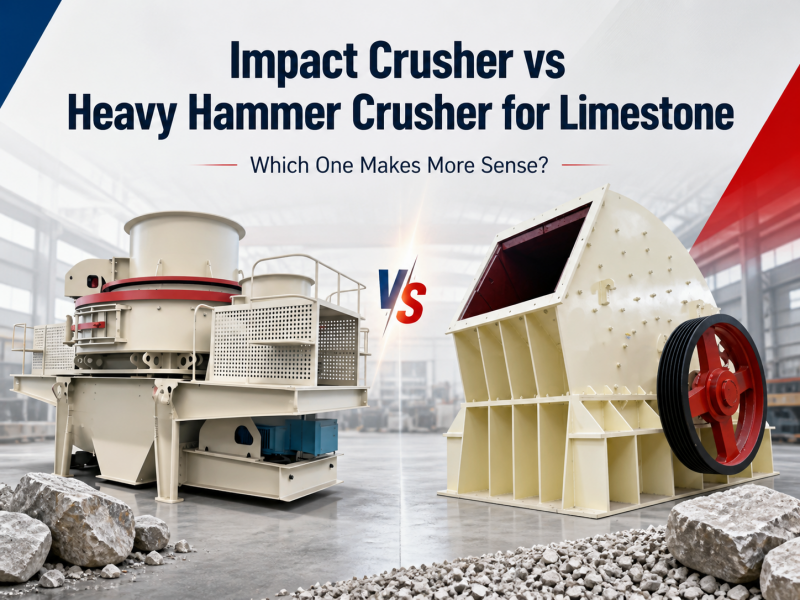
For a stone crushing plant, the layout may include jaw crusher, impact crusher or cone crusher, vibrating screen, belt conveyors, and product piles. For a sand making plant, it may also include sand maker, washing machine, dewatering screen, fine sand recovery system, and water treatment area.
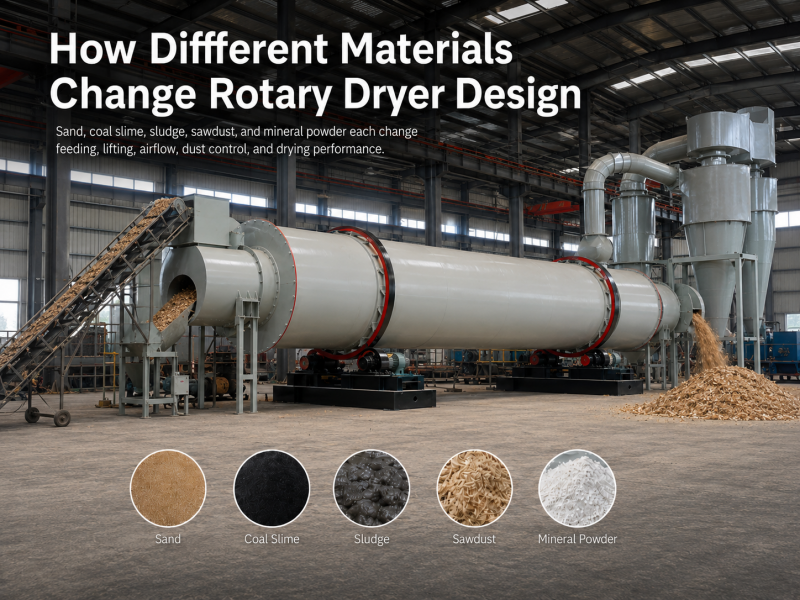
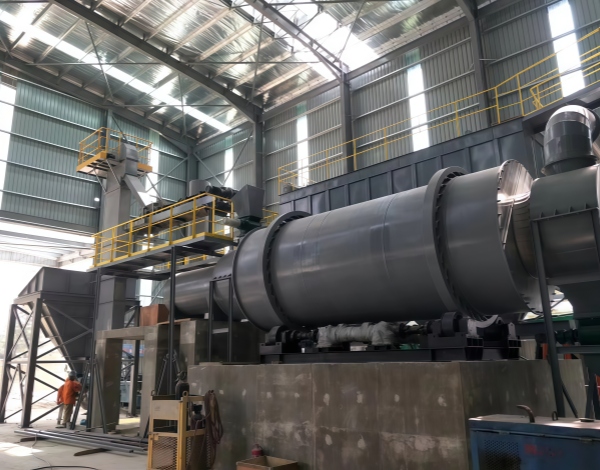
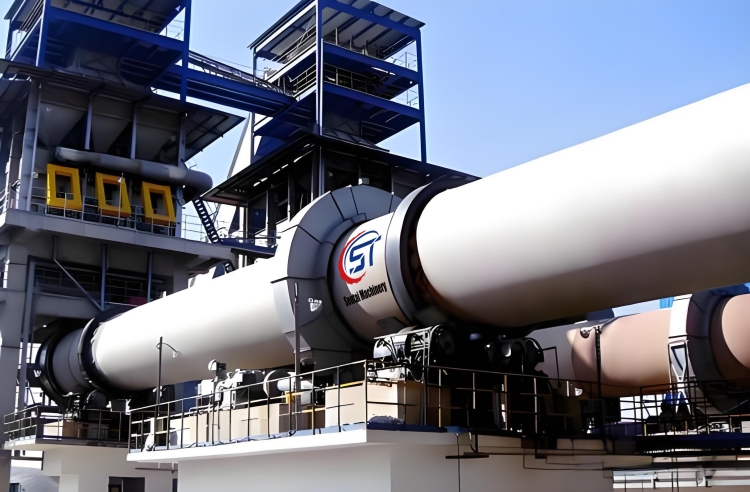
For a rotary kiln or rotary dryer project, the site must allow enough length for the drum body, feeding system, discharge system, duct connection, dust collection, and foundation.
A simple site sketch with length, width, entrance direction, and available installation area can help a lot.
Raw material feeding position affects the whole layout.
Buyers should confirm where the raw material will come from. Will it be loaded by wheel loader, excavator, truck, or belt conveyor? Is the raw material pile already fixed at the site? Is there enough space for trucks to turn around and feed the hopper?
If the feeding direction is not considered early, the plant may need longer conveyors or extra turning points. This can increase cost and make the layout more complicated.
For crushing and sand making plants, feeding height and hopper position are also important. The feeding system should match the site and the loading method.
Finished product storage is often ignored during early discussion.
A plant may produce several product sizes. Each size needs a discharge conveyor and enough storage area. If the buyer wants to load finished products directly into trucks, the conveyor height and truck access should be considered.
For sand making projects, the buyer should also confirm whether the final sand will be dry, washed, or dewatered. Wet sand may need a different storage method from dry aggregate.
If product piles are too close to each other, different sizes may mix. If the storage area is too small, the plant may need frequent loading and clearing, which affects production efficiency.
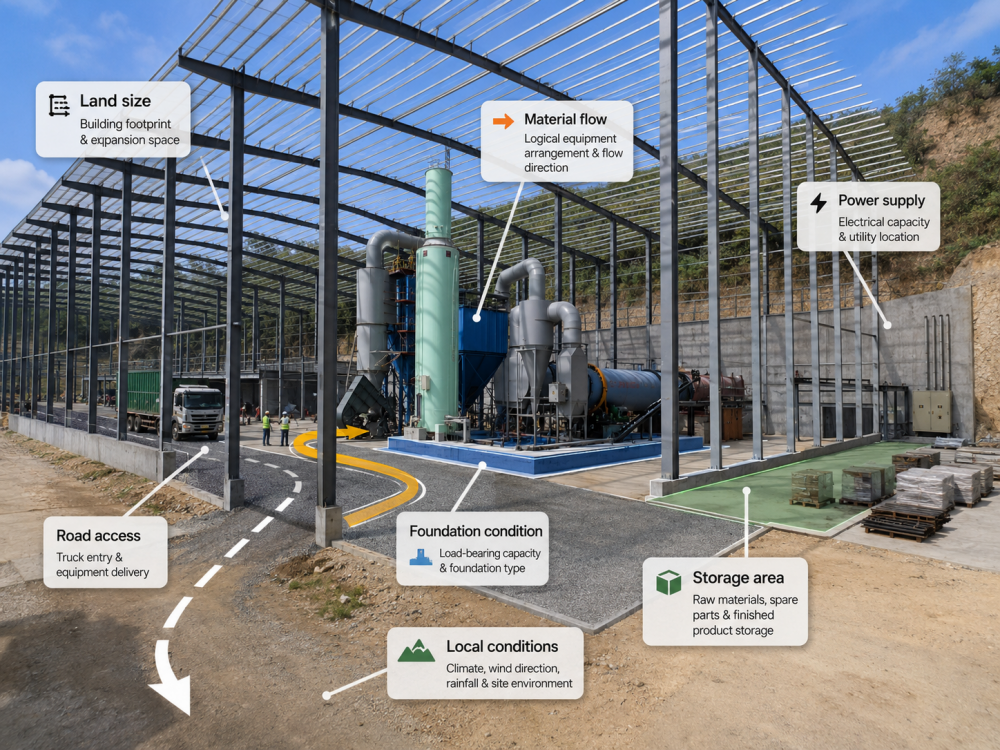
Power supply is another key point.
The buyer should confirm the available voltage, frequency, transformer capacity, and distance from the power source to the equipment area. Some projects need a control cabinet or centralized control room. If the power condition is not clear, electrical design may be delayed.
Water source is important for sand washing plants, ore processing plants, and some dust control systems. The buyer should confirm water availability, water circulation requirement, and mud treatment space.
For rotary dryer or rotary kiln projects, fuel condition is also important. The available fuel type, fuel supply position, and heat source arrangement can affect layout design.
Heavy machinery needs a stable foundation.
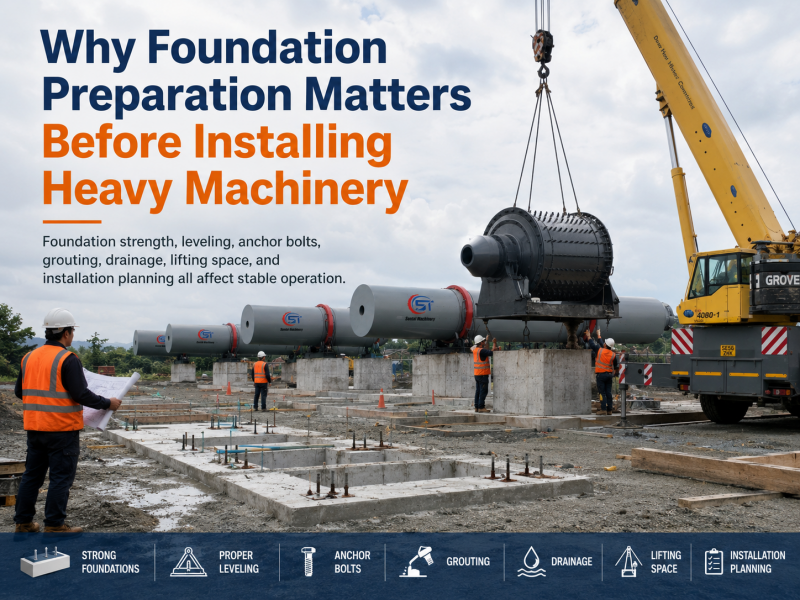
Before layout design, buyers should consider ground condition, soil bearing capacity, drainage, and whether concrete foundation work is possible. Machines such as jaw crushers, ball mills, rotary dryers, and rotary kilns are heavy and create dynamic load during operation.
If the foundation position is not planned properly, installation may become difficult later. For overseas projects, it is better to confirm foundation drawings and site preparation before the equipment arrives.
A good layout should leave enough space for foundation construction, equipment lifting, and future maintenance.
Many equipment delivery and installation problems come from site access.
The buyer should confirm whether trucks can enter the site, whether large machines can be unloaded, and whether a crane can work safely. Some equipment parts are long, heavy, or high. If the road is narrow or the installation area is blocked, unloading may become difficult.
Maintenance space should also be considered. Operators need space to change screen mesh, replace wear parts, check belts, inspect motors, and clean material around the machine.
A layout that only fits the machines but leaves no maintenance space is not practical.
Different sites may have different environmental requirements.
For crushing and screening plants, dust control may require water spray, sealing, dust collector, or better conveyor transfer design. For drying and calcining projects, dust collection, duct layout, fan position, and discharge handling are important.
Noise, drainage, nearby buildings, local rules, and working hours may also affect layout design.
Buyers do not need to solve every technical detail before quotation, but they should inform the supplier if there are special site restrictions.
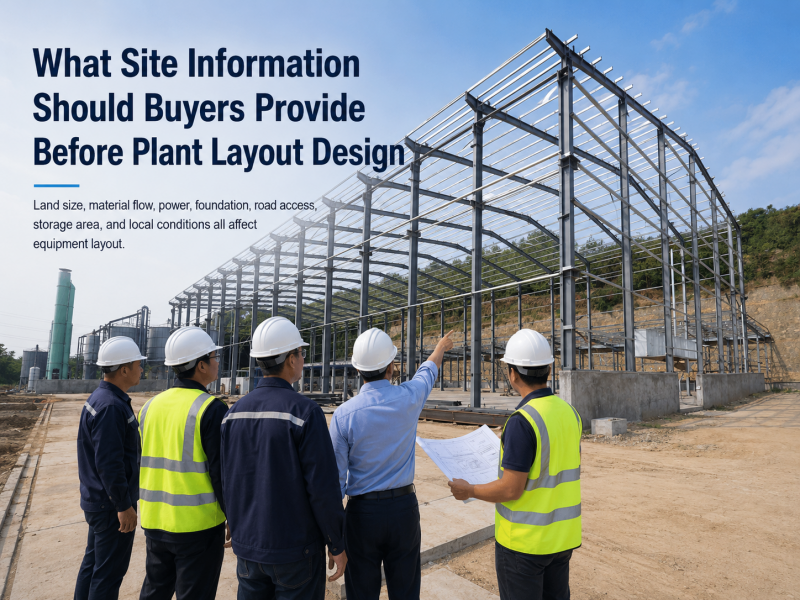
Before layout design, buyers can prepare the following information.
Site Information | Why It Matters |
Site length and width | Helps decide equipment arrangement |
Raw material feeding position | Affects hopper and conveyor direction |
Finished product storage area | Affects discharge conveyor layout |
Road and truck access | Affects unloading, feeding, and product transport |
Power supply position | Affects cable and control system design |
Water source | Important for washing, ore processing, and dust control |
Ground condition | Affects foundation design |
Existing buildings or obstacles | Affects machine and conveyor placement |
Local dust or noise requirements | Affects environmental control design |
Photos or videos of the site | Helps supplier understand real conditions |
Buyers do not need to provide perfect engineering drawings at the beginning. Simple information can already help.
Useful materials include site photos, drone photos, hand drawn sketches, land size, raw material pile location, road direction, power room location, and expected finished product area.
A short video walking around the site can also help the supplier understand space, height, road access, and nearby conditions.
For overseas projects, this early communication can reduce layout changes later.
Plant layout design is not only about arranging machines.
A practical layout must match the real site. Capacity, equipment model, and process flow are important, but site size, feeding direction, storage area, power, water, foundation, road access, and environmental requirements also decide whether the plant can be installed and operated smoothly.
For buyers, the better question is not only "What equipment do I need?" A more useful question is "What site information should I provide so the plant can be designed correctly?"
When the supplier understands the site clearly, the layout becomes more realistic, the quotation becomes more accurate, and the project becomes easier to move forward.
If you are planning a stone crushing plant, sand making plant, ore processing plant, rotary dryer line, or rotary kiln calcining plant, Sentai Machinery can help design the layout according to your material, capacity, site size, feeding method, power condition, and project requirements.
Send us your site photos, land size, material information, required capacity, and finished product plan. Our team can help evaluate a practical equipment layout for your project.
1. What Photos and Documents Should Be Prepared Before Overseas Equipment Shipment
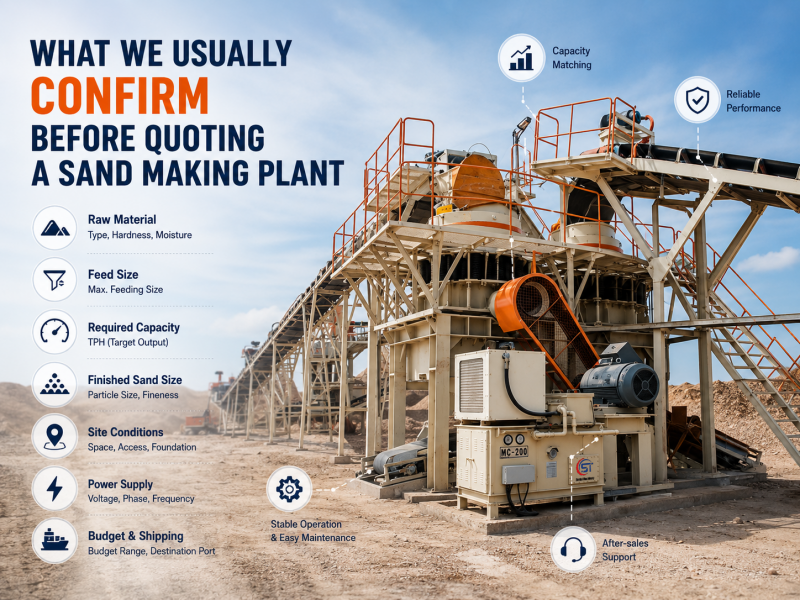
2. What We Usually Confirm Before Production Starts
3. How to Choose Equipment for a Stone Crushing Plant
4. How to Choose Equipment for a Sand Making Plant
5. Why Rotary Kiln Output Is Not Only Decided by Kiln Size
1. Stone Crusher Plant
2. Sand Making Plant
3. Beneficiation Plant
4. Material Calcining Plant
 WhatsApp
 Email
Email
 +86 15538010601