
STCrushers Is A Professional Minging Equipment Manufacturer since 2004, Providing High Quality Crushers, Sand Making Machines, Drying Equipment and more.
STCrushers Is A Professional Minging Equipment Manufacturer since 2004, Providing High Quality Crushers, Sand Making Machines, Drying Equipment and more.
Many buyers begin with a simple question: I have gold ore. What equipment do I need for a small processing plant?
This is a common starting point, but it is not enough for a reliable equipment recommendation.
A small gold ore processing plant may look simple from the outside. It may include crushing, grinding, classification, separation, and supporting equipment. But the actual process route depends on the ore. Some gold ore may be suitable for gravity separation. Some may need flotation. Some may need both. Some ore can be processed with a relatively simple line, while other ore needs more testing before equipment is selected.
For Sentai Machinery, when we discuss a gold ore project with an overseas buyer, we do not only ask about capacity. We need to understand the ore type, feeding size, gold particle condition, target recovery method, water and power supply, and site layout.
The equipment list should follow the ore, not the other way around.
Capacity is important, but it cannot decide the full process alone.
For example, two buyers may both ask for a 5 tons per hour gold ore processing plant. One ore may contain coarse gold that can be recovered partly by gravity separation. Another ore may contain fine gold that needs grinding and flotation. The equipment configuration will not be the same.
If the buyer only provides capacity, the supplier can only make a rough suggestion. To design a more practical plant, the supplier needs to know what kind of gold ore is being processed and what final result the buyer expects.
A small plant should not be designed only by copying a standard list. It should be matched with the actual ore condition.
Gold ore is not always the same.
Some gold ore is associated with quartz. Some may be mixed with sulfide minerals. Some may contain visible coarse gold. Some may contain very fine gold that is difficult to recover without proper grinding and separation.
If the gold is coarse and free, gravity separation may play an important role. If the gold is fine or closely associated with other minerals, flotation may be needed. If the ore contains complex mineral composition, more test work may be required before selecting the process.
This is why buyers should provide ore photos, basic analysis, or test results if available. Even simple information can help the supplier judge whether the plant should focus on gravity separation, flotation, or a combined process.
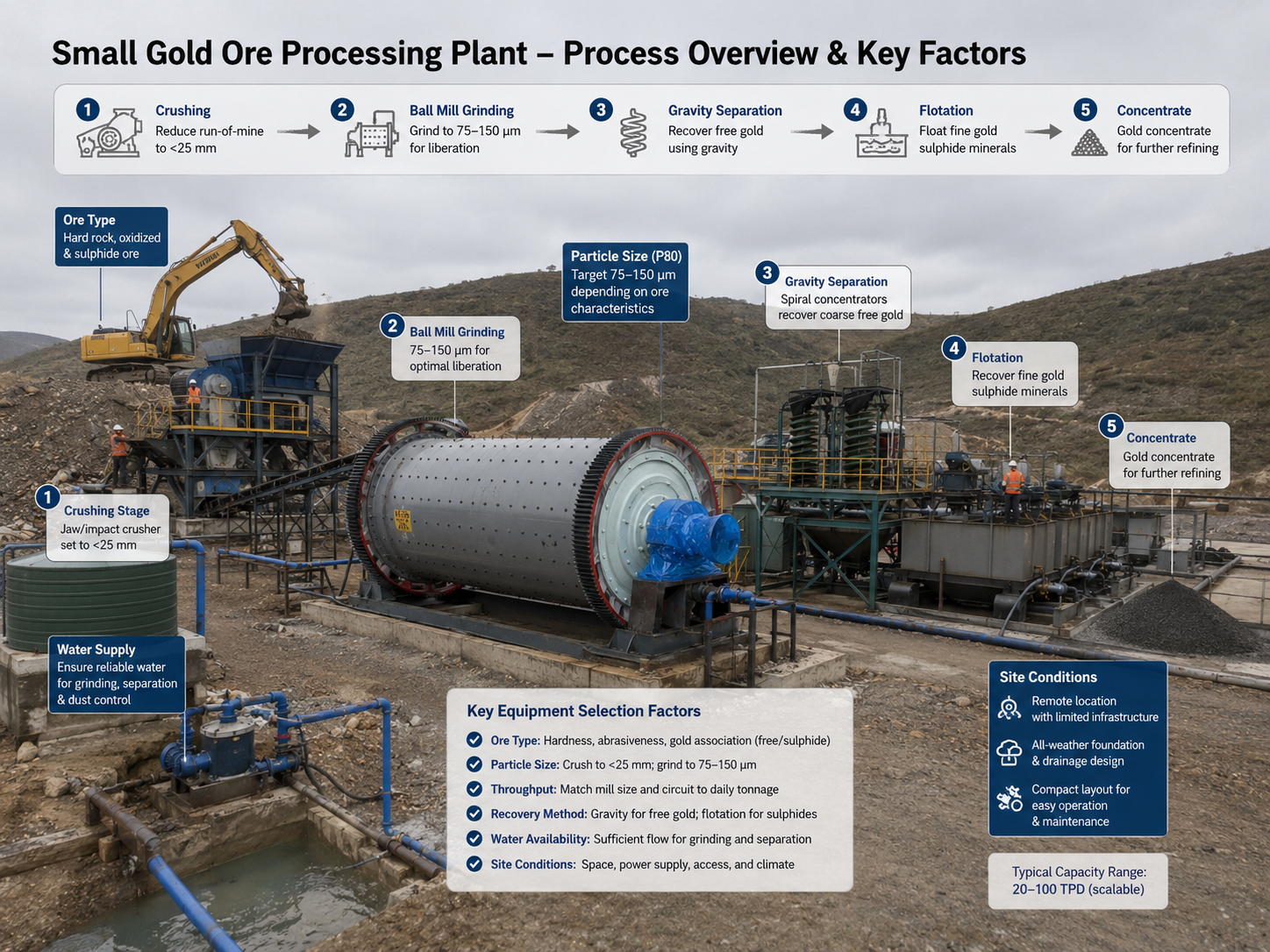
Before gold ore enters the ball mill, it usually needs crushing.
For a small plant, jaw crusher is commonly used for primary crushing. Depending on the feeding size and required output size, secondary crushing or screening may also be needed.
If the crushed material is too large, the ball mill will have a heavier load. This can reduce grinding efficiency, increase power consumption, and reduce practical capacity. If the crushing stage is properly matched, the ball mill can work more smoothly.
This is why the crushing section should not be ignored. It directly affects the cost and stability of the grinding section.
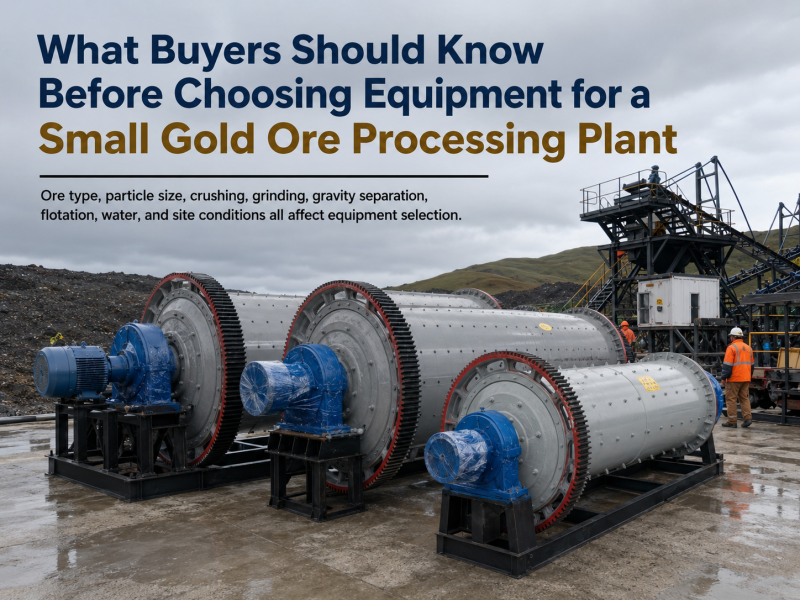
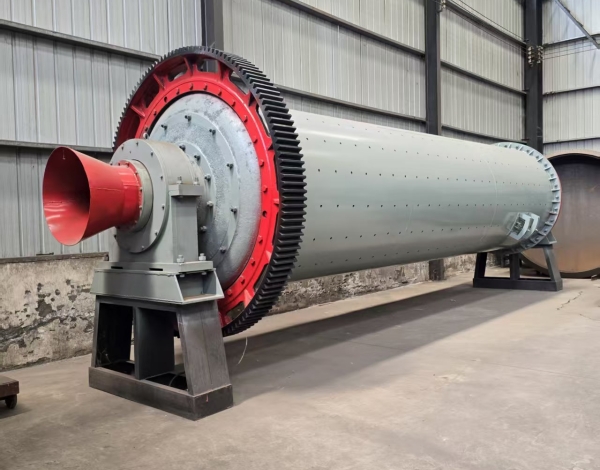
In many gold ore processing plants, a ball mill works with a spiral classifier or other classification equipment. The ball mill grinds the ore, while the classifier separates fine particles from coarse particles.
Fine particles can move forward to the next separation stage. Coarse particles return to the ball mill for further grinding.
If the classifier is too small or poorly matched, the whole grinding system may become unstable. Too much return sand can increase ball mill load. Unstable overflow fineness can affect gravity separation or flotation results.
For small gold ore projects, buyers should not choose the ball mill alone. The grinding and classification system should be considered together.
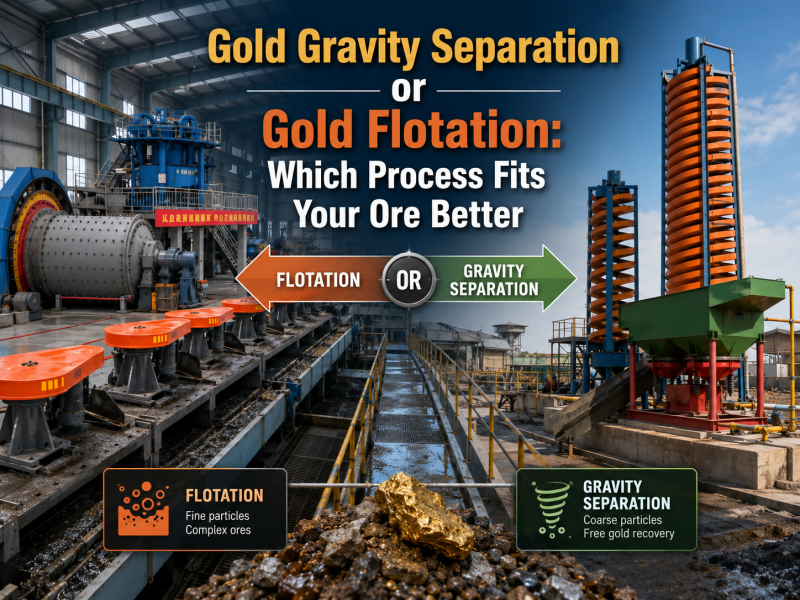
One of the most important questions is whether the plant should use gravity separation, flotation, or both.
Gravity separation is often used when there is a useful amount of free gold or coarse gold. It may use equipment such as jig, shaking table, or other gravity equipment. It can be simple and practical for some small projects.
Flotation is often used when gold is fine or associated with sulfide minerals. In this case, the ore usually needs suitable grinding fineness before flotation. The flotation machine, slurry condition, and process control become important.
Some plants may use gravity separation first to recover coarse gold, then flotation for fine gold. The final choice should depend on ore testing and project goals.
Small gold ore processing plants still need stable site conditions.
Wet grinding, classification, gravity separation, and flotation all need water. If the site has limited water supply, water circulation and tailings handling should be considered early.
Power supply is also important. The buyer should confirm voltage, frequency, transformer capacity, and whether the site can support crushers, ball mill, classifier, pumps, and flotation machines.
Site layout also affects equipment selection. The plant needs space for feeding, crushing, grinding, separation, tailings, water circulation, and maintenance. If the site is small or remote, the layout should be simple and practical.
Factor | Why It Matters | What Buyers Should Provide |
Ore type | Decides process direction | Ore photos or test data |
Feeding size | Affects crusher selection | Maximum raw ore size |
Required capacity | Affects equipment model | Tons per hour or per day |
Grinding fineness | Affects recovery method | Target mesh size if known |
Gold particle condition | Affects gravity or flotation choice | Visible gold or fine gold information |
Water supply | Affects wet processing | Water source and circulation plan |
Power condition | Affects motor and control design | Voltage and available power |
Site layout | Affects plant arrangement | Photos, land size, and access road |
Before recommending equipment for a small gold ore processing plant, Sentai Machinery usually needs to confirm several details.
1. What is the raw ore type?
2. What is the maximum feeding size?
3. What capacity is required?
4. Is there any ore test result?
5. Is the gold coarse, fine, or associated with other minerals?
6. Is gravity separation, flotation, or combined process expected?
7. What water source is available?
8. What power condition is available at the site?
9. Does the buyer need single machines or a complete line?
10. Are there any site space or installation limits?
A small gold ore processing plant should not be selected only by capacity or by a fixed equipment list.
The ore condition decides the process. Crushing size affects grinding cost. Ball mill and classifier matching affects fineness stability. Gravity separation and flotation should be selected according to gold particle condition and recovery goal. Water, power, and site layout also affect the final plant design.
For buyers, the better question is not only "What equipment do I need?" A more useful question is "What information should I provide so the process can match my gold ore?"
When the process route and equipment are selected according to real ore conditions, the plant becomes more practical, stable, and easier to operate.
If you are planning a small gold ore processing project, Sentai Machinery can help evaluate the equipment configuration according to your ore type, feeding size, capacity, water condition, power supply, and site layout.
Send us your ore photos, feeding size, required capacity, available test results, and project site information. Our team can help recommend a suitable crushing, grinding, classification, and beneficiation solution for your gold ore project.
1. Iron Ore Beneficiation Plant: Key Equipment and Process Flow
2. What Buyers Often Miss When Matching a Ball Mill and Spiral Classifier
3. Ball Mill vs Rod Mill: Which One Should You Choose for Your Plant?
4. How Grinding Stability Affects Flotation Performance
5. What Site Information Should Buyers Provide Before Plant Layout Design
 WhatsApp
 Email
Email
 +86 15538010601