
STCrushers Is A Professional Minging Equipment Manufacturer since 2004, Providing High Quality Crushers, Sand Making Machines, Drying Equipment and more.
STCrushers Is A Professional Minging Equipment Manufacturer since 2004, Providing High Quality Crushers, Sand Making Machines, Drying Equipment and more.
Some buyers believe that if the rotary kiln is large enough and the temperature is high enough, the calcination result will be stable.
In real projects, this is not always true.
A rotary kiln is the main calcining equipment, but it cannot solve every problem caused by poor raw material preparation. If the material enters the kiln with uneven particle size, high moisture, unstable feeding, poor mixing, or too many impurities, the kiln may still run, but the final result can become unstable.
For Sentai Machinery, when we discuss a rotary kiln project with an overseas buyer, we do not only ask about capacity and kiln size. We also need to understand what material will enter the kiln and how it is prepared before calcination.
Good raw material preparation helps the rotary kiln work more steadily. Poor preparation can make even a suitable kiln difficult to operate.
Many buyers start with questions such as:
"What kiln size do I need?"
"What is the price of a rotary kiln for calcination?"
"Can this kiln reach the required temperature?"
These questions are important, but they are not enough.
For calcination, the raw material condition can change the whole process. The same rotary kiln may perform differently when processing limestone, kaolin, bauxite, zinc oxide material, sponge iron material, cement raw material, or ceramsite material.
Even within the same material type, different preparation conditions can lead to different results. For example, limestone with uniform size may calcine more evenly. Limestone with too many large and small pieces mixed together may create uneven burning. Kaolin with unstable moisture may affect later calcination quality. Bauxite or mineral materials with many impurities may require more careful process control.
So the kiln model should be selected together with the raw material condition, not separately.
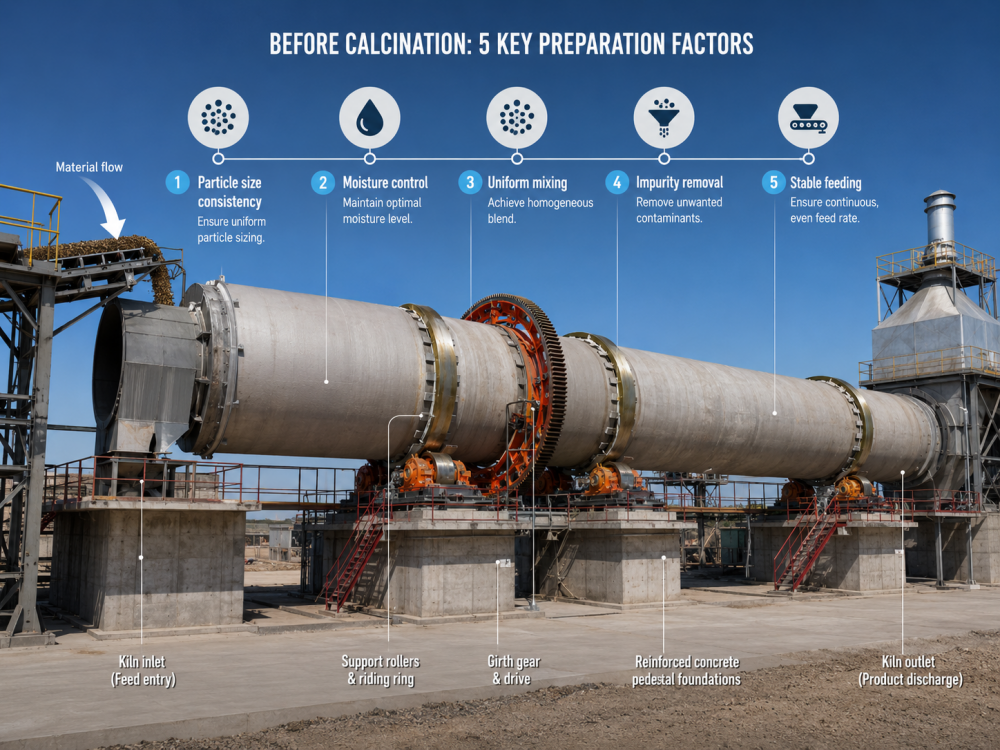
Particle size is one of the first things to check before rotary kiln calcination.
If the particles are too large, heat may not reach the inside evenly. The outside may be overburned while the inside is not fully calcined. This can affect product quality and increase fuel consumption.
If the particles are too fine, the material may create dust, move too quickly with airflow, or affect the stability of kiln feeding. Fine powder may also increase the load of dust collection and gas treatment systems.
If the particle size range is too wide, the kiln becomes harder to control. Large particles and fine particles do not heat at the same speed. This can lead to uneven final product quality.
For this reason, crushing, screening, or pre-sizing may be needed before the material enters the rotary kiln. The goal is not simply to make the material smaller. The goal is to make the feeding condition more stable and suitable for calcination.
Moisture is another key factor.
If the raw material has high moisture, part of the heat inside the kiln must first be used to evaporate water. This can increase fuel consumption and reduce effective calcination efficiency. If moisture changes greatly from batch to batch, the kiln temperature and production stability may also fluctuate.
For some materials, drying before calcination is very important. For example, kaolin, mineral powder, sludge based material, and some ore materials may need moisture reduction before entering the kiln. If the material is too wet, it may stick, form lumps, block feeding equipment, or affect smooth movement inside the kiln.
This is why rotary dryer and rotary kiln systems are sometimes considered together. The dryer prepares the material condition before the kiln, while the kiln completes the high temperature treatment.
For some calcination projects, the raw material is not a single simple material. It may require blending, proportioning, or adding auxiliary materials.
If the mixture is not uniform, different parts of the material may react differently inside the kiln. Some areas may need more heat, while others may be overtreated. This can reduce product consistency.
In cement related materials, ceramsite production, some metallurgical materials, and chemical mineral projects, raw material mixing can be very important. Even if the kiln temperature looks normal, poor mixing before feeding may still cause unstable final product.
This is why raw material preparation should be seen as part of the complete calcining system, not only as work before production.
A rotary kiln needs stable feeding.
If the feeding amount changes too much, the material layer inside the kiln changes. This affects residence time, heat contact, flame control, and discharge quality.
Too much feeding may reduce calcination time and cause incomplete treatment. Too little feeding may waste heat and reduce production efficiency. Unstable feeding may also make the operator adjust the system frequently.
For better kiln operation, the feeding system should match the material condition. Some materials need a belt feeder, screw feeder, bucket elevator, or other supporting equipment. The exact choice depends on material size, moisture, flowability, and plant layout.
Impurities are often ignored during early project discussion.
For limestone calcination, impurities may affect lime quality. For kaolin calcination, iron content and other impurities may affect whiteness and product value. For bauxite, zinc oxide material, or sponge iron related projects, impurity control can influence process result and downstream use.
The rotary kiln can provide heat and residence time, but it cannot remove every raw material problem. If the incoming material quality is not stable, the final product will also be difficult to keep stable.
Before designing a calcination project, the buyer should provide material analysis if possible. Even a basic analysis can help the supplier judge whether the process design is reasonable.
Before recommending a rotary kiln configuration, Sentai Machinery usually needs to confirm the following information.
1.What material will be calcined?
2.What is the required capacity?
3.What is the feeding particle size?
4.What is the moisture content before calcination?
5.Is the material powdery, granular, sticky, or lumpy?
6.Is pre-drying needed before the kiln?
7.Are there impurities that affect final product quality?
8.What final product is required after calcination?
9.What fuel is available locally?
10.Does the project need a complete calcining plant layout?
These details help avoid wrong selection. They also help the supplier judge whether supporting equipment is needed before or after the kiln.
The table below shows several raw material conditions and the related preparation focus.
Raw Material Condition | Possible Kiln Problem | Preparation Focus |
Particle size too large | Incomplete calcination inside particles | Crushing or size control |
Too much fine powder | Dust and unstable airflow | Screening or dust control design |
High moisture | Higher fuel use and feeding difficulty | Pre-drying or moisture control |
Uneven mixing | Unstable product quality | Better blending before feeding |
Sticky material | Feeding blockage or lump formation | Drying and feeding system adjustment |
Unstable material quality | Difficult kiln control | Material testing and process confirmation |
This table does not replace detailed engineering design, but it shows why the kiln body is only one part of the full calcination process.
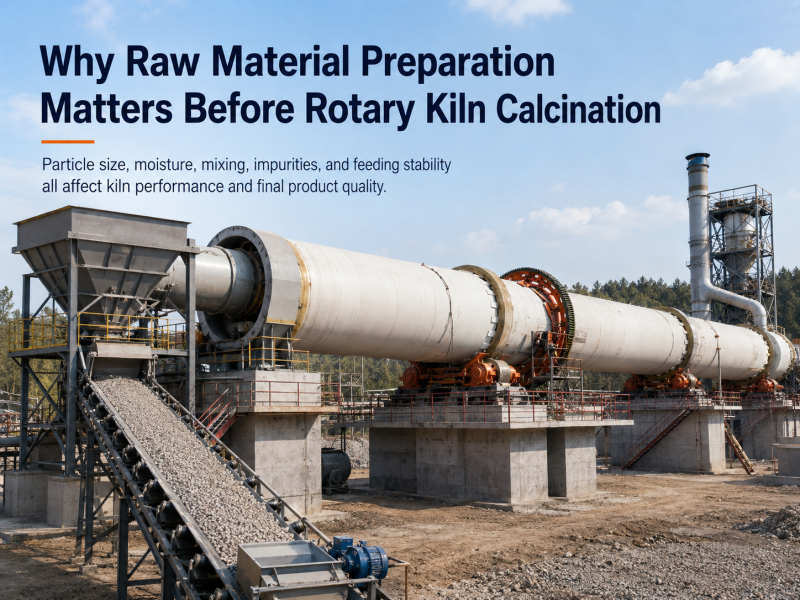
A rotary kiln is important, but stable calcination starts before the material enters the kiln.
Particle size, moisture, mixing, impurities, and feeding stability all affect how the material behaves inside the kiln. If these conditions are not controlled, the buyer may face unstable temperature, uneven calcination, higher fuel consumption, or inconsistent final product.
For buyers, the better question is not only "Which rotary kiln model should I choose?" A more useful question is "Is my raw material ready for stable calcination?"
When raw material preparation and rotary kiln design are considered together, the whole calcining plant becomes easier to operate and more reliable.
If you are planning a rotary kiln calcination project, Sentai Machinery can help evaluate the process according to your raw material, particle size, moisture, capacity, fuel condition, and final product requirement.
Send us your material information, photos, test data if available, and expected production goal. Our team can help recommend a suitable rotary kiln configuration and supporting equipment for your calcining plant.
Related Articles:
1. Rotary Kiln for Limestone Calcination: Process and Equipment
2. 5 Common Mistakes Buyers Make When Choosing a Rotary Kiln
3. Why Wet Material Condition Matters More Than Dryer Model Alone
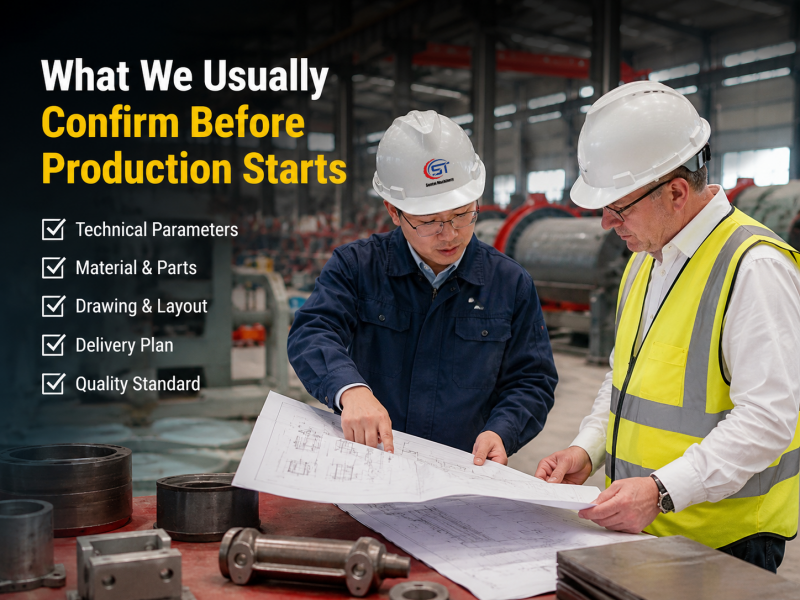
4. What We Usually Confirm Before Production Starts
5. What Photos and Documents Should Be Prepared Before Overseas Equipment Shipment
Suggested Solutions:

 WhatsApp
 Email
Email
 +86 15538010601