
STCrushers Is A Professional Minging Equipment Manufacturer since 2004, Providing High Quality Crushers, Sand Making Machines, Drying Equipment and more.
STCrushers Is A Professional Minging Equipment Manufacturer since 2004, Providing High Quality Crushers, Sand Making Machines, Drying Equipment and more.
Many buyers ask a simple question when planning a sand making plant: which sand making machine can produce good sand?
This question is understandable, but it is not complete.
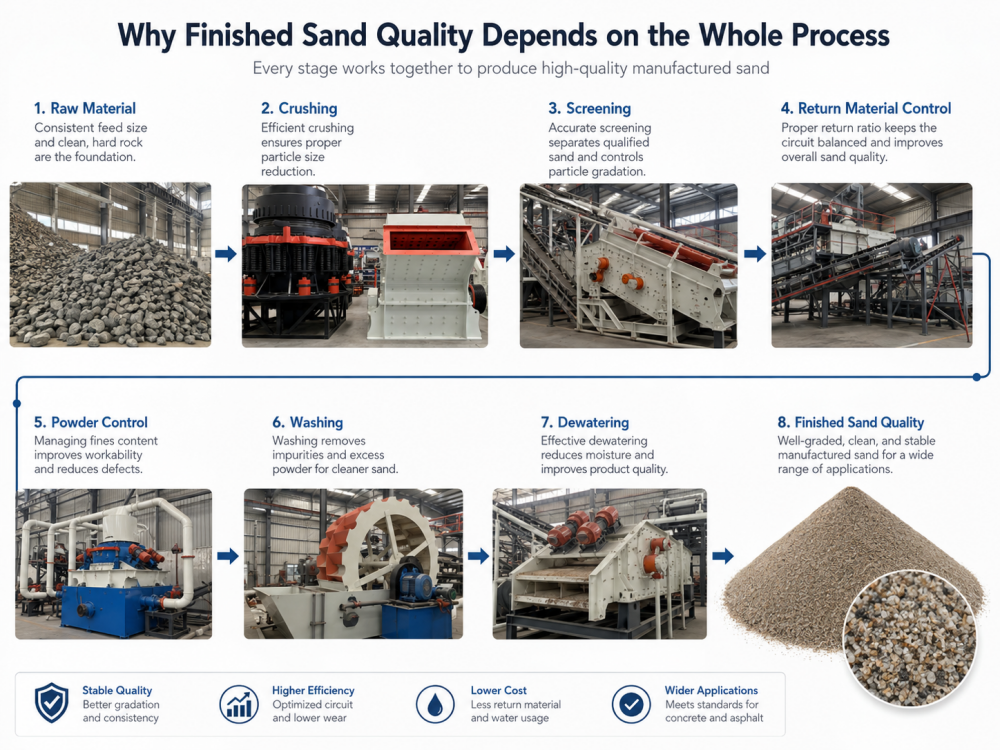
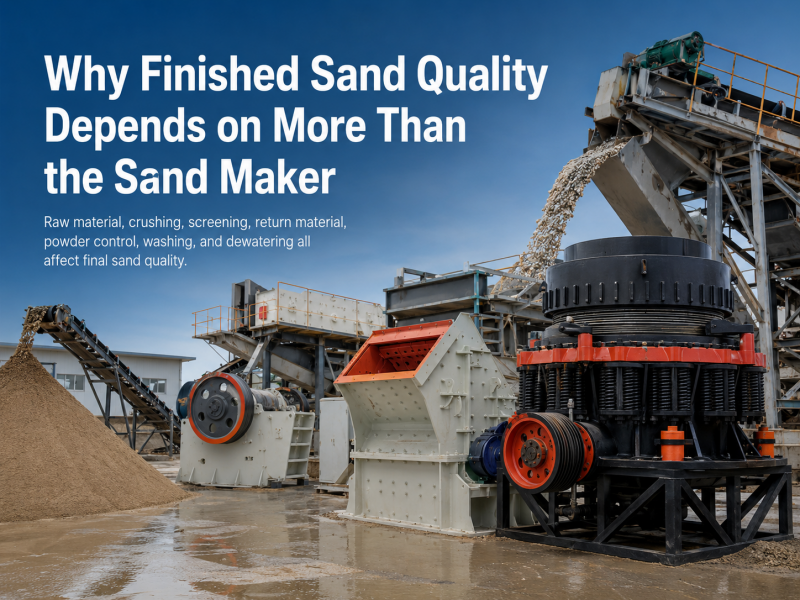
A sand maker is important, but it is not the only factor that decides finished sand quality. In real production, good sand comes from the balance of the whole line. Raw material condition, primary and secondary crushing, screening, return material ratio, powder control, washing, and dewatering can all change the final result.
For Sentai Machinery, when we discuss a sand making project with an overseas buyer, we do not only ask about the sand maker model. We also need to understand the raw material, required capacity, target sand size, powder limit, washing demand, and final application.
A good sand maker can shape the material, but a good sand production line must control the whole process.
Some buyers believe that once they choose a VSI sand making machine or another sand maker, the finished sand quality will be solved automatically.
In real production, this is not always true.
If the raw material is not suitable, the feed size is unstable, the screen is not matched, or the return material is not controlled, the sand maker alone cannot guarantee stable output. The machine may be working normally, but the final sand may still have poor gradation, too much powder, uneven particle size, or unstable moisture after washing.
This is why finished sand quality should be discussed as a system result, not as a single machine result.
The first factor is the raw material.
River stone, limestone, granite, basalt, and other materials do not behave the same during sand making. Some materials are hard and abrasive. Some are softer and easier to crush. Some produce better particle shape. Some create more stone powder.
For example, hard river stone may cause higher wear and require stronger crushing and shaping. Limestone may be easier to crush, but the powder content and particle size distribution still need control. Granite and basalt may need careful equipment selection because of hardness and wear cost.
If the supplier does not understand the raw material, the sand making plant may be designed too simply. The final sand quality may become unstable even if the sand maker itself is a common model.
The sand maker is not usually the first machine in the line. Before the material enters the sand maker, it often goes through jaw crusher, impact crusher, cone crusher, hammer crusher, or other crushing equipment.
If the previous crushing stage produces unstable feed size, the sand maker will receive uneven material. Too large feed may reduce efficiency and increase wear. Too much fine material before sand making may also affect the final grading and powder content.
A stable sand making plant should control the material before it reaches the sand maker. This is why primary crushing, secondary crushing, and screening should be considered together.
Good finished sand starts before the sand maker.
Vibrating screen selection is very important in a sand making plant.
The screen separates qualified material from oversized material. Qualified sand goes forward. Oversized material may return to the sand maker or crushing stage for further processing.
If the screen area is too small, the mesh is not suitable, or the screening efficiency is low, the whole line may become unstable. Qualified material may return unnecessarily. Oversized material may enter the finished product. The final sand gradation may change during production.
This is why vibrating screen matching is not a small detail. It directly affects finished sand size control and return material balance.
Return material is normal in a sand making plant. It helps reshape and reprocess oversized particles. However, too much return material can create problems.
If the return ratio is too high, the sand maker load increases. Power consumption rises. Wear parts are consumed faster. The practical output may become lower than expected.
If the return ratio is too low, some material may not receive enough shaping or reprocessing. This can affect particle shape and grading.
The goal is not to remove return material completely. The goal is to keep it within a reasonable range so that the line works smoothly.
Finished sand quality is not only about particle size. Stone powder content is also important.
Some applications allow a certain amount of powder. In some markets, controlled stone powder can even help improve grading. But too much powder may affect concrete performance, water demand, or customer acceptance.
Different projects have different requirements. Sand used for concrete, dry mortar, road material, or general construction may not need the same powder level.
This is why the sand making plant may need powder separation, washing, or better screening depending on the final use.
Not every sand making plant needs a washing system, but many projects require it.
If the raw material contains mud, clay, or too much fine powder, a sand washing machine may be needed to improve cleanliness. After washing, a dewatering screen or fine sand recovery system may help reduce moisture and recover fine sand.
However, washing is not only about making sand look clean. It also changes the final product condition. The buyer should consider water supply, mud treatment, site layout, and final moisture requirement.
If washing is added without proper dewatering, the finished sand may be too wet for storage, transport, or later use.
This table shows why finished sand quality should be judged by the full process, not only by the sand maker model.
Factor | How It Affects Sand Quality | What Should Be Checked |
Raw material | Hardness, powder generation, wear cost | Material type and size |
Feed size | Sand maker efficiency and wear | Size before sand making |
Crushing stages | Gradation and particle shape | Crusher matching |
Screening | Finished size control | Screen model and mesh |
Return material | Load and shaping effect | Return ratio |
Powder content | Final product acceptance | Application requirement |
Washing | Cleanliness and mud removal | Water and mud condition |
Dewatering | Final moisture | Storage and transport need |
Before recommending a sand making plant, Sentai Machinery usually needs to confirm the following information.
1. What raw material will be processed?
2. What is the feeding size?
3. What finished sand size is required?
4. What capacity is expected per hour?
5. Is the material clean or mixed with mud?
6. Is washing required?
7. What is the acceptable stone powder content?
8. Is the final sand used for concrete, mortar, road material, or other applications?
9. Is the project stationary or mobile?
10. What site space and power conditions are available?
These details help build a more realistic configuration. They also help avoid choosing a sand maker without considering the rest of the line.
A sand maker is important, but it does not work alone.
Finished sand quality depends on the whole system. Raw material, crushing, screening, return material, powder control, washing, and dewatering all affect the final product.
For buyers, the better question is not only "Which sand maker should I buy?" A more useful question is "What kind of sand quality do I need, and how should the whole line be matched to achieve it?"
When the complete process is designed properly, the sand maker can perform better, the finished sand becomes more stable, and the production line becomes easier to operate.
If you are planning a manufactured sand production project, Sentai Machinery can help evaluate your raw material, required capacity, finished sand size, powder control demand, washing requirement, and site layout.
Send us your material photos, feeding size, target product size, and final application. Our team can help recommend a suitable sand making plant configuration.
Related Articles:
1. What Buyers Often Get Wrong About Sand Making Plant Capacity
2. What Changes When River Stone Is Used Instead of Limestone in a Sand Making Plant
3. What Buyers Often Ignore When Choosing a Sand Washing Machine
4. What Determines Finished Aggregate Shape in an Impact Crushing Process
5. Why Return Material Ratio Matters in a Stone Crushing Plant
Suggested Solutions:

 WhatsApp
 Email
Email
 +86 15538010601