
STCrushers Is A Professional Minging Equipment Manufacturer since 2004, Providing High Quality Crushers, Sand Making Machines, Drying Equipment and more.
STCrushers Is A Professional Minging Equipment Manufacturer since 2004, Providing High Quality Crushers, Sand Making Machines, Drying Equipment and more.
Many Buyers Focus on Crushing First and Washing Much Later
In many sand making projects, buyers spend most of their attention on jaw crusher, sand making machine, vibrating screen, and plant capacity.
That is understandable. These machines feel like the main part of the line.
The washing stage is often treated differently. Some buyers look at the washing machine as a simple supporting unit and assume the logic is easy: if the sand is not clean enough, just add washing.
But in real projects, the washing stage affects much more than surface cleanliness.
A sand washing machine can influence finished sand quality, fines loss, water use, downstream dewatering, recovery efficiency, and overall operating cost.
This is why choosing a sand washing machine should not be an afterthought.
Why Buyers Underestimate the Washing Stage
The main reason is simple: washing looks easier than crushing.
Crushing equipment feels technical and powerful. Washing equipment looks like something added later to clean things up.
That impression is misleading.
In a real sand making plant, washing is not only about making sand look better. It changes the balance between cleanliness, yield, water consumption, sludge handling, fine material recovery, and operating cost.
Some buyers only realize this after the line starts running. By then, the machine may already be installed, and the plant has to solve practical problems instead of preventing them early.
What a Sand Washing Machine Really Affects
A sand washing machine should be judged by what it does to the whole line, not only by whether it removes visible dirt.
In many cases, it directly affects finished sand cleanliness, fines loss, water use, dewatering and recovery, and real plant balance.
A washing machine that looks suitable on paper may still create trouble if it does not match the real throughput and material condition of the plant.
1. Raw Material Mud and Fines Condition
This is one of the first things buyers often ignore.
Not all raw materials need the same washing intensity.
Some materials contain more muddy fines, more clay, more natural impurities, or more unstable moisture. Others are relatively clean already and may need less washing intervention.
If the raw material condition is misunderstood, the selected washing machine may be too light for the real job, too aggressive for the material, unsuitable for the fines structure, or more expensive to run than necessary.
Better way to judge it:
Before choosing the machine, confirm how much mud is in the feed, how much fine material is naturally present, and how clean the final sand actually needs to be.
2. How Much Fine Material Can Be Lost
This is one of the most overlooked questions.
Many buyers focus on cleaner finished sand, but forget to ask: How much fine material will be washed away with it?
If the washing stage removes too much usable fine material, the line may produce cleaner sand but lower overall yield. That can become a commercial problem.
This is especially important when the margin on final product is tight, fine sand still has market value, or the plant is already sensitive to output loss.
Better way to judge it:
Do not ask only: Can this machine wash the sand cleaner?
Also ask: What will be lost during washing, and how much of that matters to my project?
3. Water Availability and Water Management
Some buyers discuss washing equipment as if water is unlimited.
In reality, washing changes the project in several practical ways: water demand increases, circulation planning matters more, sludge handling becomes more relevant, water treatment may need attention, and site drainage becomes more important.
This is one reason washing should be treated as a process decision, not only as a machine purchase.
A washing machine may be technically suitable, but still inconvenient if the site has limited water, the plant lacks good water reuse planning, slurry handling is not considered, or the local environment makes discharge difficult.
Better way to judge it:
A sand washing machine should be selected together with water logic, not separately from it.
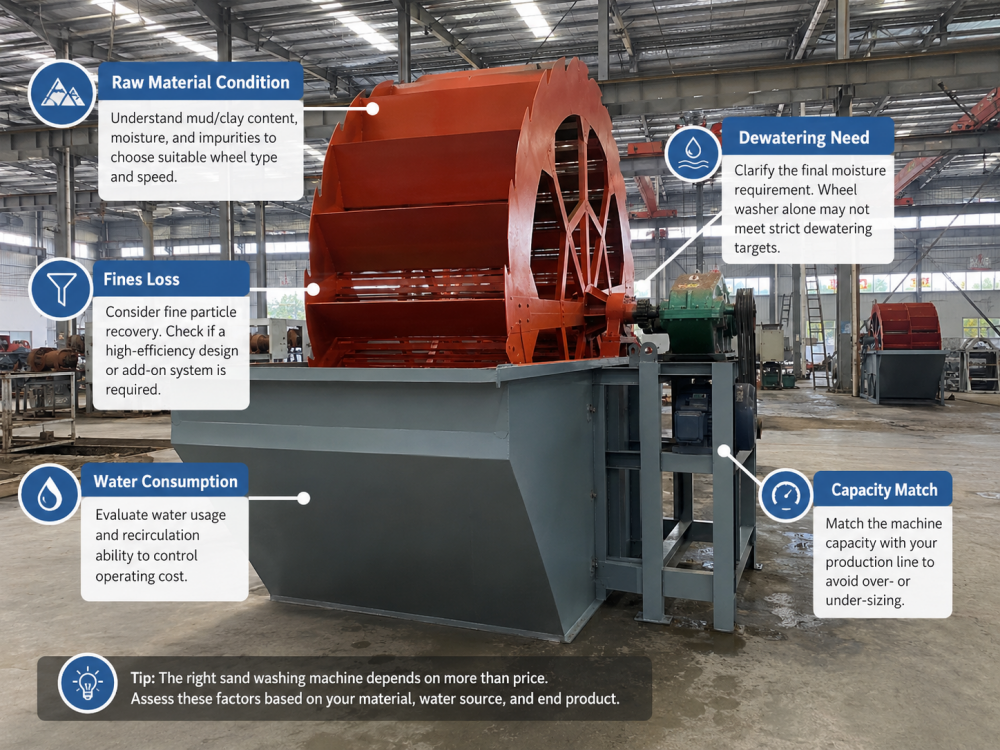
4. Whether Dewatering or Recovery Equipment Is Also Needed
This is where many buyers think too narrowly.
They choose a washing machine, but do not think far enough about what happens after washing.
Questions that matter include:
Will the finished sand hold too much water after washing?
Is dewatering needed before stockpiling or loading?
Will fine material loss become too high without recovery support?
Does the washing stage change downstream handling?
In some lines, washing works better when combined with dewatering support, fine sand recovery logic, and better water circulation planning.
Better way to judge it:
Do not treat washing as an isolated machine choice. Treat it as part of the whole finished sand handling system.
5. Whether the Machine Matches Real Plant Capacity
A washing machine should match the realistic plant output, not just a simple theoretical number.
A common mistake is selecting washing equipment based only on the nominal capacity of the sand making line, without checking actual finished sand throughput, fines content, water load, material consistency, and whether the plant runs steadily or with strong fluctuations.
If the washing machine is not properly matched, the plant may face throughput limitation, unstable washing result, poor recovery balance, or more operating cost than expected.
Better way to judge it:
Always compare washing capacity with the real sand flow, not just the crusher quotation.
Quick Judgment Table
What Buyers Focus On | What They Often Ignore | Better Way to Judge |
Cleaner finished sand | Fines loss may also increase | Judge cleanliness together with yield |
Machine model | Raw material mud and fines vary greatly | Start from actual material condition |
Washing ability | Water supply and circulation may be weak | Evaluate water logic before selection |
One machine only | Dewatering or recovery may also be needed | Think in process combinations |
Plant capacity number | Actual washed sand flow may differ | Match the machine to real working conditions |
A Common Wrong Assumption
A buyer wants cleaner finished sand and adds a washing machine late in the project.
The idea sounds simple: The line is already producing sand. We just need to wash it cleaner.
But several things were not checked carefully: how muddy the feed really is, how much fines can be lost, whether water is easy to manage, whether dewatering or recovery is also needed, and whether the selected machine fits the true throughput.
Now the result becomes mixed: the sand is cleaner, but yield may drop, water handling becomes harder, fine loss becomes more visible, and total operating cost rises.
The washing machine itself may not be wrong. The decision logic before choosing it may have been incomplete.
What Should Be Confirmed Before Final Selection
Before confirming a sand washing machine, buyers should check:
What is the real raw material condition?
How much mud and fines are present?
How clean does the final sand really need to be?
How much fines loss is acceptable?
What is the real washed sand throughput?
Is water supply and circulation practical?
Will dewatering or fine recovery also be needed?
These questions usually lead to a better decision than choosing by appearance or brochure alone.
Final Thought
A sand washing machine should not be chosen as a simple add-on. In many plants, it changes final sand quality, fines recovery, water use, and operating logic more than buyers expect.
At Sentai machinery, we help customers evaluate washing equipment based on raw material, plant layout, product target, and realistic operating conditions. A better washing decision usually starts not from the machine alone, but from what the whole line is trying to achieve.
Planning a sand making or sand washing project? Send Sentai machinery your raw material, mud condition, target output, and final product requirement for a more practical recommendation.
Related Articles:
How to Choose Equipment for a Sand Making Plant
What Buyers Often Get Wrong About Sand Making Plant Capacity
What We Usually Confirm Before Quoting a Sand Making Plant
Suggested Solutions:


 WhatsApp
 Email
Email
 +86 15538010601