
STCrushers Is A Professional Minging Equipment Manufacturer since 2004, Providing High Quality Crushers, Sand Making Machines, Drying Equipment and more.
STCrushers Is A Professional Minging Equipment Manufacturer since 2004, Providing High Quality Crushers, Sand Making Machines, Drying Equipment and more.
When a buyer plans to build a sand making plant, the first question is often about equipment.
What machines are needed for a 100 tph sand production line? How much does a sand making plant cost? Which sand making machine should be used?
These are practical questions, but they should not be the starting point.
A sand making plant is not only a list of machines. It is a complete production system that includes feeding, crushing, sand making, screening, washing, fine sand recovery, conveying, stockpiling, water circulation, dust control, and loading.
If the raw material and site conditions are not clear, the equipment list may look complete on paper but fail to match real production.
Before choosing a sand making machine, buyers should first confirm the material, finished sand requirement, site layout, water supply, power condition, and local environmental restrictions.
The raw material decides the foundation of the plant design.
Limestone, river stone, granite, basalt, tailings, and weathered rock do not behave the same way during crushing and sand making. Some materials are soft and easier to crush. Some are hard and abrasive. Some contain more clay or mud. Some create more stone powder during shaping.
For example, limestone may be easier to crush but can generate fine powder depending on the crushing process. River stone is usually harder and more abrasive, so wear parts and machine selection become more important. Granite and basalt may require stronger crushing equipment and better wear resistance. Tailings may need special attention to particle size, moisture, and final use.
Before asking for a quotation, buyers should provide material photos or videos, material name, hardness if known, moisture condition, mud content, and whether the material is from quarry, river deposit, mining waste, or existing stockpile.
A sand making machine cannot receive any size of raw material directly.
The maximum feed size must match the machine and the process design. If the raw material is too large, the plant may need a jaw crusher, cone crusher, impact crusher, or other crushing equipment before the sand making stage.
For a complete sand production line, feed size affects almost every step:
Whether primary crushing is needed
Whether secondary crushing is needed
Whether the sand maker can work efficiently
How much return material will be created
Whether the vibrating screen can separate material smoothly
How stable the finished sand grading will be
If the feed size changes often, the plant may also need a stronger feeding and screening arrangement. Stable feed size helps the sand making plant run more steadily.
The final use of the sand should be confirmed before equipment selection.
Different applications may require different sand grading, powder content, cleanliness, and moisture condition. Concrete sand, dry mortar sand, road base material, asphalt aggregate, and general construction sand do not always need the same process.
If the sand will be used for concrete or dry mortar, grading and cleanliness may be more important. If the material contains too much mud or fine powder, washing and fine sand recovery may be needed. If the sand is for general construction use, the process may be simpler, depending on local standards.
A buyer should not only say "I want 0-5 mm sand." It is better to explain where the sand will be used, what local quality requirement applies, and whether washing is required.
The final product requirement should guide the plant design.
Not every sand making plant must include washing equipment, but washing should be considered early.
If the raw material contains clay, mud, or too much fine powder, a sand washing system may be needed. Washing can improve sand cleanliness and help meet product requirements. However, washing also brings additional site requirements.
A sand washing plant needs water supply, wastewater handling, sedimentation pond or recycling system, and enough space for wet sand discharge and dewatering.
Fine sand recovery should also be considered when washing is used. Without recovery, valuable fine sand may be lost with wastewater. This can reduce yield and affect final grading.
So buyers should not only ask whether a sand washer is needed. They should also ask whether the site can support water circulation, sedimentation, dewatering, and fine sand recovery.
Water condition is critical for wet sand making plants.
If the project includes washing, the buyer should confirm water source, water volume, water recycling plan, sedimentation pond space, and local wastewater requirements.
Some sites have enough water and space for ponds. Some sites need a more compact water recycling design. Some projects may face stricter environmental rules for wastewater discharge and mud handling.
If water supply is limited, the plant design should avoid unnecessary washing or plan water recovery carefully. If wastewater cannot be managed properly, the project may face operating problems even if the equipment itself works well.
Water planning should be discussed before layout design, not after the machines arrive.
A sand making plant uses several machines at the same time.
Feeders, crushers, sand makers, vibrating screens, washers, dewatering machines, conveyors, pumps, and dust control systems all need power. The buyer should confirm available power capacity, voltage, transformer condition, and whether the site can support the full plant load.
If power supply is unstable, production may stop frequently or equipment may not run at designed capacity. If the plant is far from an existing power source, power planning should be included in the early project stage.
Operating conditions also matter. The buyer should consider local labor skill, maintenance ability, spare parts access, and working hours per day. A production line that is too complex for the site may create more trouble than value.
Many buyers focus on the machine area but underestimate stockpile and loading space.
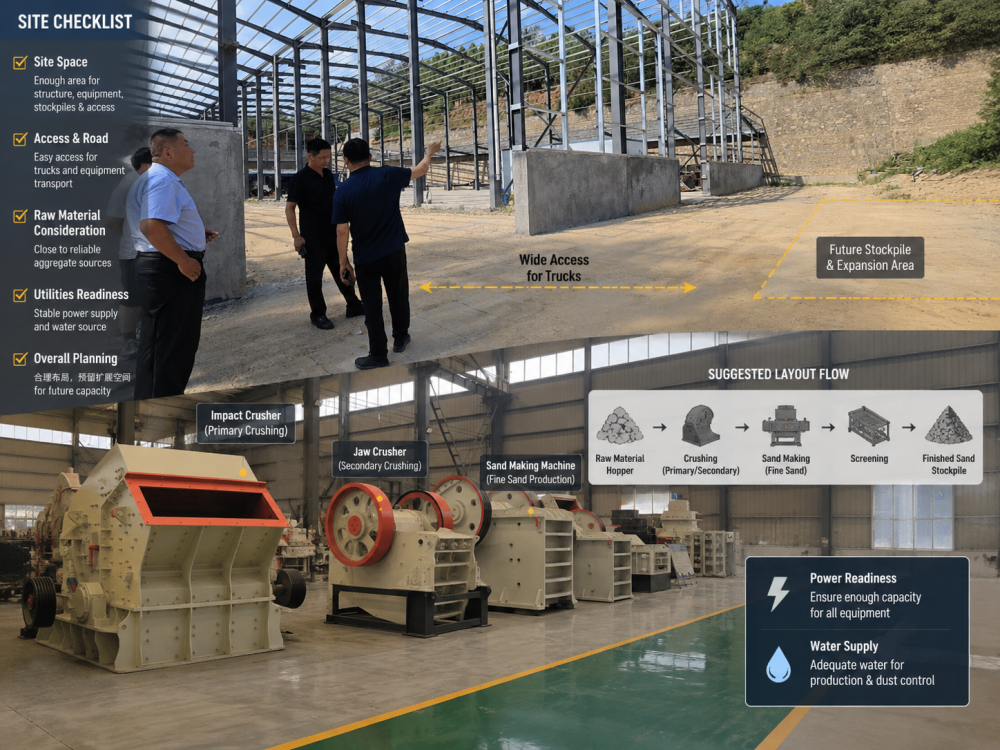
A sand making plant needs space for raw material stockpiles, intermediate material, finished sand, oversize return material, loading roads, maintenance access, and sometimes wastewater ponds.
If the site is too narrow, conveyors may become difficult to arrange. Finished sand piles may mix with other materials. Loading trucks may interfere with equipment maintenance. Water ponds may be placed too close to production or traffic areas.
A good layout should allow material to flow smoothly from feeding to finished product storage. It should also leave enough room for daily operation, inspection, and future adjustment.
Capacity should not be judged only by the sand making machine.
A 100 tph, 150 tph, or 250 tph plant depends on the whole system. Feeding, crushing, screening, washing, conveying, and stockpiling must all match the target capacity.
If the sand maker has enough capacity but the screen is too small, the plant will be limited by screening. If washing is too slow, wet sand discharge becomes the bottleneck. If conveyors are not matched, material flow becomes unstable. If the stockpile area is too small, the plant may stop even when machines are available.
For this reason, capacity should be planned as a system target, not a single machine number.
Before asking for a sand making plant quotation, buyers can prepare the following information.
Information Needed | Why It Matters |
Raw material type | Decides crushing and wear requirements |
Material photos or videos | Helps judge shape, mud, moisture, and size |
Maximum feed size | Decides front crushing equipment |
Required finished size | Affects screening and sand maker selection |
Final sand application | Decides grading, washing, and quality target |
Required capacity | Defines plant scale and equipment matching |
Washing requirement | Affects washer, recovery, water, and pond design |
Water supply | Decides whether wet process is practical |
Power condition | Affects equipment operation and layout |
Site size and shape | Affects plant arrangement and conveyor direction |
Stockpile and loading plan | Affects daily operation efficiency |
Local environmental limits | Affects dust, wastewater, and noise control |
Building a sand making plant should not start from a machine list alone.
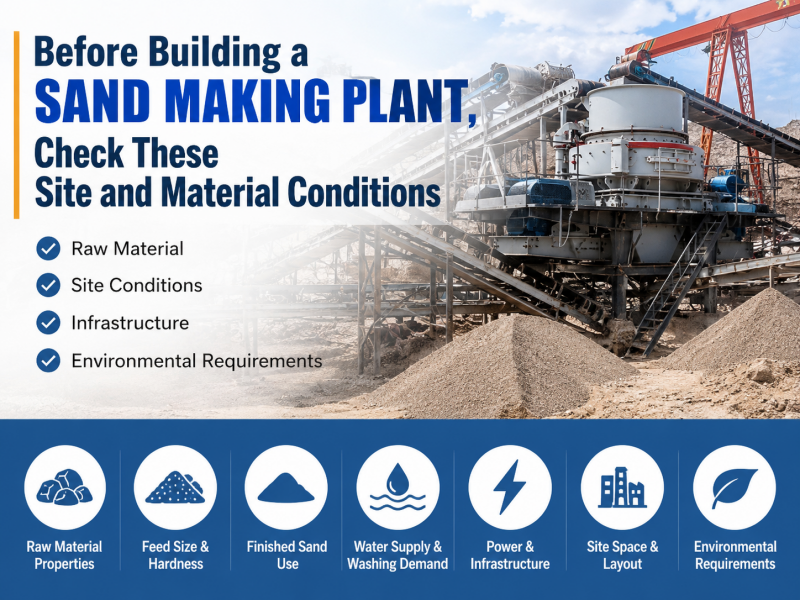
The correct process should start from raw material, feed size, finished sand application, washing demand, site space, water condition, power supply, stockpile arrangement, and environmental requirements.
For buyers, the better question is not only "How much is a sand making plant?" A more useful question is "What site and material conditions must be confirmed before the plant is designed?"
When these conditions are clear, the supplier can recommend a more suitable sand production line and avoid unnecessary changes during installation or operation.
If you are planning to build a sand making plant, Sentai Machinery can help review your raw material, feed size, finished sand requirement, site layout, washing demand, water condition, power supply, and capacity target.
Send us your material photos or videos, site photos, required capacity, finished sand size, water and power condition, and final sand application. Our team can help prepare a suitable sand making and washing plant solution.
What We Usually Confirm Before Quoting a Sand Making Plant
Why Finished Sand Quality Depends on More Than the Sand Maker
Why Is There Too Much Stone Powder in Manufactured Sand
What Changes When River Stone Is Used Instead of Limestone in a Sand Making Plant
What Site Information Should Buyers Provide Before Plant Layout Design
 WhatsApp
 Email
Email
 +86 15538010601