
STCrushers Is A Professional Minging Equipment Manufacturer since 2004, Providing High Quality Crushers, Sand Making Machines, Drying Equipment and more.
STCrushers Is A Professional Minging Equipment Manufacturer since 2004, Providing High Quality Crushers, Sand Making Machines, Drying Equipment and more.
When buyers ask about flotation machines, they often start with a simple question:
What tank volume should I choose?
Tank volume is important, but it should not be the first decision. A flotation machine works inside a process system. The correct configuration depends on ore type, grinding fineness, slurry concentration, reagent condition, air supply, foam behavior, flotation stage, and plant capacity.
Two projects may have the same processing capacity, but they may need different flotation cell arrangements. One ore may float easily with a simple roughing and cleaning process. Another ore may need longer flotation time, more stages, better slurry control, or different cell distribution.
For Sentai Machinery, flotation machine selection should begin with mineral behavior and process route. The question is not only how large the flotation cell should be. The better question is what flotation task each cell must complete.
Different ores behave differently in flotation.
Copper ore, gold-bearing sulfide ore, lead-zinc ore, fluorite, coal, and other minerals may require different flotation conditions. Some minerals attach to bubbles easily after proper grinding and reagent conditioning. Some need more careful separation because valuable minerals are mixed with gangue or other sulfide minerals.
The ore type affects:
1. Required grinding fineness
2. Reagent system
3. Flotation time
4. Foam stability
5. Concentrate grade target
6. Tailings control
7. Number of flotation stages
8. Cleaning and scavenging requirement
If the ore is easy to float, a simpler cell configuration may be enough. If the ore is complex, the plant may need separate roughing, cleaning, and scavenging sections.
This is why buyers should not choose flotation machines only by capacity. Ore test results and process targets should guide the equipment configuration.
Flotation depends on contact between mineral particles and bubbles. If the useful minerals are not liberated from gangue, flotation recovery and concentrate grade may be limited.
Before flotation, the ore often passes through crushing, grinding, and classification. Ball mill and spiral classifier matching can affect the particle size entering flotation.
If grinding is too coarse, valuable minerals may remain locked inside gangue. If grinding is too fine, excessive slime may appear. Slime can affect foam behavior, reagent consumption, and flotation stability.
The flotation machine cannot fully correct poor grinding control. A suitable flotation cell configuration must match the particle size that the grinding circuit can provide.
Before selecting flotation machines, buyers should confirm:
1. Feed size before grinding
2. Required flotation fineness
3. Liberation condition
4. Risk of overgrinding
5. Classification stability
6. Slime content
Grinding and flotation should be discussed together, not as isolated equipment sections.
Slurry concentration has a direct effect on flotation performance.
If slurry is too thick, air dispersion, particle suspension, reagent distribution, and foam movement may become difficult. If slurry is too dilute, the plant may need larger equipment volume, more water, and higher pumping load.
Stable slurry concentration helps the flotation machine work more consistently. It supports better mixing, bubble contact, and foam control.
Ore with high clay or slime content may require more careful slurry management. Clay can increase viscosity, affect foam layer, and reduce separation efficiency. In this case, the flotation machine selection should consider not only tank size, but also agitation strength, air supply, and process arrangement.
A flotation machine should match the real slurry condition, not only the dry ore capacity.
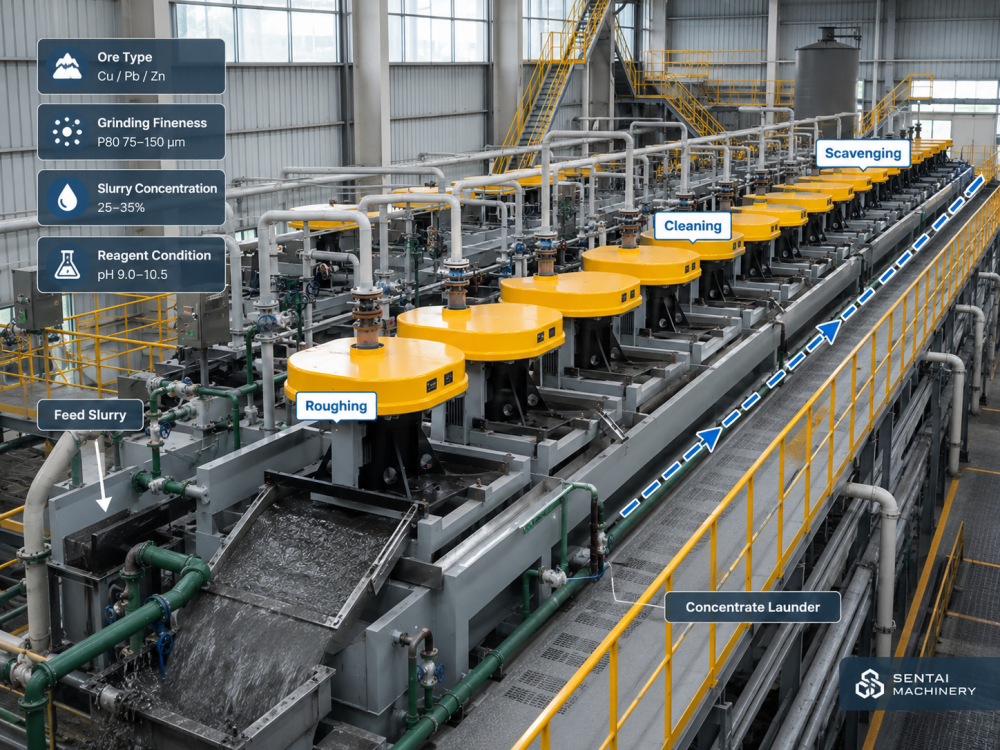
A flotation plant usually does not use all flotation cells for the same job.
Roughing cells are used to recover valuable minerals from the feed slurry. Their task is often to capture as much valuable mineral as possible.
Cleaning cells are used to improve concentrate grade. Their task is to remove more gangue and produce a cleaner concentrate.
Scavenging cells are used to recover remaining valuable minerals from rougher tailings. Their task is to reduce loss in tailings.
Because these stages have different goals, the cell configuration may also be different. The number of cells, residence time, air control, foam depth, and concentrate handling should match the stage function.
A buyer should not simply ask for one flotation machine model. It is better to confirm the complete flotation circuit.
Reagents change mineral surface behavior. They affect which minerals attach to bubbles, how stable the foam is, and how clean the concentrate can become.
The flotation machine must provide suitable mixing and air contact for the reagent system to work. If reagent conditioning is poor, even a suitable flotation machine may not achieve stable results.
However, this article is not a reagent selection guide. The key point is that machine selection and reagent conditions should be considered together.
The supplier should know whether the flotation route includes collectors, frothers, regulators, depressants, or other conditioning stages. This helps judge the required mixing time, tank arrangement, and process layout.
Flotation machines use air and agitation to create bubbles. Bubble size, air volume, mixing intensity, and foam layer control all affect separation.
If air supply is unstable, the foam layer may fluctuate. If mixing is too weak, mineral particles may not contact bubbles effectively. If mixing is too strong, foam may become unstable or fine particles may be carried incorrectly.
Foam control is especially important when the plant needs stable concentrate grade. The operator should be able to adjust air, slurry level, and discharge conditions according to ore changes.
Flotation machine selection should consider operation control, not only mechanical structure.
Scenario 1: Gold-bearing sulfide ore
The ore may need grinding and flotation to recover gold-bearing sulfide minerals. The flotation system should match liberation size, reagent conditioning, roughing, cleaning, and concentrate handling.
Scenario 2: Copper ore beneficiation
Copper ore flotation may require stable grinding, slurry concentration, reagent control, and staged flotation. The cell configuration should follow the target recovery and concentrate grade.
Scenario 3: Lead-zinc or mixed sulfide ore
Mixed sulfide ore may require more selective flotation. Different minerals may need separate flotation stages, cleaning steps, and process control. In this case, cell configuration must follow the test result.
These scenarios show that flotation machine selection should follow ore behavior and process goal.
A common mistake is choosing flotation machines only by tank volume.
Another mistake is asking for a complete quotation without providing ore test data. Without ore type, grade, particle size, and flotation response, the supplier can only give a general suggestion.
Some buyers also ignore the grinding and classification stage. If the flotation feed is unstable, the flotation section will also be unstable.
Another misjudgment is thinking that one flotation cell can solve all recovery problems. In many beneficiation plants, recovery and concentrate grade depend on the full circuit, including crushing, grinding, classification, reagent conditioning, flotation stages, concentrate handling, and tailings management.
A useful discussion should start with ore information.
First, provide ore type, grade, mineral composition, photos, videos, and any available test results.
Second, confirm the target product. The supplier needs to know whether the goal is higher recovery, higher concentrate grade, or a balance between both.
Third, explain the grinding condition. Required fineness, classification method, and expected slurry concentration should be clear.
Fourth, describe the expected process route. The supplier should understand whether the plant needs roughing only, roughing and cleaning, or roughing, cleaning, and scavenging.
Fifth, provide site information, including water source, power supply, plant space, tailings handling, and working hours.
With these details, the flotation machine configuration can be designed around the real process requirement.
Flotation machine selection should not start from tank volume alone.
Ore type, mineral liberation, slurry concentration, reagent condition, air supply, foam behavior, flotation stage, and site operation all affect the final cell configuration.
For buyers, the better question is not only "What flotation machine model do I need?" A more useful question is "What flotation circuit fits my ore and product target?"
When flotation machines are selected according to ore behavior and slurry condition, the beneficiation plant is easier to operate and more likely to achieve stable recovery and concentrate quality.
If you are planning a flotation process for gold, copper, lead-zinc, or other mineral beneficiation projects, Sentai Machinery can help review your ore type, grinding fineness, slurry condition, target recovery, concentrate grade, flotation stage requirement, and site layout.
Share your ore photos or videos, material analysis, capacity target, and process requirement. Our team can help recommend a suitable flotation machine configuration based on your actual mineral processing conditions.
1. What Affects Flotation Recovery in a Copper Ore Processing Plant
2. What Buyers Often Miss When Choosing Flotation Reagents for Copper Ore
3. Gold Gravity Separation or Gold Flotation: Which Process Fits Your Ore Better
4. What Buyers Often Miss When Matching a Ball Mill and Spiral Classifier
5. Ball Mill vs Rod Mill: How to Choose the Right Grinding Stage for Mineral Processing
 WhatsApp
 Email
Email
 +86 15538010601