
STCrushers Is A Professional Minging Equipment Manufacturer since 2004, Providing High Quality Crushers, Sand Making Machines, Drying Equipment and more.
STCrushers Is A Professional Minging Equipment Manufacturer since 2004, Providing High Quality Crushers, Sand Making Machines, Drying Equipment and more.
When buyers plan an ore processing plant, they often ask whether a ball mill or a rod mill is the better choice. The better starting point is not the machine name. It is the grinding stage.
A ball mill and a rod mill are both used for ore grinding, but they do not solve the same process problem in every project. The correct choice depends on feed size, required discharge size, ore behavior, and the recovery process after grinding.
In mineral processing, grinding is not only about making material smaller. It is about preparing the ore for gravity separation, flotation, magnetic separation, leaching, or another beneficiation process. If the grinding stage is selected incorrectly, the later recovery step may become unstable even when the mill itself is running normally.
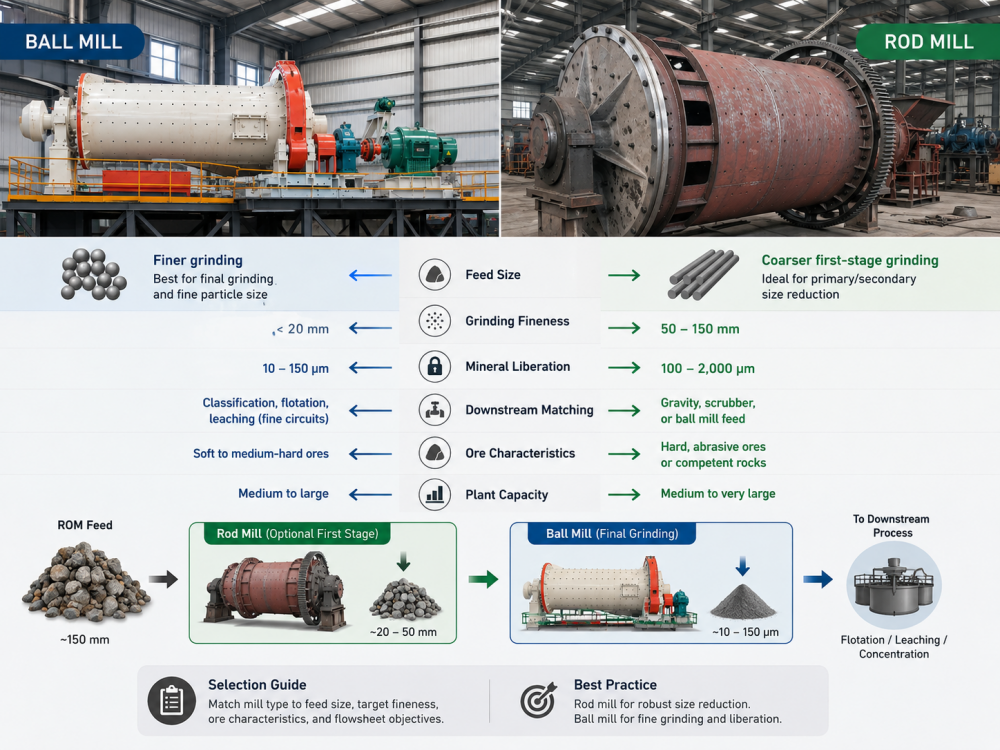
A rod mill uses steel rods as grinding media. The rods contact the material in a more linear way, so the grinding action usually produces a more controlled product size with fewer excessive fines.
This makes rod mills useful in some coarse grinding or first-stage grinding applications. They can be considered when the next process needs a more even particle size range or when over-grinding may reduce recovery.
A rod mill is not a lower level choice. It simply fits a different process target. In some gold gravity separation projects, for example, the goal may be to release free gold while avoiding unnecessary fine slime.
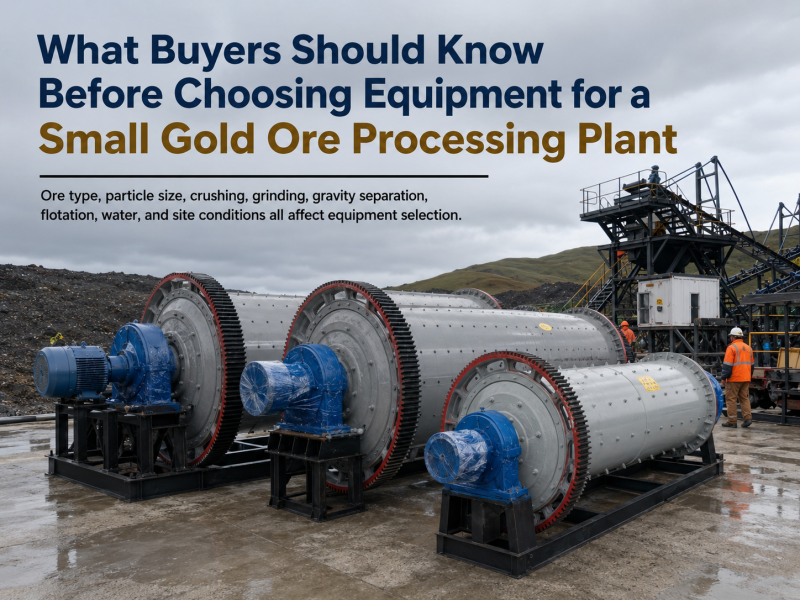
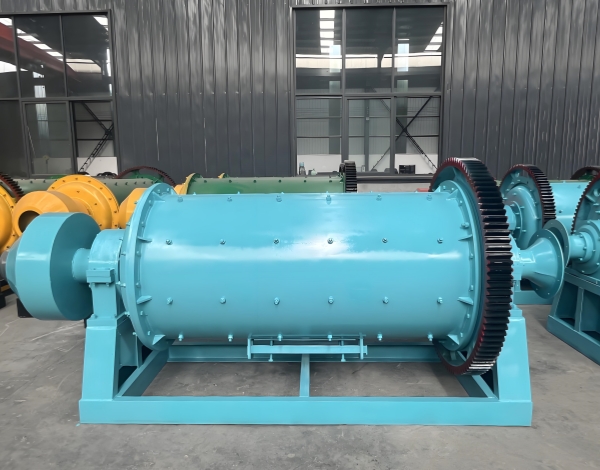
A ball mill uses steel balls as grinding media. The balls create stronger impact and grinding action inside the cylinder, which makes the ball mill more suitable for finer grinding.
Many beneficiation processes need finer material before recovery. Flotation often requires enough mineral liberation so valuable particles can react with reagents. Magnetic separation may also need suitable grinding so magnetic minerals can separate from gangue.
For these projects, a ball mill is often the more practical choice, especially when it works with a spiral classifier in a closed grinding circuit.
Feed size is one of the first details to confirm. If material entering the grinding stage is still relatively coarse, a rod mill may be considered for initial grinding. If the feed has already been crushed to a suitable size and the target is finer grinding, a ball mill may be more suitable.
The required discharge size is just as important. If the process needs controlled coarse grinding, a rod mill may be useful. If the process requires fine grinding for mineral liberation, a ball mill usually becomes the stronger option.
However, finer is not always better. Over-grinding can increase power consumption, create more slime, and sometimes reduce recovery. The best grinding size is the size that releases valuable minerals enough for the next process.
The mill should be selected according to the process after grinding.
For a gold gravity separation plant, if free gold can be liberated at a relatively coarse size, a rod mill may help reduce unnecessary fine material.
For a copper flotation plant, the ore may need finer grinding to expose valuable mineral surfaces. In this case, a ball mill is often selected because flotation performance depends heavily on grinding fineness and slurry condition.
For an iron ore processing plant, the choice depends on how closely iron minerals are associated with gangue. Some projects may use ball milling before magnetic separation, while some flowsheets may include a rod mill at an earlier stage.
The downstream process should guide the grinding machine selection.
Scenario 1: Coarse free gold recovery
If gold is present as free particles and can be recovered without very fine grinding, a rod mill may be considered. The goal is to prepare suitable material for gravity recovery while avoiding excessive fines.
Scenario 2: Fine sulfide ore flotation
If valuable minerals are finely disseminated or associated with sulfide minerals, a ball mill is usually more suitable. The process needs finer grinding to improve liberation before flotation.
Scenario 3: Multi-stage mineral processing
Some projects may not choose only one machine. A rod mill can be used for first-stage grinding, and a ball mill can be used for finer grinding later. This depends on ore test results and final recovery requirements.
One common mistake is comparing only capacity. A rod mill and a ball mill may both process similar tonnage, but the discharge product may be very different.
Another mistake is choosing only by equipment price. A lower purchase price is not always the lower cost solution if the grinding result does not match the recovery process. Poor grinding selection may reduce recovery, increase circulating load, or create extra operating cost later.
A third mistake is assuming that a ball mill is always better because it can grind finer. If the process does not need fine grinding, unnecessary fine material may create problems instead of benefits. The correct question is not which mill is stronger. The correct question is which mill prepares the ore better for the next process.
Before asking for a ball mill or rod mill quotation, buyers should prepare several key details. These details help the supplier judge whether the project needs coarse grinding, fine grinding, classification, or a combined grinding circuit.
Information Needed | Why It Matters |
Ore type | Different ores require different grinding and recovery conditions |
Feed size after crushing | Decides whether coarse grinding or fine grinding is needed |
Target discharge size | Controls ball mill or rod mill selection |
Downstream process | Gravity separation, flotation, magnetic separation, and leaching need different feed conditions |
Over-grinding risk | Excessive fines can increase cost and affect recovery |
Classifier requirement | Affects closed circuit design and grinding stability |
Planned capacity | Helps select suitable model and circuit size |
A grinding stage rarely works alone. It may include crushing before grinding, classification after grinding, slurry handling, pumps, conveyors, and downstream separation equipment.
For this reason, buyers should not select a rod mill or ball mill as an isolated machine. The equipment should be selected as part of the complete ore processing flow.
When the grinding circuit is designed around ore characteristics and recovery targets, the plant has a better chance to run steadily and produce suitable feed for beneficiation.
Ball mills and rod mills are both useful grinding machines, but they fit different process targets. A rod mill may be suitable when controlled coarse grinding and reduced fines are important. A ball mill may be better when finer grinding and higher mineral liberation are required.
For buyers, the most useful decision is not based on machine name alone. It is based on feed size, discharge requirement, ore behavior, downstream process, and recovery target. When the grinding stage is selected from the process point of view, the whole beneficiation plant becomes easier to balance.
If you are comparing ball mills and rod mills for a mineral processing project, Sentai Machinery can help review your ore type, feed size, grinding target, expected capacity, and downstream beneficiation process.
Share your material photos or videos, raw ore size, planned capacity, target grinding fineness, and final recovery process. Our team can help recommend a suitable grinding and ore processing solution.
1. What Buyers Should Confirm Before Choosing a Ball Mill for Ore Grinding
2. Gold Gravity Separation or Gold Flotation: Which Process Fits Your Ore Better
3. What Buyers Often Miss When Matching a Ball Mill and Spiral Classifier
4. Why Crushing Size Before Ball Milling Affects Grinding Cost
5. How Grinding Stability Affects Flotation Performance
 WhatsApp
 Email
Email
 +86 15538010601