
STCrushers Is A Professional Minging Equipment Manufacturer since 2004, Providing High Quality Crushers, Sand Making Machines, Drying Equipment and more.
STCrushers Is A Professional Minging Equipment Manufacturer since 2004, Providing High Quality Crushers, Sand Making Machines, Drying Equipment and more.
A buyer may ask for a 100 tph stone crusher plant. The number sounds clear, but it is not enough to design the process.
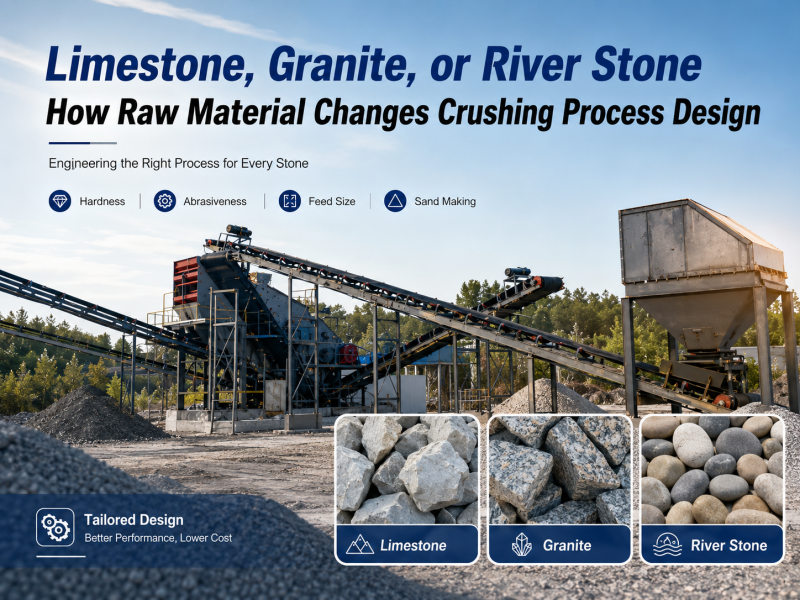
A 100 tph limestone crushing plant, a 100 tph granite crushing plant, and a 100 tph river stone sand making plant may need very different equipment combinations. The capacity is the same, but the raw material behavior is not the same.
Limestone may be easier to crush, but powder content and finished aggregate shape still need attention. Granite is hard and abrasive, so wear cost and crushing strength become more important. River stone is usually hard, smooth, and difficult to break into good sand shape without proper crushing and shaping stages.
This is why crushing process design should start from the rock, not from a fixed machine list.
Limestone is often considered easier to crush than granite or river stone. For many aggregate projects, jaw crusher and impact crusher combinations are commonly used. In some cases, hammer crusher or heavy hammer crusher may also be considered, depending on the raw material size, required capacity, and final product demand.
However, easier crushing does not mean the process can be careless.
Limestone may generate fine powder during crushing, especially when the equipment setting is too aggressive or the material is repeatedly crushed. If the finished product is used for concrete aggregate, road construction, or manufactured sand, the plant still needs to control particle size, powder content, and screening efficiency.
The process choice also depends on the final product. If the buyer mainly needs coarse aggregate, the design may focus on crushing and screening. If the buyer needs manufactured sand, shaping, screening, and possibly washing should be considered.
For limestone, the key is not only how to crush the stone. The key is how to produce the required aggregate or sand without creating unnecessary powder and return material.
Granite is much harder and more abrasive than limestone. This changes the process design immediately.
In a granite crushing plant, the first concern is not only capacity. Wear parts, crushing force, machine structure, and maintenance cost must be considered. If a soft rock process is used for hard granite, the plant may still run, but wear cost and downtime can become serious problems.
The primary crushing stage usually needs a strong jaw crusher to reduce the large raw stone. The secondary crushing stage must be selected carefully according to product size, hardness, and wear cost. Screening is also important because overloaded screens can increase return material and reduce plant stability.
For granite projects, buyers should pay attention to:
Raw stone hardness
Maximum feed size
Required final aggregate size
Expected wear parts consumption
Whether manufactured sand is needed
How much maintenance downtime the site can accept
River stone is different from both limestone and granite.
It is usually hard, rounded, and smooth on the surface. Because of long-term natural washing, river stone often has good appearance but can be difficult to crush and shape efficiently. It may also cause high wear in sand making equipment.
Many river stone projects are connected with manufactured sand production. Buyers want to turn natural pebbles into sand with suitable grading and particle shape. In this case, the plant may need primary crushing, secondary crushing, sand making, screening, and washing.
River stone also creates a special challenge: product shape and wear cost must be balanced.
If the crushing process is too simple, the final sand shape may not meet the buyer's requirement. If the process is too aggressive, wear parts cost may increase quickly. If washing is needed, the site must also plan water supply, fine sand recovery, and wastewater handling.
For river stone, VSI sand making machine and suitable screening are often important parts of the complete process. The plant should be designed for both crushing efficiency and final sand quality.
Capacity is only one design condition.
The same 100 tph target can lead to different machine choices because each material creates a different load on the plant.
Limestone may allow a simpler crushing route when the product requirement is not too strict. Granite may need stronger crushing stages and more attention to wear. River stone may need more shaping and sand making support.
The final equipment combination depends on several practical questions:
Is the raw material soft, medium hard, or hard?
Is the material abrasive?
What is the maximum feed size?
Is the final product aggregate or manufactured sand?
Is washing required?
How strict is the finished product size?
What wear cost is acceptable for the buyer?
How much site space is available for screening, return material, and stockpiles?
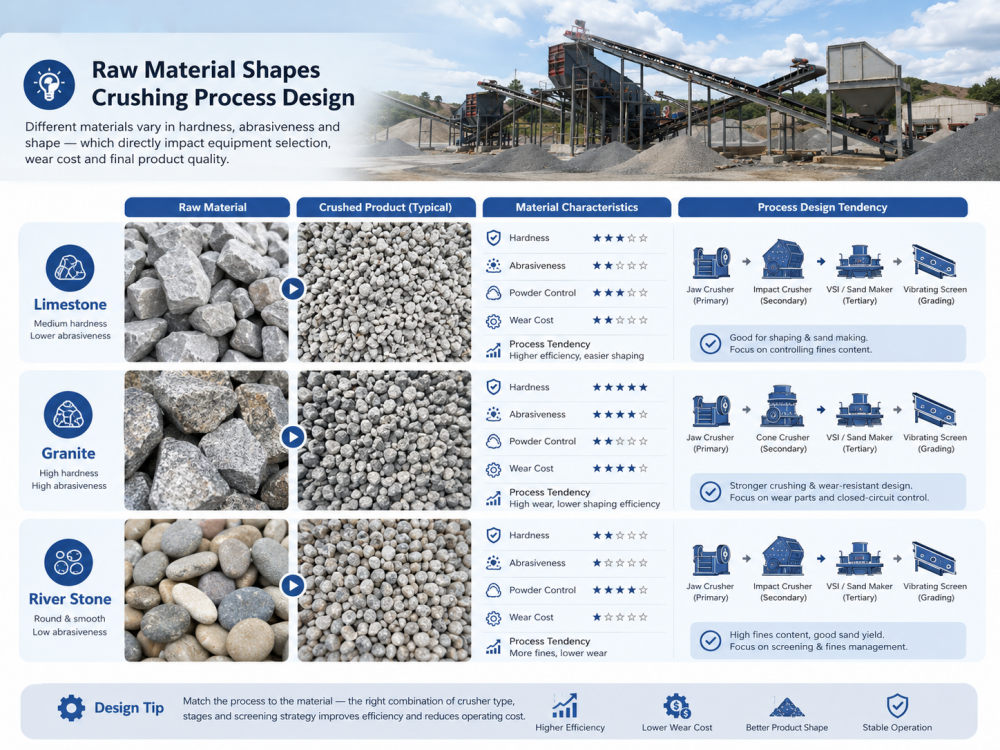
A crushing plant and a sand making plant are not exactly the same.
If the buyer needs coarse aggregate, the process may focus on primary crushing, secondary crushing, and screening. The main goal is to produce stable sizes such as 0-5 mm, 5-10 mm, 10-20 mm, or other local aggregate sizes.
If the buyer needs manufactured sand, the process becomes more detailed. The plant may need sand making, shaping, fine screening, washing, dewatering, or fine sand recovery. Stone powder content, grading, mud content, and moisture may become important quality points.
This is why buyers should define the final product before confirming the equipment list.
A plant designed for aggregate may not produce good manufactured sand without extra process stages. A plant designed for sand may need different screening, washing, and return material control from a basic aggregate line.
The following routes are examples, not fixed formulas. The final design should still depend on material test, site condition, capacity, and product requirement.
Limestone aggregate route:
Jaw crusher for primary crushing, impact crusher or hammer crusher for secondary crushing, vibrating screen for size separation, and conveyors for stockpiling. This route may suit many limestone aggregate projects where the material is not extremely hard and the final product is mainly construction aggregate.
Granite aggregate route:
Jaw crusher for primary crushing, suitable hard rock secondary crushing equipment, vibrating screen for classification, and stronger wear control in the whole process. This route focuses more on crushing strength, wear resistance, and stable screening.
River stone sand route:
Jaw crusher for primary crushing, secondary size reduction if needed, VSI sand making machine for shaping and sand production, vibrating screen for grading, sand washing and recovery system when cleanliness or powder control is required. This route is more connected with manufactured sand quality.
The important point is that process design should follow rock behavior. It should not copy one route across all materials.
Many project mistakes come from using one material experience for another material.
Some buyers use a limestone process to plan granite crushing and later find that wear cost is much higher than expected. Some buyers choose the cheapest machine combination for river stone and then find that sand shape or capacity is not stable. Some buyers only compare main crusher prices and ignore vibrating screen size, return material ratio, conveyors, stockpile space, and washing demand.
Another common misunderstanding is to treat final product size as the only target. For real projects, final product quality also includes shape, powder content, mud content, grading stability, and moisture if washing is involved.
A practical crushing process should consider both production and long-term operation.
Instead of sending only one sentence such as "I need a 100 tph crusher plant," buyers can discuss the project in a more useful order.
Start with the raw material. Explain whether it is limestone, granite, river stone, basalt, ore, tailings, or another material. Then provide the maximum feed size and material photos or videos.
Next, explain the final product. Is the target coarse aggregate, manufactured sand, road material, concrete aggregate, or mixed products?
Then discuss capacity, working hours, site space, water condition, power supply, and whether washing is required.
After these points are clear, the supplier can prepare a more realistic process flow instead of giving a general equipment list.
Limestone, granite, and river stone should not be treated as the same raw material.
Limestone may allow a simpler crushing process, but powder and product shape still matter. Granite requires stronger attention to hardness, wear cost, and equipment durability. River stone often needs careful shaping, screening, and washing support for manufactured sand production.
For buyers, the useful question is not only "Which crusher should I buy?" The better question is "How does my raw material change the complete crushing process?"
When the process starts from the rock and the final product target, the plant design becomes more practical, stable, and easier to operate.
If you are comparing equipment options for limestone, granite, river stone, or other raw materials, Sentai Machinery can help review the rock condition and final product target before preparing a process flow.
Share your raw material photos or videos, maximum feed size, required capacity, finished product size, site condition, and whether washing is needed. Our team can help match the crushing, screening, sand making, and washing equipment according to your project conditions.
1. What Changes When River Stone Is Used Instead of Limestone in a Sand Making Plant
2. How Feed Size Affects the Performance of a Jaw Crusher
3. Why Does Jaw Crusher Discharge Size Become Unstable
4. Why Finished Sand Quality Depends on More Than the Sand Maker
5. Why Is There Too Much Stone Powder in Manufactured Sand
3. 80-100 tph Stone Crusher Plant
 WhatsApp
 Email
Email
 +86 15538010601