
STCrushers Is A Professional Minging Equipment Manufacturer since 2004, Providing High Quality Crushers, Sand Making Machines, Drying Equipment and more.
STCrushers Is A Professional Minging Equipment Manufacturer since 2004, Providing High Quality Crushers, Sand Making Machines, Drying Equipment and more.
In a bauxite calcination project, many buyers begin with a direct question: what size rotary kiln do I need for my production plant?
This question is important, but it should not be the first step. A bauxite rotary kiln production plant cannot be selected only by kiln diameter, kiln length, or daily output. The kiln works as part of a complete calcining system that may include raw material crushing, screening, drying, feeding, calcination, cooling, dust collection, conveying, and final product handling.
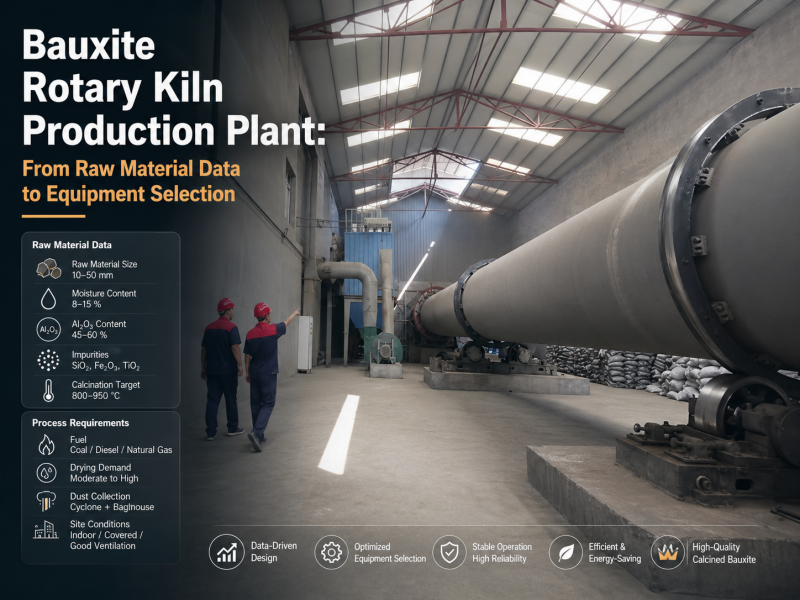
If the raw material data is not clear, the equipment recommendation may look reasonable on paper but fail to match real production. Bauxite size, moisture, chemical composition, impurity level, calcination temperature, fuel condition, and final product use all affect the process design.
For Sentai Machinery, bauxite calcination equipment selection should move from material data to system design, not from a machine list to a quotation only.
Bauxite from different mines can have different chemical and physical properties. Even if two materials are both called bauxite, their Al2O3 content, SiO2 content, Fe2O3 content, moisture, particle structure, and impurities may not be the same.
This matters because calcination is not only a heating process. The purpose may be to improve material properties for refractory material, abrasive material, cement industry use, or other industrial applications. Different final uses may require different calcination targets and product stability.
Before discussing kiln selection, buyers should prepare basic material information, including bauxite source, chemical analysis if available, expected final use, and photos or videos of the raw material. If the buyer already has a laboratory report, it should be shared before equipment selection.
Particle size has a direct effect on calcination uniformity.
If the raw bauxite size is too large, heat may not penetrate evenly during calcination. The surface may reach the target condition while the inside is not fully treated. If the size range is too wide, small particles and large particles will not need the same residence time inside the kiln.
This can lead to unstable final product quality. Some material may be over-treated while larger pieces are still under-treated.
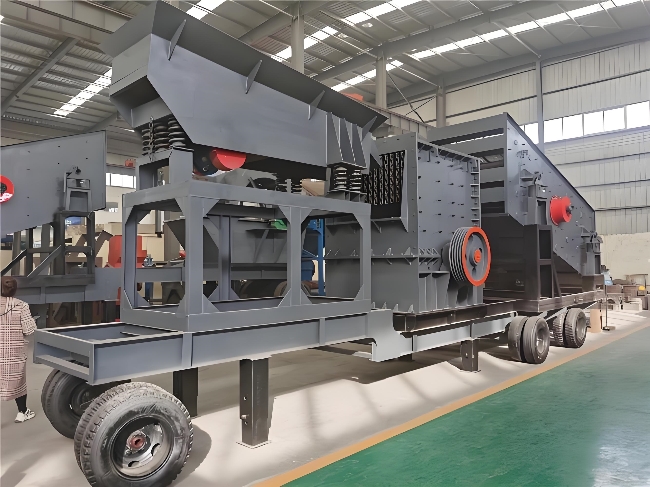
For this reason, crushing and screening before kiln feeding should be considered early. The goal is not only to reduce size, but also to control the size range entering the rotary kiln. A more stable feed size helps the kiln maintain more stable calcination results.
Moisture is another important factor in bauxite calcination plant design.
If the bauxite contains high or unstable moisture, part of the heat in the kiln system will first be used to evaporate water. This affects fuel consumption, heat balance, residence time, and exhaust gas volume.
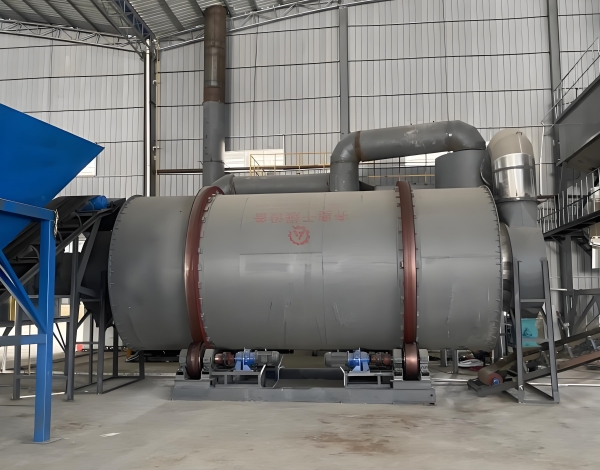
For some projects, a rotary dryer may be needed before the rotary kiln. Pre-drying can help stabilize feed moisture and reduce the heat load inside the kiln. For other projects, if moisture is low and stable, the system may not need an independent dryer.
The decision should not be made by habit. It should be based on real moisture data, seasonal changes, storage method, and final calcination requirement.
A bauxite rotary kiln production plant should be designed according to the final product requirement.
Different buyers may use calcined bauxite for different applications. Some care more about product strength. Some care about chemical stability. Some care about refractoriness or particle consistency. Some projects may need strict control of over-burning and under-burning.
This means the supplier must understand not only the raw material, but also the expected final product. Target calcination temperature, residence time, cooling method, and dust collection design may all change according to the final use.
If the final product requirement is not clear, kiln selection can only be rough. A better inquiry should connect bauxite data with product use from the beginning.
Fuel is not just an operating cost. It also affects kiln system design.
Different projects may use coal, gas, oil, biomass fuel, or other local fuels. Each fuel type has different combustion behavior, heat value, ash content, supply stability, and control requirement. If the fuel is unstable, the kiln temperature and heat distribution may also become unstable.
For bauxite calcination, stable heat supply is important for product consistency. When selecting equipment, buyers should confirm available fuel type, fuel quality, local cost, storage condition, and whether the site can support stable combustion control.
A rotary kiln should be matched with the heat source and combustion system, not selected as an isolated drum.
Some buyers focus mainly on the rotary kiln body and forget the supporting systems. This can create problems during installation and operation.
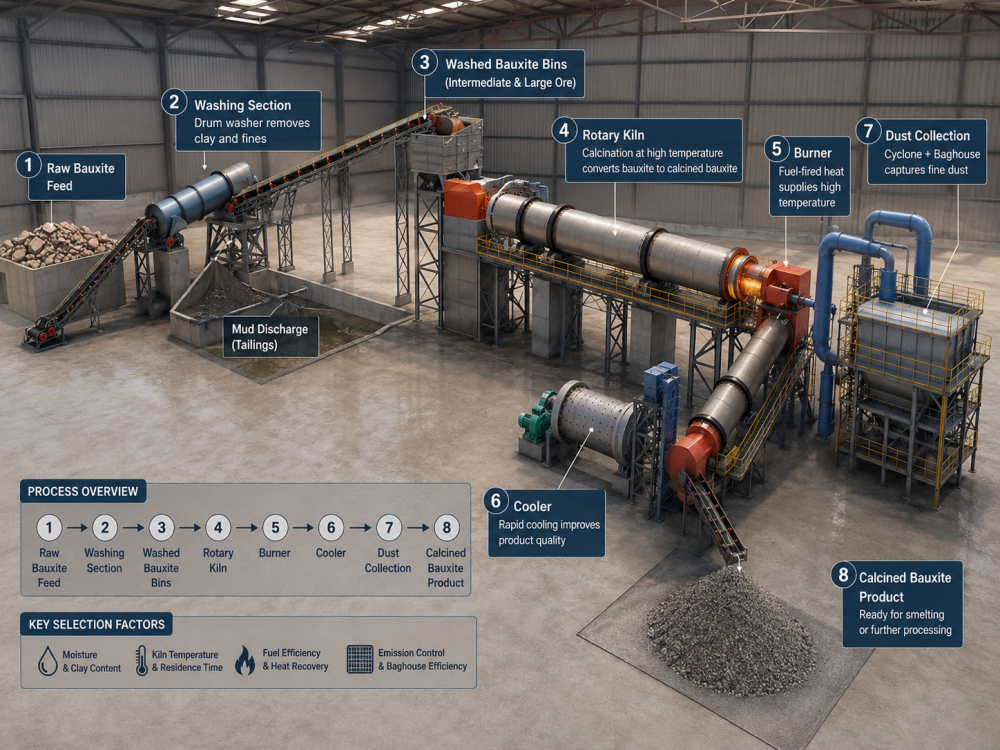
Bauxite calcination may produce dust and hot exhaust gas. The plant may need suitable dust collection, exhaust gas handling, sealing, and safe material transfer. After calcination, the hot material also needs cooling and conveying before storage or packing.
If these supporting systems are planned too late, the project layout may need changes after equipment manufacturing. This can increase time cost and installation difficulty.
A practical bauxite rotary kiln production plant should include feeding, kiln calcination, cooling, dust collection, conveying, and maintenance space as one system.
A bauxite calcination plant needs enough space for raw material storage, feeding equipment, rotary dryer if needed, rotary kiln, cooling system, dust collector, conveyors, finished product storage, maintenance access, and vehicle loading.
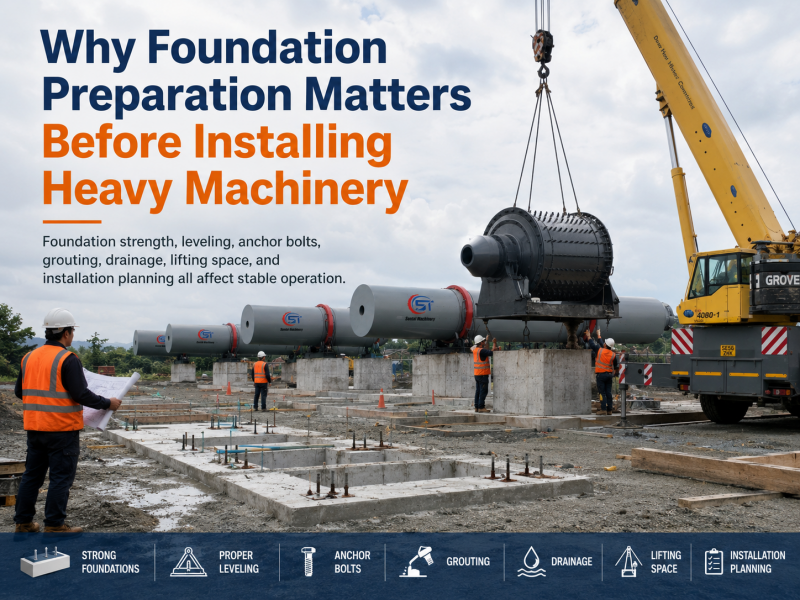
Power supply, foundation condition, installation space, local environmental requirements, and transport access should also be confirmed before final layout design.
If the site is narrow, equipment arrangement and conveyor direction need careful planning. If environmental requirements are strict, dust collection and exhaust gas handling should be considered from the beginning. If the site has limited power or fuel supply, equipment selection should be adjusted accordingly.
Information Needed | Why It Matters |
Raw bauxite source | Helps judge material behavior and process direction |
Chemical analysis | Supports calcination target and final product planning |
Particle size range | Affects crushing, screening, and calcination uniformity |
Moisture content | Decides whether pre-drying may be needed |
Impurity condition | Affects final quality and process stability |
Target capacity | Defines kiln size and supporting equipment scale |
Final product use | Guides temperature, residence time, and quality control |
Fuel type and quality | Affects combustion system and heat stability |
Site layout condition | Affects equipment arrangement and installation |
Environmental requirements | Affects dust collection and exhaust handling |
Preparing these details before quotation helps the supplier design a more realistic bauxite rotary kiln production plant.
A bauxite rotary kiln production plant should not be selected only by kiln size or price. The right solution depends on raw bauxite composition, particle size, moisture, final product use, fuel condition, dust collection, cooling, conveying, and site layout.
For buyers, the better question is not only "What size rotary kiln do I need?" A more useful question is "What raw material data and site conditions should be confirmed before choosing the calcination system?"
When the project starts from real material data, the equipment selection becomes more practical, and the production plant is easier to install, operate, and adjust.
If you are planning a bauxite calcination project, Sentai Machinery can help review your raw material data, particle size, moisture, final product requirement, fuel condition, site layout, and capacity target.
Send us your bauxite photos or videos, chemical analysis if available, feed size range, moisture condition, expected output, fuel type, and final product use. Our team can help prepare a suitable bauxite rotary kiln production plant solution.
1. What Affects Calcined Product Quality in a Rotary Kiln
2. Why Raw Material Preparation Matters Before Rotary Kiln Calcination
3. Why Rotary Kiln Output Is Not Only Decided by Kiln Size
4. Kaolin Calcination: Why Drying and Particle Control Matter Before the Kiln
5. Why Is Quicklime Quality Unstable After Rotary Kiln Calcination
 WhatsApp
 Email
Email
 +86 15538010601