
STCrushers Is A Professional Minging Equipment Manufacturer since 2004, Providing High Quality Crushers, Sand Making Machines, Drying Equipment and more.
Two suppliers quote a wet ball mill for the same ore. One offers a grate discharge mill and predicts more tonnes per hour. The other offers an overflow mill and highlights its simpler discharge end. Which quotation should a plant manager take seriously? Start by asking both suppliers to complete the same sentence: "This circuit will process ___ dry tonnes of new ore per hour, with 80% of the product passing ___ microns at the feed to the next process."
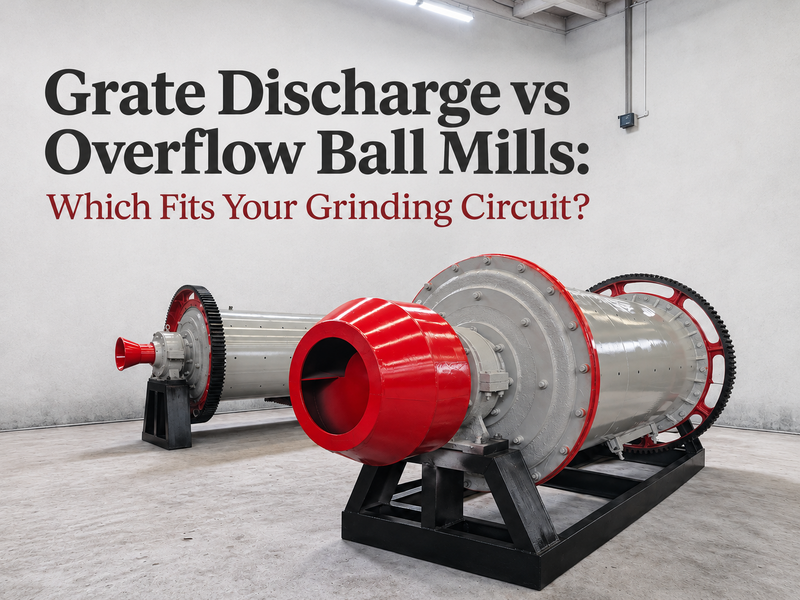
Either design might meet that duty. A grate mill is worth investigating when the rate at which slurry leaves the mill limits production. An overflow mill is a good starting point when it can deliver the required grind and the plant values having fewer discharge parts to maintain. A drawing explains the mechanical difference. A circuit balance tells you whether that difference matters to your plant.
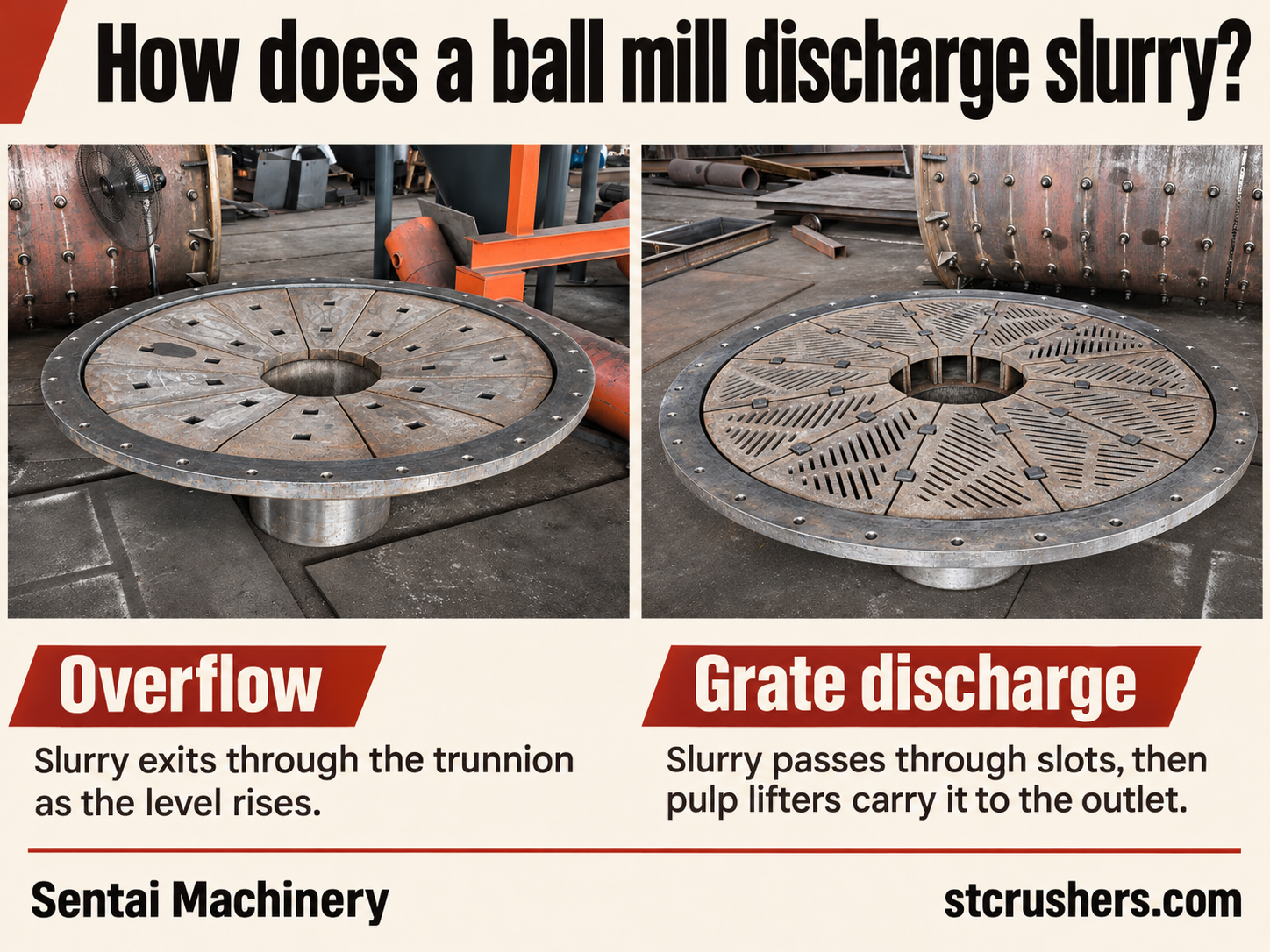
On a sectional drawing of an overflow ball mill, trace the slurry to the hollow outlet shaft, called the discharge trunnion. Ore and water leave when the slurry level reaches the outlet lip. Until then, some slurry stays pooled among the grinding balls. The word "overflow" describes how material exits; it does not mean that every particle leaving the mill is fine enough for flotation.
A grate discharge mill takes a different route. Slurry passes through openings in a grate at the discharge end. The grate holds back the grinding balls, while compartments behind it, called pulp lifters, carry slurry up as the mill turns and deliver it to the outlet. The mill can therefore discharge at a lower slurry level. If a quotation shows only an exterior photograph, request a sectional drawing: the outlet shaft is visible on both designs, but the slurry takes a different path to reach it.
What to compare | Grate discharge mill | Overflow mill |
How slurry exits | Through grate openings, then via pulp lifters | Over the lip of the discharge trunnion |
Where to look on the drawing | Grate panels, total open area and lifter compartments | Outlet elevation and trunnion lining |
What maintenance should price | Replacement panels and lifters, fasteners and access for a changeout | Wear liners and access at the outlet; no discharge grate or pulp lifters |
What establishes final fineness | Sample the classified product at the agreed fresh-feed rate | Use the same sampling point and fresh-feed rate |
Suppose a flotation plant needs a product P80 of 100 microns. That means 80% of the product passes 100 microns by mass. It does not mean the supplier should fit 100-micron grate openings. The grate must let slurry through while retaining the grinding media. In a closed grinding circuit, a separate device, such as a hydrocyclone or spiral classifier, separates a finer stream for the next process and returns a coarser stream for further grinding.
This distinction matters when two proposals both say "discharge fineness." One supplier may be quoting a sample at the mill outlet, before classification. The other may mean the product that actually goes to flotation. Mark the sampling point on each flow sheet. If the downstream process is sensitive to very fine particles, also request the size distribution: two products with the same P80 can contain different amounts of material at the fine end.
Consider an illustrative duty of 30 dry tonnes of new ore per hour. If the classifier returns 45 dry tonnes per hour to the mill, its inlet receives 75 dry tonnes of solids per hour. The plant still processes only 30 new tonnes. The other 45 tonnes have already been through the mill. Neither figure includes water, so neither tells you on its own how much slurry the discharge end must handle.
Now compare an offer for "up to 75 t/h through the mill" with one for "30 t/h fresh feed at the specified flotation feed size." The first number sounds larger, but it does not establish higher production. Request the assumed return load, slurry concentration and final product size from both suppliers. Once the numbers describe the same duty, ask what prevents the existing plant from reaching it: insufficient grinding power, restricted slurry discharge or a classifier that sends too much material back.
Take an existing overflow mill that already meets its fine-grinding target across the normal ore blend. If the owner wants a second line with the same output, the simpler discharge arrangement has a practical advantage: the maintenance crew knows the wear parts and can plan around previous shutdowns. A competing grate design needs to show an identifiable benefit under those conditions to justify carrying another set of spares.
The case changes if the existing mill holds a large slurry pool, has unused motor capacity and cannot accept more fresh feed at the required grind. Here a grate option deserves an engineering review. Ask how much slurry the proposed openings can pass and whether the lifters can carry that volume to the outlet. Larger openings alone do not settle the question. Compare expected energy use in kilowatt-hours per dry tonne of new feed at the same grind; a motor rating in kilowatts cannot tell you which option consumes less energy per tonne.
Give each supplier the same ore description, feed size distribution, available grindability results, dry fresh-feed target and required product size. Identify the classifier and the sampling point. For an operating line, include measured power, return load and slurry concentration from the same operating period. For a new line, ask the supplier to label estimates explicitly and identify which ones need ore testing. Request a discharge-end drawing and a priced wear-parts list with each offer so maintenance can review the decision alongside production.
The strongest reason to choose a grate mill is evidence that moving slurry out sooner will help the circuit reach its target. The strongest reason to choose overflow is that it can meet that target with a simpler outlet. If neither supplier can say where fineness will be measured or what "tonnes per hour" counts, settle those two questions before comparing prices.
Planning a new beneficiation plant or replacing an existing mill? Send Sentai Machinery your ore data, target fresh-feed rate and required product size. If you have a flow sheet, mark where the product is sampled so the quotation can use the same basis as your plant.
Related Articles: Ball Mill vs Wet Pan Mill for Gold Ore; How Much Water Does a Beneficiation Plant Need?
Product Links: Ball Mill; Spiral Classifier
Solutions Link: Beneficiation Plant

 WhatsApp
 Email
 +86 15538010601