
STCrushers Is A Professional Minging Equipment Manufacturer since 2004, Providing High Quality Crushers, Sand Making Machines, Drying Equipment and more.
STCrushers Is A Professional Minging Equipment Manufacturer since 2004, Providing High Quality Crushers, Sand Making Machines, Drying Equipment and more.
A buyer has selected a preliminary beneficiation route and received an equipment list for a target dry ore capacity. The site survey says that water is available, so the project appears ready for layout. One question remains unanswered: how much fresh water must the site supply while the plant is running?
Water moves through grinding, classification, separation, concentrate handling, and tailings. Part circulates inside the process, part returns from the tailings area, and part leaves the system. A practical estimate must follow those flows instead of applying one general figure to every ton of ore.
A plant rated at 50 TPH normally refers to dry solids entering the process. After water is added, the ball mill, spiral classifier, flotation cells, magnetic separators, pumps, launders, and pipelines handle slurry rather than dry ore alone. The resulting volumetric flow depends on the solids concentration at each process stage.
Two plants with the same dry capacity can circulate different amounts of water. One ore may reach useful liberation at a coarse grind and respond to a simple magnetic route. Another may need finer grinding, conditioning, several flotation stages, and more dilution points. Clay, ultrafines, ore moisture, and recycle load can change the flow again.
Water may first enter with wet ore or at the grinding section. More can be added to control mill discharge, classifier overflow, or slurry transfer. The separation stage may need additional dilution for conditioning, flotation, magnetic separation, or product cleaning. Concentrate and tailings then carry water away from the main circuit.
At every exit point, the design must identify whether water returns, remains in concentrate or tailings, or becomes a process loss.
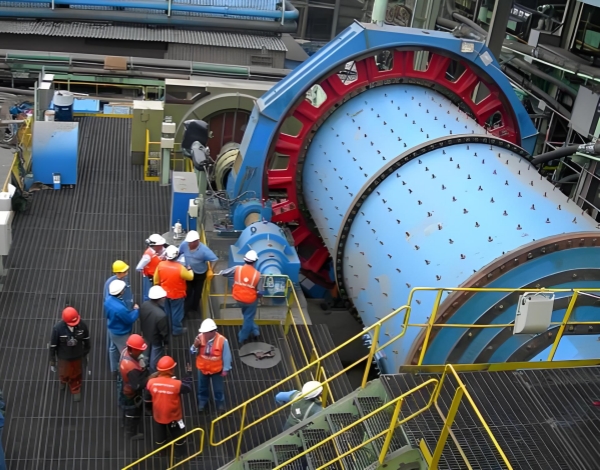
Wet grinding is often the first major circulating-water section. A ball mill reduces particle size while the discharge moves forward as pulp. A spiral classifier separates finer overflow from coarse particles that return for more grinding. Water influences pulp transport, classifier overflow, return sand, and the amount of material circulating through the mill.
A dense slurry can become difficult to move or classify consistently. Excessive dilution increases hydraulic flow and can reduce residence time or overload following equipment. The required condition depends on ore behavior, grind target, mill discharge, classifier duty, and downstream separation.
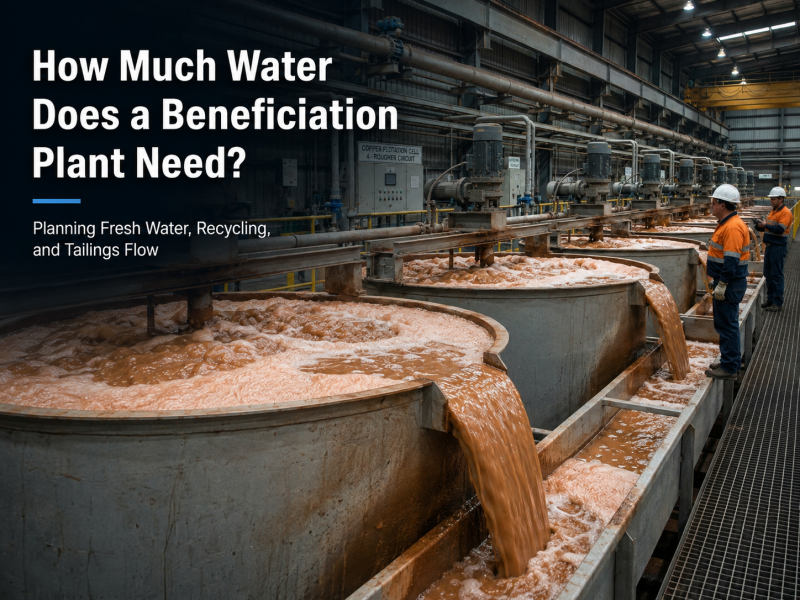
Flotation and wet magnetic separation use water differently. In flotation, slurry concentration affects conditioning, reagent distribution, air dispersion, bubble-particle contact, and froth movement. A change in dilution can alter both residence time and the amount of slurry passing through each cell, even when the dry feed rate is unchanged.
A wet drum magnetic separator is also sensitive to hydraulic loading. Very dilute feed increases slurry volume for the same dry tonnage, while an overly dense feed can increase particle crowding and unwanted entrainment. Feedbox flow, particle size, magnetic response, tank condition, and stage duty must be reviewed together.
Neither process supports a universal water-per-ton figure. The selected route, ore test work, and equipment duty must define the operating range before the water balance is calculated.
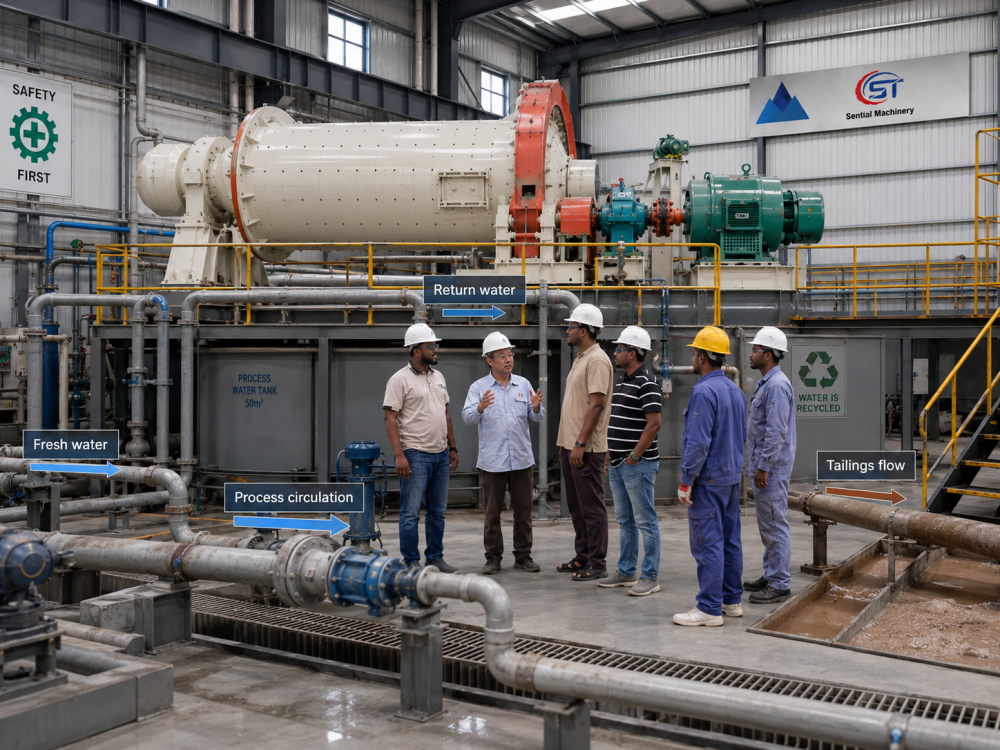
Total process water and fresh water supply are different design values. The total flow includes water already circulating between grinding, classification, separation, and return-water storage. Fresh make-up water replaces the portion that cannot immediately return.
Losses include moisture retained in concentrate and tailings, evaporation, leakage, washdown, and water discharged because its quality is unsuitable for reuse. Start-up demand can exceed normal make-up demand because tanks, pipelines, and process areas must first be filled. The source should be checked against start-up, normal operation, and interruption recovery.
Recovered water may still contain suspended ultrafines, dissolved salts, residual reagents, or other components released from the ore. Clear-looking water is not automatically neutral process water. Its effect depends on the mineral system and separation method.
In flotation, changing water chemistry can influence reagent response, froth, and selectivity. In classification or magnetic separation, suspended solids can change feed conditions and add fines to the circuit. Representative process-water testing may be appropriate when reuse is high or water quality is uncertain. The design should state where return water is acceptable and where cleaner water is required.
Tailings are a major exit path for both solids and water. The amount that can return depends on tailings concentration, settling behavior, storage method, recovery arrangement, distance, elevation, and available area. Slow-settling clay or very fine particles can make clarification and reuse more difficult than a simple process drawing suggests.
Concentrate handling also belongs in the balance because saleable product retains moisture after separation and dewatering. Both streams must be counted before estimating fresh supply. A late tailings plan can reveal that the water source, pond area, or return system is too small for continuous production.
A site with limited water needs more than a smaller supply pipe. Storage volume, settling area, return-water routing, elevation, pumping distance, seasonal availability, and emergency reserve can reshape the layout. A remote project may also need enough buffer to continue through temporary supply interruptions.
Reducing fresh demand may require better recovery and tighter loss control, but higher slurry concentration or greater reuse must be checked against process response. The selected route must remain workable for the ore.
A useful review begins with dry ore capacity, planned operating hours, ore moisture and clay condition, grinding target, separation route, and the expected slurry conditions from test work. The buyer should also provide the water source, reliable supply rate, seasonal variation, basic water quality, available storage area, elevation differences, and distance between the plant and tailings area.
The concentrate and tailings handling methods complete the picture. These inputs identify where water enters, circulates, returns, or leaves and which assumptions still need confirmation before final equipment sizing and layout.
Beneficiation plant water demand cannot be read from dry ore capacity alone. A reliable estimate separates total circulating water from fresh make-up water and connects both values to slurry concentration, process route, return-water quality, concentrate moisture, tailings behavior, and site conditions. When these flows are defined early, equipment duty and plant layout can be discussed on a more realistic basis.
If you are planning a wet beneficiation project, share the ore information and available test work, dry capacity, grinding and separation route, operating hours, water source, seasonal supply condition, tailings plan, and site layout. Sentai Machinery can review how the ball mill, spiral classifier, flotation machine, or magnetic separator connects with the expected slurry flow and which water assumptions should be clarified before a complete equipment proposal is finalized.
What Ore Test Work Is Needed Before Designing a Beneficiation Plant?
Iron Ore Processing Plant Design: Confirm Ore Type Before Choosing the Process Route
What Buyers Often Miss When Matching a Ball Mill and Spiral Classifier
Flotation Machine Selection: Why Ore Type and Slurry Condition Matter Before Cell Configuration
Wet Drum Magnetic Separator Feed Loading: Why Higher Throughput Can Increase Magnetite Losses
 WhatsApp
 Email
Email
 +86 15538010601