
STCrushers Is A Professional Minging Equipment Manufacturer since 2004, Providing High Quality Crushers, Sand Making Machines, Drying Equipment and more.
STCrushers Is A Professional Minging Equipment Manufacturer since 2004, Providing High Quality Crushers, Sand Making Machines, Drying Equipment and more.
Hot exhaust gas leaves the feed end of a rotary kiln while hot calcined product leaves the discharge end. Both streams carry energy, but they create different recovery opportunities. A preheater may use exhaust heat before fresh feed enters the kiln. A cooler lowers product temperature and may return heated air to combustion. Whether either unit belongs in the plant depends on the material, process, operating scale, and a practical use for the recovered heat.
A rotary kiln receives feed, fuel, and controlled air. It heats the material, drives the required physical or chemical change, and releases gas and product at elevated temperatures. Some heat completes the process; some leaves in exhaust gas, hot solids, and the kiln shell.
The two outlet streams should be evaluated separately. Kiln exhaust may preheat suitable feed. Hot product may transfer heat to cooling air before storage or conveying. Usable heat is not defined by temperature alone; gas volume, dust, moisture, product condition, and operating hours also matter.
A preheater creates contact between hot kiln gas and incoming material before the main calcination zone. Raising feed temperature can reduce part of the kiln duty. The arrangement must still provide controlled material movement, acceptable pressure drop, and safe dust separation.
A cooler works after calcination. It reduces product temperature for conveying, storage, or the next process. In an integrated design, air heated by the product may return toward the burner as combustion air. Cooling affects handling and heat use, but it does not perform the same function as preheating.
Limestone decomposition, bauxite calcination, ceramsite firing, kaolin treatment, and reduction processes do not share one temperature profile or atmosphere. The material calcining plant must be built around the required transformation and qualified product, not around a standard group of accessories.
Some feeds benefit from gradual heating. Others release vapor, organics, or process gas that changes exhaust treatment. Some products can be cooled with air; others require a controlled rate or atmosphere. The decision begins with process data, product requirements, and a heat and mass balance.
Particle size, moisture, bulk density, stickiness, and fines influence movement through a preheater. Free-flowing, reasonably uniform material may support stable gas-solid contact. Sticky or variable feed may bridge, build up, or flow unevenly. Excess fines increase entrainment and load on cyclones, fans, and filters.
High moisture needs separate attention. A preheater may remove some water, but an unstable moisture load consumes recovery capacity and disturbs gas conditions. Where substantial evaporation is required, an independent drying stage may be more controllable. Preheating and drying are not interchangeable labels.
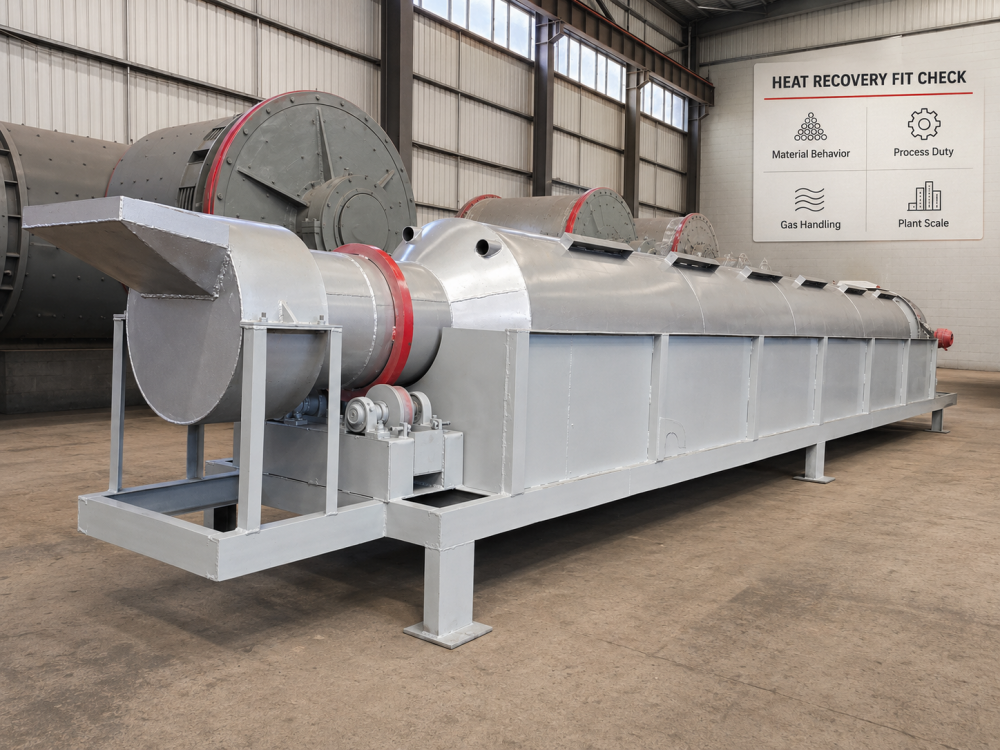
Material leaving the kiln may be too hot for ordinary conveyors, silos, packing equipment, or manual access. Cooling protects downstream equipment and makes handling safer. It may also affect quality because some calcined materials continue reacting, absorb moisture, or change condition during slow cooling.
The lime rotary kiln production plant includes cooling around quicklime handling. A ceramsite rotary kiln production plant connects cooling with heat returned to the kiln. These examples show system logic, not universal templates.
Heat recovery becomes valuable when another part of the process can use the available temperature and flow at the same time. High exhaust temperature does not prove that a preheater is economical, and hot product does not make one cooler arrangement universally suitable.
Heat leaving the process | Possible recovery path | Main design question |
Kiln exhaust gas | Preheat or partly dry suitable feed | Can the material move reliably while dust, moisture, and pressure drop remain controlled? |
Hot calcined product | Heat cooling air for return to combustion | Does the product tolerate the cooling method, and can the burner use the returned air? |
Shell and radiation losses | Improve refractory or insulation where appropriate | Can heat loss be reduced without creating unsafe shell conditions or hiding refractory problems? |
Fuel demand still depends on reaction duty, feed moisture, fuel quality, excess air, leakage, production stability, and heat loss. One saving percentage cannot describe all kiln applications.
A preheater adds resistance to the gas path. A cooler adds air movement, seals, drives, discharge connections, and another possible dust source. Fans and ducts must maintain suitable pressure, while the burner receives controlled rather than leaking air.
This is why rotary kiln air leakage matters in a heat-recovery design. Extra equipment cannot compensate for worn seals or uncontrolled gas flow. Dust and emissions equipment must match the actual gas volume, temperature, chemistry, and particulate load.
A smaller project with moderate operating hours, variable feed, limited space, or existing downstream cooling may not justify every recovery stage. A specialized material may also be unsuitable for direct contact in a conventional preheater or air cooler. A simpler line can then reduce interfaces and maintenance.
The decision should compare installed scope and operating conditions. Removing equipment without checking discharge temperature, exhaust treatment, or product quality can move costs elsewhere. Simplicity works only when every required function has a clear solution.
Preheating and controlled cooling deserve evaluation when the plant runs continuously, feed is stable, fuel cost is important, and useful heat leaves at recoverable temperatures. Recovery equipment performs poorly when feed and gas conditions repeatedly move far from the design basis.
Capacity must refer to qualified product, not a short feed peak. As explained in Why Rotary Kiln Output Is Not Only Decided by Kiln Size, supporting equipment can limit the plant. Preheater, cooler, fan, dust collector, conveying, and controls must accommodate continuous duty.
Two quotations may list the same kiln size while covering different thermal systems. One may include the kiln body and drive; another may add preheating, burner, cooler, fans, ducts, dust collection, controls, and commissioning. The cement rotary kiln quotation scope shows why supply boundaries must be clear.
Fuel also affects the surrounding equipment. Coal, natural gas, and fuel oil require different preparation, delivery, combustion, and safety arrangements. Recovered hot air must be integrated with the burner and control strategy.
Sentai Machinery should receive the material analysis, feed size, moisture range, bulk condition, target product, process temperature, qualified output, working hours, and fuel data. The inquiry should also state discharge temperature, downstream handling, site altitude and climate, layout limits, electricity, environmental requirements, and existing equipment.
These inputs support the heat balance and define interfaces among the kiln, preheater or dryer, cooler, burner, fan, dust collector, conveying, and controls. They also show where testing is required before the scope is frozen.
A preheater and cooler are not automatic accessories selected from kiln diameter. They need suitable material flow, a usable heat path, and matched gas handling. The practical configuration may be a simple kiln line or an integrated recovery system. The answer comes from the material, product requirement, operating plan, and thermal balance.
If you are planning a rotary kiln calcining project, send Sentai Machinery your material analysis, feed size and moisture, target product, capacity, operating schedule, fuel condition, desired discharge temperature, site layout, and environmental requirements. Our team can review the complete process and determine whether preheating, independent drying, product cooling, and heat recovery should be included in the proposed system.
Rotary Kiln Fuel Selection: How Coal, Natural Gas, and Fuel Oil Change Burner and System Design
What Affects Calcined Product Quality in a Rotary Kiln
Why Rotary Kiln Output Is Not Only Decided by Kiln Size
Cement Rotary Kiln Quotation Scope: Are You Buying a Kiln Section or a Complete Clinker Line?
 WhatsApp
 Email
Email
 +86 15538010601