
STCrushers Is A Professional Minging Equipment Manufacturer since 2004, Providing High Quality Crushers, Sand Making Machines, Drying Equipment and more.
STCrushers Is A Professional Minging Equipment Manufacturer since 2004, Providing High Quality Crushers, Sand Making Machines, Drying Equipment and more.
A buyer planning a 100 TPH sand washing plant may ask for one water-consumption figure. The equipment supplier may instead need three: the flow required at the washing equipment, the water circulating through the recovery system, and the fresh water that must enter continuously. These figures are related, but they are not interchangeable. A plant can move a large volume through pumps and sprays while drawing only the make-up water needed to replace losses. The real requirement depends on the material, the product, and the way water and solids leave the circuit.
Plant capacity establishes the amount of material entering the process, but it does not describe the washing duty. Clean crushed stone may need controlled rinsing, while weathered feed containing clay may require stronger washing and more separation work. Both plants can be described as 100 TPH, yet their water systems can be very different.
The production basis also matters. A figure may refer to wet feed entering the line, dry solids, or finished sand leaving after washing and dewatering. If those definitions are mixed, water demand and saleable output can both be misunderstood before equipment selection begins.
Water delivered to a washer or wet screen does not necessarily come directly from a well, river, or municipal connection. In a partly closed circuit, clarified water returns from a pond or treatment unit and mixes with make-up water. The pump sees the combined flow. The source supplies only the portion that the circuit cannot recover.
This is why a pump rating cannot be copied into a daily water-source requirement. Pump and pipe selection must support the working flow and pressure at the equipment. Fresh-water planning must replace water carried away with product, sludge, purge, evaporation, leakage, and other losses. Both calculations are necessary, but they answer different questions.
Incoming material is not always dry. Sand from a wet stockpile or previous wet stage brings water into the balance and may also create irregular slurry concentration.
Clay and silt increase the suspended load that the water circuit must separate. Sticky clay may need more contact or scrubbing than loose stone powder. Feed evaluation should therefore cover moisture, grading, clay condition, and valuable fines that should remain in the product.
Under stable operation, fresh make-up broadly replaces the water leaving with dewatered sand, sludge or pond sediment, deliberate purge, evaporation, splashing, and leakage, after accounting for water entering with the feed. This is a planning relationship, not a universal sizing formula.
Finished sand retains moisture after dewatering, and thickened sludge also holds water. A circuit may need a controlled bleed if dissolved salts or ultrafine solids build up. Each outlet should be estimated separately because one assumed recycling percentage can hide the main loss.
The article Does Manufactured Sand Need Washing? explains that some products can move from dry screening to stockpiling while others need a wet section. Once wet processing is chosen, the target still has to be defined. Removing loose dust, dispersing clay, controlling excess fines, and meeting a strict cleanliness specification are different duties.
Adding water alone does not guarantee a cleaner product. Agitation, retention, spray coverage, screen area, slurry density, and material behavior also matter. Excessive flow can carry usable fine sand into the slurry and overload downstream recovery.
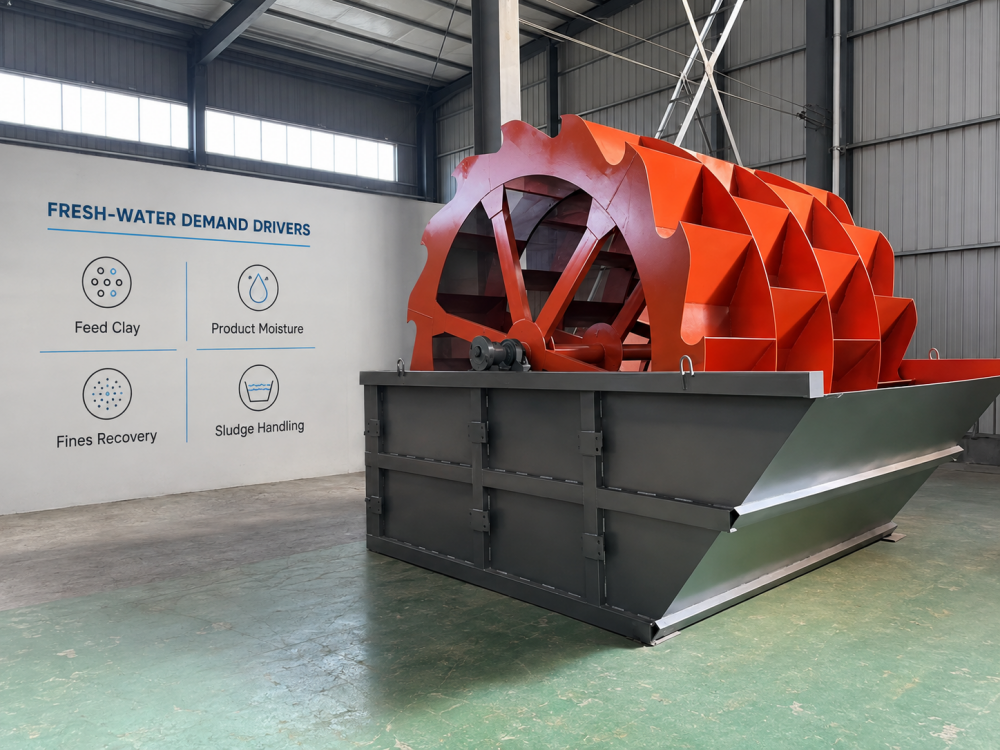
Fine sand recovery equipment is intended to return suitable particles that would otherwise leave with process water. Water clarification removes or concentrates the remaining suspended solids so that water can be reused. Recovering saleable sand does not automatically make the overflow clean enough for unrestricted return.
This distinction is visible in a connected wet circuit. The rod mill sand making circuit guide separates washing, fine sand recovery, and dewatering because each stage controls a different outcome. The water system must also provide a destination for the clay and ultrafine material that should not return to the product.
Dewatering affects conveying, stockpile drainage, truck loading, and the water balance. High product moisture carries more water out of the circuit. Later stockpile drainage is recoverable only when it is intentionally collected and returned.
A dewatering unit should be evaluated against actual wet feed and slurry condition, not only dry plant capacity. Screen area, concentration, grading, and drainage time influence final moisture. One moisture value cannot describe every sand.
A settling pond or clarifier is sometimes treated as a utility added after the main equipment is selected. In practice, it can limit continuous production. If suspended solids enter faster than the system can settle, concentrate, or remove them, returned water becomes progressively dirtier and available pond volume decreases.
Required area and retention cannot be selected from plant TPH alone. Fine particle behavior, flocculation testing where relevant, slurry concentration, operating hours, sludge-removal frequency, rainfall, and available land all matter. The water-recovery section needs its own capacity basis and maintenance plan.
Water does not need to be drinking-water quality to return to many washing circuits, but it must remain suitable for the intended duty. Excess suspended clay can reduce the cleaning gradient between the sand and water. Solids may accumulate in tanks, pipes, spray bars, and nozzles, while variable density makes operation harder to control.
The plant may use clearer water for final rinsing and recycled water for earlier washing. Reuse should be judged by product quality and process performance, not only by the percentage returned.
A sand making plant may have enough crushing and screening capacity while the site lacks a reliable water source, pond area, drainage route, or acceptable sludge destination. Seasonal drought, freezing conditions, heavy rainfall, and local discharge rules can change the practical design.
The published 200TPH sand-making washing plant shows how crushing, screening, sand making, and washing can form one production route. A project-specific water circuit must go further by defining supply, return, clarification, drainage, and sludge handling around the selected equipment.
A useful inquiry should state whether capacity refers to wet feed, dry solids, or finished sand. It should identify operating hours, feed moisture, clay and fines condition, target grading, cleanliness requirement, and acceptable product moisture. Raw material photos help, but samples or test data may be needed when clay and settling behavior are uncertain.
Site information should cover water quantity and quality, seasonal changes, elevation, treatment area, rainfall, discharge restrictions, and the sludge destination. The quotation should distinguish washing equipment, pumps, pipelines, fine sand recovery, dewatering, clarification, storage, and civil works. This is more reliable than attaching one water figure to crusher capacity.
The question is not only how much water a sand washing plant moves. The project must know how much flow the equipment needs, how much water can return at suitable quality, where water and solids leave, and how much fresh make-up the site can provide continuously. When these figures are separated, the plant can be sized around realistic washing duty instead of a misleading single number.
If you are planning a wet sand production project, send Sentai Machinery your raw material photos or analysis, feed moisture, clay and fines condition, capacity basis, finished sand specification, operating schedule, water-source information, site layout, and local reuse or discharge requirements. Our team can review the washing, fine sand recovery, dewatering, water return, and sludge-handling scope as one connected system.
Does Manufactured Sand Need Washing? When Dry Screening Is Enough and When a Wet Process Makes Sense
What Buyers Often Ignore When Choosing a Sand Washing Machine
How to Choose Equipment for a Sand Making Plant
Rod Mill Sand Making Circuit Design: Feed Preparation, Screening, and Product Size Control


 WhatsApp
 Email
Email
 +86 15538010601