
STCrushers Is A Professional Minging Equipment Manufacturer since 2004, Providing High Quality Crushers, Sand Making Machines, Drying Equipment and more.
STCrushers Is A Professional Minging Equipment Manufacturer since 2004, Providing High Quality Crushers, Sand Making Machines, Drying Equipment and more.
A delivery truck can enter the project site with every major machine listed on the packing list, yet the plant may still be far from producing saleable aggregate. Foundations may be unfinished, conveyor supports may not be aligned, cables may not have arrived, or the crushing circuit may still need adjustment. The delivery date is therefore a logistics milestone, not the production-start date.
A realistic stone crusher plant construction timeline follows the dependencies that turn separate machines into one operating system. Some work can proceed in parallel; other work cannot begin until drawings, concrete, power, access, or mechanical completion have been released. The useful question is not simply how many days the project takes, but what must be ready before each milestone can move.
Manufacturing cannot be planned accurately while the process remains open. Raw material, maximum feed size, required capacity, finished sizes, recirculating load, dust-control scope, motor standard, and site voltage affect the equipment list and arrangement. The buyer should provide the site information needed before plant layout design before treating the schedule as fixed. Late changes to the flow sheet or product grading can alter foundations, conveyors, controls, and the shipping plan.
Once the process is confirmed, equipment arrangement and civil drawings release the site team to work. Foundation dimensions, elevations, anchor-bolt positions, maintenance clearances, truck routes, drainage, stockpile areas, and cable routes must agree with the final layout. The importance of foundation preparation is not limited to concrete strength: position and elevation determine whether crushers, screens, chutes, and conveyors can be assembled into a continuous line. Pouring early against an unapproved drawing may save calendar time on paper but create rework later.
The largest schedule gain normally comes from parallel preparation. While Sentai Machinery manufactures and assembles the equipment scope, the buyer can complete earthwork, foundations, access roads, utilities, lifting plans, local fabrication, and storage arrangements. Parallel work is effective only when both sides use controlled drawings and a clear responsibility boundary. A revision that reaches the factory but not the civil contractor can break the assumed time saving.
Milestone | Parallel? | Release condition |
Process confirmation | No | Material, capacity, products, site data, voltage, and supply boundary are approved. |
Manufacturing and civil work | Yes | Issued drawings remain controlled and revisions reach both factory and site teams. |
Shipping | Partly | Packing is complete; site access, unloading, storage, and customs plans are ready. |
Mechanical installation | No | Foundations are accepted and lifting resources, tools, and installation materials are available. |
Electrical and no-load tests | Partly | Mechanical alignment is released and power, cables, protection, and controls are ready. |
Trial production | No | No-load checks pass and representative feed, operators, and product acceptance criteria are available. |
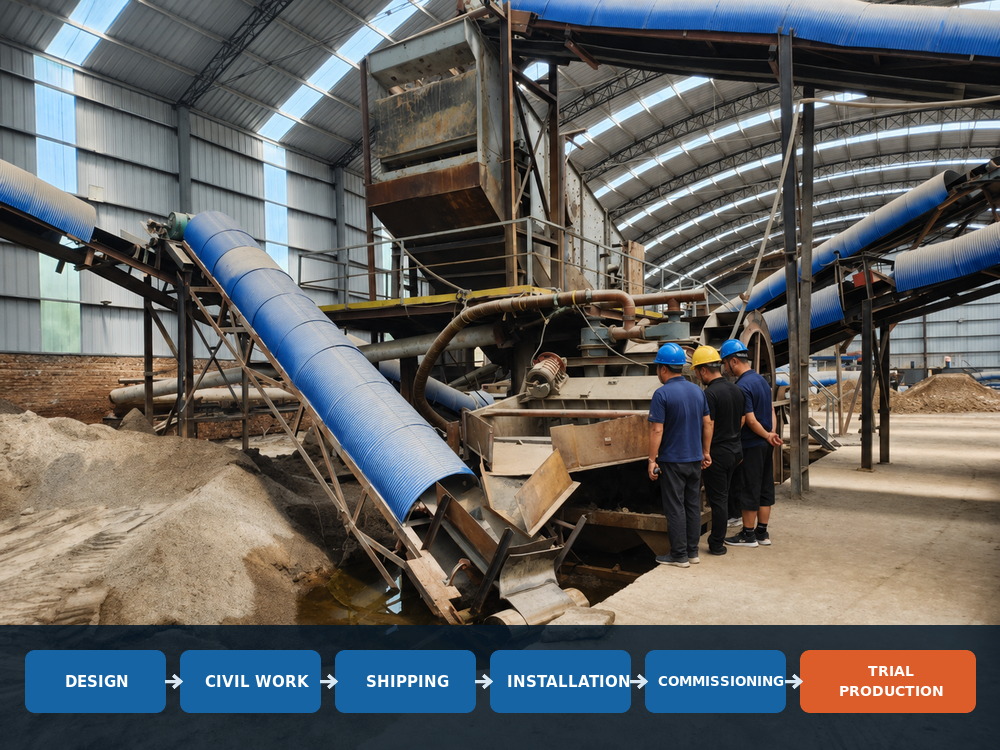
During packing and transit, the project should prepare for receipt rather than wait for the cargo. The team needs confirmed unloading capacity, internal transport, secure storage, lifting access, and a method for checking packages against documents. Port clearance and inland transport can remain on the critical path even after the vessel arrives. A route survey should confirm bridge limits, road width, turning space, and whether long conveyor sections or heavy machines require special handling. These buyer-side arrangements should be scheduled against the expected cargo release, not started after the equipment is already waiting at the port. The arrival inspection described in What Buyers Should Check When Equipment Arrives at the Project Site protects the installation sequence: missing or damaged items should be identified before crews and cranes are mobilized around an incomplete work front.
Mechanical installation includes more than setting a jaw crusher on its foundation. Feeders, secondary crushers, vibrating screens, conveyors, chutes, guards, platforms, lubrication systems, and supporting structures must be positioned, aligned, fastened, and checked as one flow. Conveyor elevation or chute-interface errors can stop downstream work even when every main machine is present. Mechanical completion should therefore be recorded by area or subsystem, not declared only because the heaviest equipment has been lifted into place.
Cables, motor control, protection, emergency stops, interlocks, sensors, and sequence logic connect the machines into an operable plant. The project power plan must also match connected load and starting demand, a distinction covered in How Much Power Does a Stone Crusher Plant Need? No-load testing then verifies rotation direction, lubrication, belt tracking, vibration, clearances, safety devices, and start-stop logic. Finding these issues before stone enters the circuit makes correction safer and more controlled.
Trial production is not simply the first time stone passes through the plant. Feed rate is increased in a controlled way while crusher settings, screen performance, circulating load, conveyor loading, dust behavior, motor current, and product gradation are observed. The finish line is stable production of acceptable aggregate under the agreed operating conditions. If the raw material used for commissioning differs from the design basis, the trial may prove that machines rotate but not that the plant can meet its intended product target.
Delay often accumulates at interfaces rather than inside a single machine. Common examples include late layout approval, foundations built to an outdated revision, customs clearance without inland transport, missing lifting tools, incomplete cable supply, unavailable commissioning feed, or unclear responsibility for chutes and supports. Weather and local permits may also control the calendar. These risks are project-specific, which is why a fixed online answer for crusher plant installation time can be misleading even when two plants have similar nominal capacity.
A workable stone crushing plant project schedule names the evidence required at each handover: approved flow sheet, released layout, issued foundation drawings, civil acceptance, packing completion, cargo receipt, mechanical completion, electrical release, passed no-load test, and qualified trial production. It should also identify the owner of every buyer-side and supplier-side task. The same principle used when building the budget from equipment quotation to first production applies to time: the schedule is complete only when every activity required to reach production has been included.
A stone crusher plant is built through a chain of released conditions, not by counting from the delivery date alone. Early process confirmation allows manufacturing and civil work to overlap; disciplined drawing control protects that overlap; and staged installation, testing, and commissioning turn equipment into a production line. When the plan follows these dependencies, the expected start date becomes easier to defend and delays become easier to manage.
If you are planning a crushing project, send Sentai Machinery the raw material, maximum feed size, required capacity, finished aggregate sizes, site drawing or available dimensions, power supply, destination, and expected supply boundary. Our team can review the process, layout, civil interface, equipment scope, and commissioning path to build a realistic milestone plan. Explore our stone crusher plant solutions or contact us through stcrushers.com.
How Much Does a Stone Crusher Plant Cost? Build the Budget From Equipment Quote to First Production
What Site Information Should Buyers Provide Before Plant Layout Design
80-100 TPH Stone Crusher Plant
100-150 TPH Stone Crusher Plant
Why Foundation Preparation Matters Before Installing Heavy Machinery
What Buyers Should Check When Equipment Arrives at the Project Site


 WhatsApp
 Email
Email
 +86 15538010601