
STCrushers Is A Professional Minging Equipment Manufacturer since 2004, Providing High Quality Crushers, Sand Making Machines, Drying Equipment and more.
STCrushers Is A Professional Minging Equipment Manufacturer since 2004, Providing High Quality Crushers, Sand Making Machines, Drying Equipment and more.
Two wet feeds can both be described as 20 TPH while placing very different loads on a dryer. One may be a drained granular material that carries mainly surface moisture. The other may contain a large amount of free water, sticky fines, or water trapped inside compact lumps. Their wet weights look similar on a quotation sheet, but the quantity of water that must be evaporated each hour can be very different.
This distinction matters because thermal drying is usually the most energy-intensive moisture-removal stage. Before selecting an industrial rotary dryer, the project team should decide whether drainage, screening, pressing, filtration, or another mechanical method can remove part of the water. Pre-dewatering keeps the dryer focused on moisture that genuinely requires heat.
A dryer receives wet material, but the project normally uses or sells the dry solids. If capacity is stated only as wet feed, water can make production appear larger than the useful product flow. Capacity should therefore include the wet feed rate, initial moisture, target final moisture, and expected dry-product output.
The dryer load is governed largely by the amount of water that must be evaporated per hour. When upstream drainage changes, that amount changes even if the conveyor scale still shows the same wet tonnage. This is also why unstable feed moisture can produce unstable fuel demand and discharge moisture, as explained in Rotary Dryer Feed Moisture Fluctuation.
Not all water inside a wet feed has the same relationship with the solid material. Free water may drain from a stockpile or pass through a dewatering screen. Surface moisture can sometimes be reduced by vibration, pressure, filtration, or centrifugal force. Moisture held in fine pores, absorbed by organic material, or trapped inside dense lumps is more difficult to separate mechanically and often remains a thermal duty.
The boundary is material-specific. Washed sand may release water readily, while fine mineral concentrate can retain it through capillary forces. Sludge may form a compressible cake, and sawdust can hold moisture within its fibers. A moisture number alone cannot describe these differences. A sample, drainage observation, and simple dewatering test reveal more about the practical process.
Pre-dewatering is worth evaluating when material comes from washing, classification, thickening, or another wet process. It also deserves attention when moisture changes with weather, stockpile management, or upstream water flow. Removing free water can reduce the fluctuation reaching the thermal system.
The review becomes especially relevant when fuel is expensive, heat supply is limited, exhaust treatment is near capacity, or the required dry output cannot be reached. For washed sand, dewatering and controlled stockpile drainage may improve consistency before a three cylinder sand dryer. Sludge or fine concentrate may require a different method.
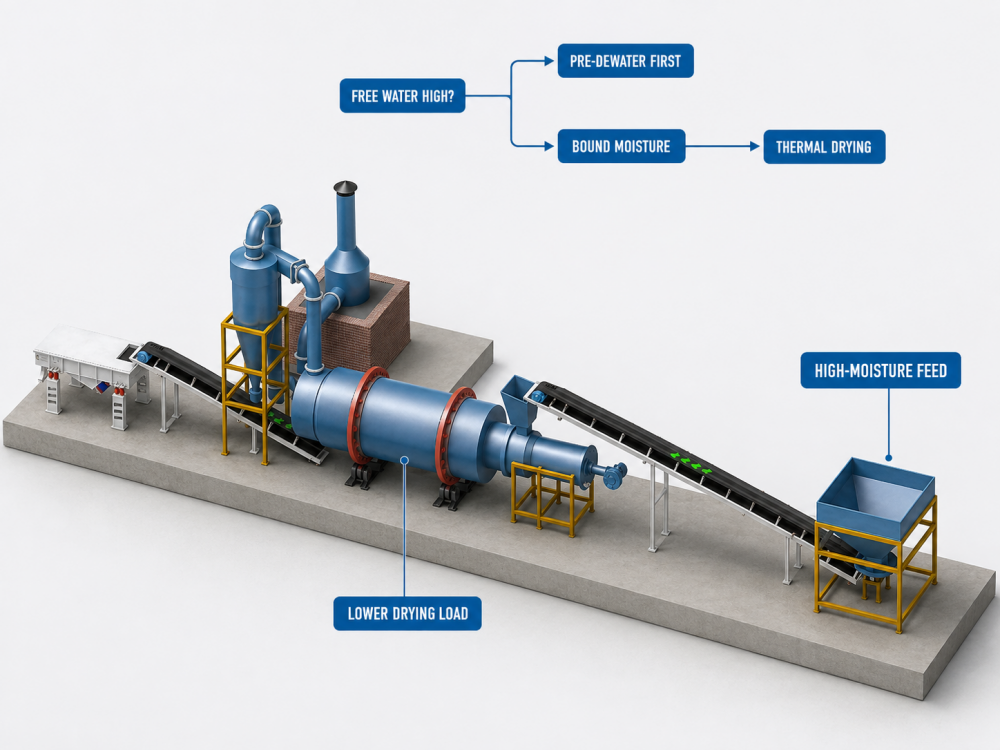
Adding a dewatering machine does not guarantee a useful result. Fine particles may pass through or blind a screen. Sticky feed may build up in chutes, and filter cake may be difficult to break and distribute inside the dryer. Some materials also need flocculants or controlled feed pressure.
Product loss also matters. If valuable fines leave with the water, lower dryer load may create a recovery problem elsewhere. The method must be judged by water removal, solids recovery, cake handling, maintenance, and its effect on dryer feeding. As described in Why Wet Material Condition Matters More Than Dryer Model Alone, feed behavior changes the whole system design.
When less water enters the dryer, less evaporation duty is imposed on the heat source. Depending on the project, that may allow a higher dry-solids throughput, a smaller thermal system, more stable final moisture, or additional operating margin during wetter feed periods. It can also reduce the volume of water vapor that the exhaust and dust-control system must handle.
These are possible engineering outcomes, not fixed promises. Fuel consumption still depends on moisture, material temperature, heat losses, exhaust conditions, dryer configuration, airflow, and control. Pre-dewatering also adds electrical load, floor space, water-management equipment, and maintenance. The project should compare the complete process.
The final moisture target should come from the next process. Sand for dry mortar may need consistent low moisture. Material entering a mill or kiln may need stable feeding rather than the lowest achievable moisture. Biomass for pelletizing and sludge prepared as fuel have different economic endpoints.
This downstream requirement helps divide the duty. Mechanical separation may remove economical free water, and the rotary dryer can then provide the controlled final moisture that drainage or filtration cannot reach. Pursuing extra mechanical dewatering after the material has stopped releasing water efficiently may only increase complexity. Sending easily removable water into the dryer can be equally inefficient.
Direct drying remains reasonable when the initial moisture is moderate, the feed is loose and uniform, and a mechanical stage would remove little additional water. It may also suit projects where the material is difficult to filter, solids loss would be unacceptable, or the added equipment would create more handling problems than it solves.
Site constraints can influence the choice as well. A compact plant with reliable low-cost heat may accept a larger thermal duty to avoid another wet-processing circuit. However, this decision should be based on a moisture balance and material test, not on the assumption that one arrangement suits every feed.
A useful project review begins with the material name, source, particle-size range, bulk condition, stickiness, and temperature sensitivity. Moisture data should include the normal range and the wetter condition that the plant must still handle. Capacity must be identified as wet feed, dry solids, or finished dry product.
The review should also record final moisture, heat source, operating hours, existing drainage equipment, water-disposal route, site space, and the next process. Photos and videos show whether material drains, forms lumps, sticks, or flows freely, but representative testing remains the strongest basis for a recommendation.
Pre-dewatering and rotary drying are not competing technologies. They handle different parts of the same moisture-removal task. A sound process places free water, surface moisture, and harder-to-remove internal moisture in the stages that can manage them most effectively. Defining that boundary before equipment selection can make capacity expectations clearer and the complete drying line more stable.
If you are planning a drying project, send Sentai Machinery the material description, initial and target moisture, particle size, wet-feed or dry-output capacity basis, available heat source, and details of any existing drainage equipment. Our team can review whether direct rotary drying or a pre-dewatering-plus-drying arrangement is more suitable for your site. Explore the Sentai Machinery product range or contact us through stcrushers.com.
Rotary Dryer Feed Moisture Fluctuation: Why Fuel Use and Discharge Moisture Become Unstable
Why Wet Material Condition Matters More Than Dryer Model Alone
Sand Drying Plant Design: What Changes When the Final Moisture Target Is Strict
How Different Materials Change Rotary Dryer Design
 WhatsApp
 Email
Email
 +86 15538010601