
STCrushers Is A Professional Minging Equipment Manufacturer since 2004, Providing High Quality Crushers, Sand Making Machines, Drying Equipment and more.
STCrushers Is A Professional Minging Equipment Manufacturer since 2004, Providing High Quality Crushers, Sand Making Machines, Drying Equipment and more.
In many sand drying projects, buyers first ask about dryer capacity.
How many tons per hour can the dryer handle? What is the model size? How much fuel will it use?
These questions are important, but they are not enough. For sand drying, the final moisture target can change the whole plant design.
Drying wet sand from very high moisture to a medium level is different from drying sand to a strict final moisture level for dry mortar, packaging, storage, or industrial use. The closer the material gets to a low final moisture target, the more carefully the system must control heat, residence time, airflow, feeding, discharge, and storage.
A sand dryer should not be selected only by wet sand input capacity. It should be selected according to initial moisture, final moisture, sand use, fuel condition, site layout, and daily operation method.
Not every sand drying project has the same final moisture requirement.
For general construction sand, the moisture target may not be extremely strict. The buyer may mainly want to reduce water content so the sand is easier to store, transport, or use.
For dry mortar sand, the requirement is usually more controlled. Moisture fluctuation can affect mixing, packaging, storage stability, and final product quality. In this case, the sand drying plant must produce a more consistent final result.
For washed sand before storage or packaging, the plant may need to remove free water and reduce moisture to a stable level. The upstream washing process, sand pile condition, and weather can all affect the feed moisture entering the dryer.
For some projects, dried sand may also be used before further processing. In that case, moisture stability may affect the next production stage.
This is why the buyer should not only say "I need a sand dryer." It is better to explain where the dried sand will be used and what final moisture range is expected.
One of the most common misunderstandings is the relationship between capacity and final moisture.
If the buyer requires a lower final moisture level, the dryer usually needs more heat and more effective drying time. Even if the dryer model is the same, the practical output may be different under different final moisture targets.
For example, a sand dryer may process more material per hour when the required final moisture is moderate. But if the target moisture becomes much lower, the same system may need to reduce feed rate to ensure the final product is dry enough.
This does not mean the dryer is weak. It means the drying task has changed.
Capacity must always be discussed together with:
1. Initial moisture
2. Final moisture target
3. Sand particle size
4. Feed stability
5. Heat source condition
6. Working hours per day
7. Final sand application
If these conditions are not clear, the quoted capacity may not match real production.
Sand moisture is not always stable.
Wet sand from washing equipment may carry different amounts of water during the day. Sand stored outdoors may absorb rainwater. Sand from different piles may have different moisture content. If feeding is not controlled, some batches may enter the dryer much wetter than others.
When feed moisture rises, the dryer must evaporate more water. This increases heat load and may reduce output. When feed moisture drops, the same dryer may produce drier material or require heat adjustment.
Strict final moisture control needs stable feeding and stable upstream material management.
For washed sand projects, the buyer should pay attention to drainage before drying. A dewatering screen, proper stockpile slope, or controlled feeding method can help reduce moisture fluctuation before the sand enters the dryer.
Drying should not be asked to solve every upstream moisture problem by itself.
A three cylinder sand dryer is often considered for sand drying projects because sand is a relatively suitable granular material for this structure.
Compared with some longer single drum dryer layouts, a three cylinder structure can help save site space and increase the heat exchange path inside a compact body. For many sand drying plants, this can be useful when the buyer wants a compact system and efficient heat use.
However, this does not mean a three cylinder sand dryer is suitable for every wet material. Sand usually has better flowability than sticky sludge, coal slime, or some high moisture organic materials. Materials that are sticky, lumpy, or difficult to disperse may need a different dryer design or additional pre-treatment.
For sand drying, the key is to check whether the material can move smoothly through the dryer, whether the feed moisture is suitable, and whether the final moisture target can be reached under stable operation.
The dryer type should follow material behavior and final moisture requirement, not only the idea of saving space.
A strict final moisture target requires stable heat supply.
If the heat source fluctuates, the final sand moisture will also fluctuate. Fuel type, furnace design, burner control, air volume, and temperature control all affect drying stability.
Some buyers focus only on the dryer body and ignore the heat source. This can become a problem. Even a suitable sand dryer cannot produce stable final moisture if the hot air supply is unstable.
For sand drying plants, common heat source considerations include:
1. Fuel availability
2. Fuel cost
3. Heat stability
4. Temperature control
5. Air volume matching
6. Dust and exhaust treatment
The heat source and dryer should be selected together as one system.
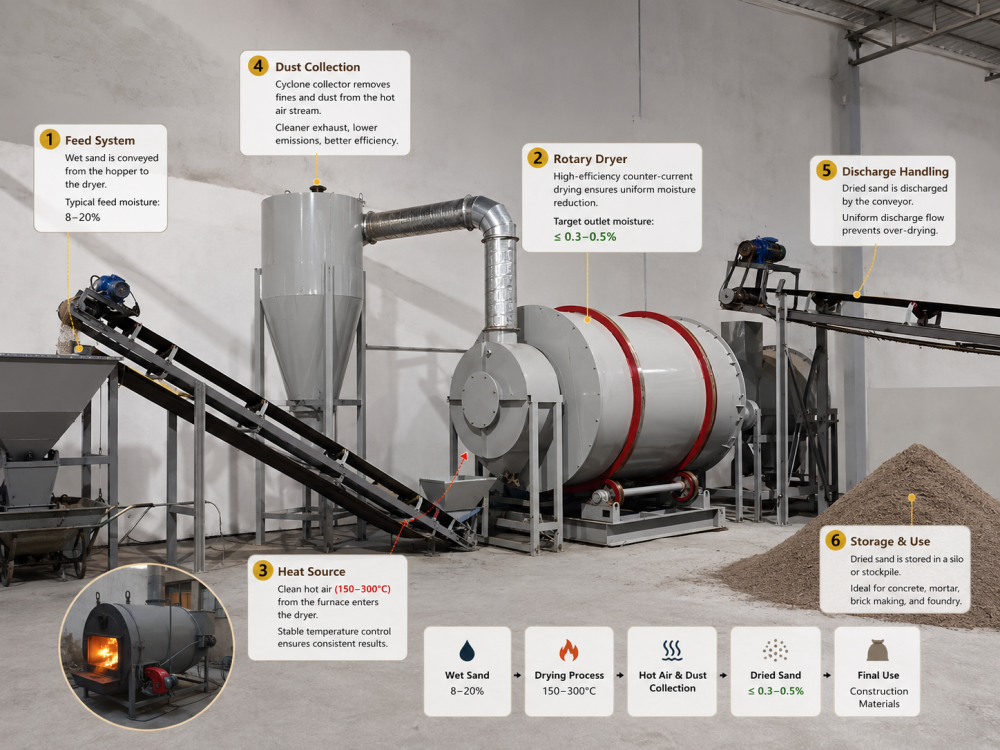
Sand drying can create dust, especially when the material contains fine powder or when the final moisture target is low.
As the sand becomes drier, fine particles may become easier to carry with airflow. If dust collection is not matched well, the plant may face dust emission, material loss, unstable airflow, or maintenance problems.
Dust collection is not only an environmental issue. It also affects system balance. If airflow resistance becomes too high, the drying result may change. If the dust collector is too small or poorly maintained, the whole plant may lose efficiency.
For strict moisture targets, airflow and dust collection should be considered during the design stage, not added after the plant has problems.
Drying does not end when sand leaves the dryer.
If dried sand is exposed to rain, humid air, or wet ground, it can absorb moisture again. If the discharge conveyor, storage area, or silo is not planned well, the final moisture measured after storage may be different from the moisture at the dryer outlet.
This is especially important for dry mortar sand or packaged sand.
Buyers should consider:
1. Discharge temperature
2. Conveyor sealing
3. Storage method
4. Rain protection
5. Silo or warehouse condition
6. Loading method
7. Time between drying and use
A sand drying plant should protect the dried product after discharge. Otherwise, strict drying inside the machine may be partly wasted during storage.
Scenario 1: Construction sand drying
The buyer mainly wants to reduce moisture for easier transport, storage, or use. The system may focus on reliable drying capacity and simple operation. The final moisture target may be less strict than dry mortar applications.
Scenario 2: Dry mortar sand preparation
The buyer needs more stable moisture and grading. The drying system should pay more attention to final moisture control, dust collection, discharge handling, and storage protection. A three cylinder sand dryer may be considered if the material condition and site layout are suitable.
Scenario 3: Washed sand drying before storage or packaging
The sand comes from washing equipment and may have fluctuating moisture. The plant should consider drainage, feeding stability, dryer capacity, fine powder control, and moisture protection after drying.
These scenarios show that sand dryer selection should follow the real production purpose.
A common mistake is asking only for dryer price without giving initial moisture and final moisture target.
Another mistake is discussing tons per hour without explaining whether the number means wet sand input or dried sand output.
Some buyers also ignore feed moisture fluctuation. If washed sand enters the dryer with changing water content, the dryer output and final moisture will also change.
Another misjudgment is to focus only on the dryer body while ignoring heat source, dust collection, discharge conveyor, storage, and weather protection.
In sand drying projects, the dryer is important, but the complete drying line decides the final result.
A useful discussion should start with the material and final product.
First, explain the sand source. Is it river sand, manufactured sand, washed sand, or mixed material?
Second, provide the initial moisture range. If the sand comes from washing, explain whether drainage or dewatering equipment is used before drying.
Third, confirm the final moisture target and final sand application. Dry mortar sand, construction sand, and packaged sand may need different levels of control.
Fourth, explain the required capacity, working hours, fuel condition, site space, and storage method.
With these details, the supplier can judge whether a three cylinder sand dryer, rotary dryer, or another drying arrangement is more suitable.
Sand drying plant design should not start from dryer size alone.
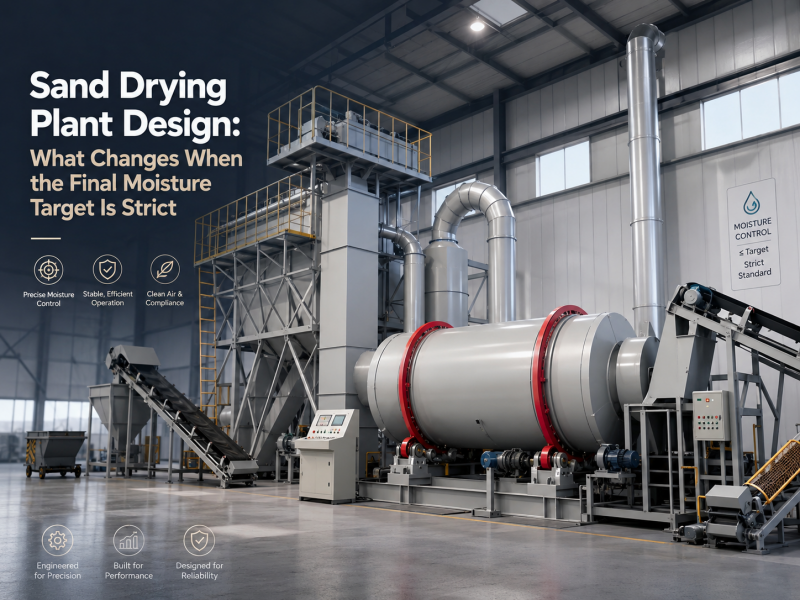
The final moisture target affects heat load, practical output, dryer type, airflow, dust collection, discharge handling, storage, and plant layout. A stricter final moisture requirement usually needs stronger system control, not just a larger machine.
For buyers, the better question is not only "Which sand dryer should I buy?" A more useful question is "What final moisture does my project need, and what system design can keep that moisture stable?"
When the plant is designed around final sand use, the drying result becomes more reliable.
If you are planning a sand drying plant, Sentai Machinery can help review your sand source, initial moisture, final moisture target, capacity, fuel condition, site layout, dust collection requirement, and storage method.
Share your sand photos or videos, moisture data, expected output, final use, and site conditions. Our team can help recommend a suitable sand drying solution based on your project requirements.
1. Single Drum Dryer vs Three Cylinder Sand Dryer: Which One Is Better
2. Why Is My Rotary Dryer Output Lower Than Expected
3. Why Wet Material Condition Matters More Than Dryer Model Alone
4. How Different Materials Change Rotary Dryer Design
5. Before Building a Sand Making Plant, Check These Site and Material Conditions
 WhatsApp
 Email
Email
 +86 15538010601