
STCrushers Is A Professional Minging Equipment Manufacturer since 2004, Providing High Quality Crushers, Sand Making Machines, Drying Equipment and more.
STCrushers Is A Professional Minging Equipment Manufacturer since 2004, Providing High Quality Crushers, Sand Making Machines, Drying Equipment and more.
When buyers discuss sponge iron production, they often start with kiln size and daily output. These are important points, but they are not enough to design a reliable production line.
A sponge iron rotary kiln line is not only a rotating cylinder. It is a reduction process system. The kiln must work together with raw material preparation, fuel preparation, feeding control, heat supply, reduction atmosphere, discharge cooling, dust collection, and material handling.
If these conditions are not clear, the same kiln model may give very different results in real production. Output, metallization rate, energy consumption, product stability, and maintenance cost can all be affected.
For Sentai Machinery, sponge iron project planning should begin with process conditions, not only equipment price. The more clearly the buyer provides material and site information, the more accurately the production line can be designed.
The first step is to confirm the iron-bearing raw material.
Different iron ores, concentrates, or iron-bearing materials may have different iron content, impurity levels, particle size, moisture, and reducibility. These differences directly affect the rotary kiln process.
Important raw material information includes:
1. Total iron content
2. Chemical composition
3. Moisture content
4. Particle size range
5. Strength of the material
6. Amount of fines
7. Gangue and impurity content
8. Whether pre-treatment is required
If the material contains too many fines, feeding stability may become difficult. If particle size is too large or uneven, reduction may be incomplete. If moisture is high, drying or preheating may be needed before stable kiln operation.
A sponge iron rotary kiln line should be designed around the actual raw material, not only around the target production capacity.
Sponge iron production depends on reduction. The fuel and reductant condition can strongly affect the kiln design.
In many coal based sponge iron rotary kiln projects, coal is used as both fuel and reducing agent. Coal quality, fixed carbon, volatile matter, ash content, sulfur content, moisture, and particle size can all affect the kiln atmosphere and product quality.
If the fuel quality is unstable, the kiln temperature and reduction condition may also fluctuate. This can cause uneven product quality, higher fuel consumption, or difficulty in process control.
Before planning the line, the buyer should confirm:
1. Fuel type
2. Fuel availability
3. Fuel cost
4. Coal or fuel analysis
5. Required fuel preparation
6. Feeding method for fuel and raw material
7. Stability of long term supply
The kiln body is only one part of the system. A suitable fuel preparation and feeding method is also necessary for stable production.
Sponge iron production requires stable material movement inside the kiln.
If the raw material size is too uneven, smaller particles may react differently from larger particles. If the feeding amount fluctuates, the material bed inside the kiln may become unstable. This can affect heat transfer, residence time, and reduction uniformity.
For this reason, crushing, screening, or classification may be needed before the material enters the kiln. In some projects, ball mill, magnetic separator, spiral classifier, or other ore processing equipment may be involved before or after the reduction stage, depending on the complete process route.
The feeding system should also be designed carefully. Stable feeding helps maintain stable kiln load, temperature control, and product quality.
A buyer should not only ask how much the kiln can process. It is also important to ask whether the upstream material preparation can support that capacity continuously.
In a sponge iron rotary kiln, temperature is important, but temperature alone does not decide the result.
The material needs enough time inside the kiln to complete the reduction process. Kiln speed, kiln slope, material particle size, filling condition, and internal movement all affect residence time.
If the material passes through the kiln too quickly, reduction may be incomplete. If the residence time is too long, fuel consumption may increase and operation may become inefficient. If the temperature is uneven, product quality may fluctuate.
A suitable kiln process needs balance among:
1. Heating condition
2. Reduction atmosphere
3. Material residence time
4. Kiln speed
5. Material bed movement
6. Feeding stability
7. Discharge condition
This is why sponge iron rotary kiln design should be discussed as a process system, not just as a steel shell with a motor and support rollers.
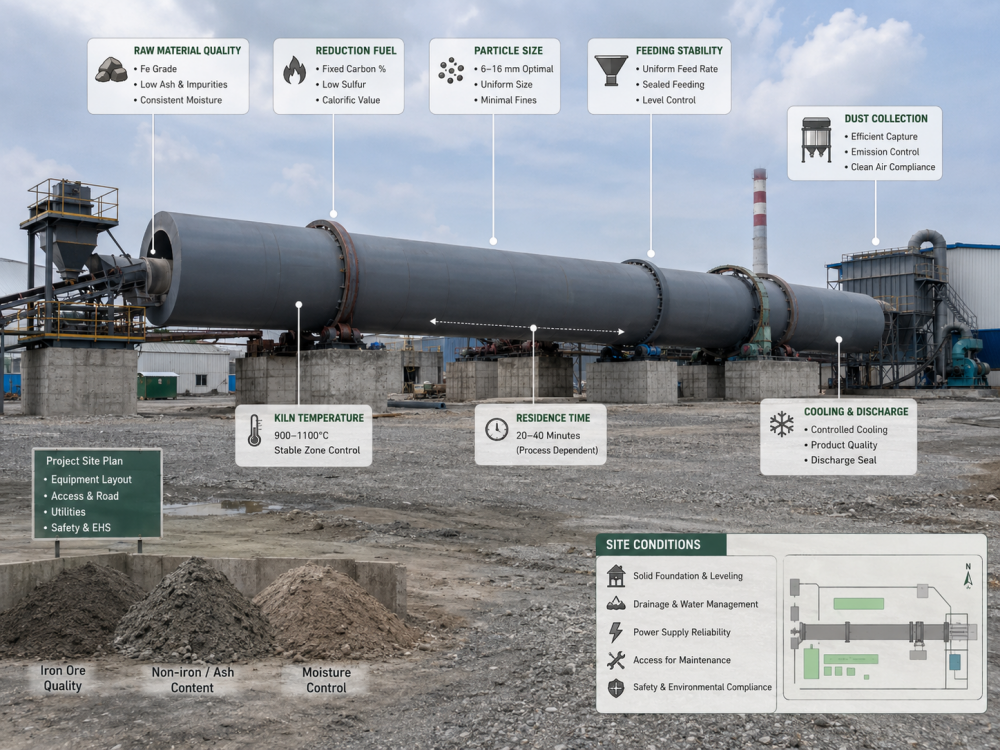
After reduction, sponge iron must be discharged and cooled properly.
Hot reduced material can be sensitive to oxidation if it is exposed to air under unsuitable conditions. Discharge temperature, cooling method, sealing, conveying, and storage all affect product handling and safety.
A poorly designed discharge and cooling system can create product loss, dust, unstable operation, or safety risks.
Before planning the project, buyers should confirm how the sponge iron will be cooled, conveyed, stored, and sent to the next process. The cooling system should match kiln output and product handling requirements.
The discharge end should not be treated as a simple outlet. It is a key part of the whole sponge iron production line.
Sponge iron rotary kiln production can generate dust and exhaust gas. Raw material fines, fuel ash, kiln gas flow, and discharge handling can all contribute to dust load.
Dust collection and gas handling should be designed together with the kiln system. If the dust collection system is too small or not matched with the process, it may affect airflow, environmental control, maintenance frequency, and production stability.
Buyers should consider:
1. Dust source points
2. Gas volume
3. Dust collection equipment
4. Pipeline layout
5. Temperature condition
6. Maintenance access
7. Local emission requirements
A complete sponge iron rotary kiln line needs a stable gas and dust handling system. This is not an optional accessory for later adjustment.
Different sponge iron projects may need different planning logic.
Scenario 1: Small trial or pilot scale project
The buyer wants to test raw material behavior, reduction performance, or fuel suitability. In this case, process flexibility and data collection may be more important than large output.
Scenario 2: Industrial sponge iron production line
The buyer needs continuous production, stable output, and controlled product quality. The full line must include raw material preparation, fuel preparation, kiln system, cooling, dust collection, and storage.
Scenario 3: Iron material upgrading before later processing
The buyer uses reduction as part of a wider iron ore or metallurgical process. In this case, downstream handling and product specification become very important.
These scenarios should not be treated as the same project. The production goal should be clear before equipment selection begins.
One common mistake is asking only for rotary kiln size.
Kiln size matters, but it does not fully decide output or product quality. Raw material condition, fuel quality, feeding stability, reduction atmosphere, residence time, cooling, and dust collection also matter.
Another mistake is not providing material analysis. Without raw material and fuel data, the supplier can only give a general suggestion.
Some buyers also ignore the cooling system. For sponge iron, discharge and cooling are not minor details. They affect product protection and production safety.
Another misjudgment is treating sponge iron production as a simple calcination process. It is a reduction process, so fuel, atmosphere, and process control are especially important.
A useful project discussion should follow a practical order.
First, provide raw material information. This should include material type, iron content, chemical analysis, particle size, moisture, and photos or videos.
Second, provide fuel information. If coal will be used, the coal analysis and particle size should be confirmed.
Third, explain the target product. The supplier needs to know the expected sponge iron quality, output, working hours, and downstream use.
Fourth, explain the site condition. This includes power supply, fuel supply, available space, foundation condition, environmental requirement, and local operation conditions.
Fifth, discuss the complete process flow. The kiln, cooler, feeding system, dust collection, conveying, storage, and control system should be considered together.
When these details are clear, the supplier can recommend a more suitable rotary kiln line instead of only quoting one machine.
A sponge iron rotary kiln line should be planned from the process conditions.
Raw material quality, fuel condition, particle size, feeding stability, reduction atmosphere, residence time, cooling, dust collection, and site layout all affect the final production result.
For buyers, the better question is not only "What size rotary kiln do I need?" A more useful question is "What process conditions must be controlled for my sponge iron production target?"
When the project is planned from real material data and production goals, the rotary kiln line is easier to operate and more likely to produce stable sponge iron.
If you are planning a sponge iron rotary kiln line, Sentai Machinery can help review your raw material condition, fuel analysis, particle size, target output, product requirement, site layout, cooling method, and dust collection needs.
Share your material analysis, fuel information, project capacity, site condition, and final product requirement. Our team can help recommend a suitable sponge iron rotary kiln production line based on your actual process conditions.
1. Why Raw Material Preparation Matters Before Rotary Kiln Calcination
2. What Affects Calcined Product Quality in a Rotary Kiln
3. Why Rotary Kiln Output Is Not Only Decided by Kiln Size
4. What Site Information Should Buyers Provide Before Plant Layout Design
5. What Buyers Should Check When Equipment Arrives at the Project Site


 WhatsApp
 Email
Email
 +86 15538010601