
STCrushers Is A Professional Minging Equipment Manufacturer since 2004, Providing High Quality Crushers, Sand Making Machines, Drying Equipment and more.
STCrushers Is A Professional Minging Equipment Manufacturer since 2004, Providing High Quality Crushers, Sand Making Machines, Drying Equipment and more.
When buyers plan a limestone crushing plant, they often ask whether an impact crusher or a hammer crusher is better. This question is common, but it can lead to the wrong answer if the project conditions are not clear.
Impact crushers and hammer crushers can both be used for limestone. Heavy hammer crushers may also be considered in some projects. But they are not used in exactly the same way. Their suitable feed size, product shape, powder generation, wear condition, maintenance method, and process arrangement can be different.
For Sentai Machinery, limestone crusher selection should not start from the machine name. It should start from raw material size, required final product, capacity target, site condition, and how the whole stone crusher plant will be arranged.
Limestone is usually easier to crush than granite, basalt, or river stone. Because of this, some buyers think limestone crushing is simple and expect one machine to solve the whole process. In some small projects, this may be possible. In many production lines, the answer depends on feed size and final product requirement.
If raw limestone is large, primary crushing may still be needed. If the buyer needs clean aggregate with better shape, the crusher choice becomes different. If the project needs sand or fine material, powder content and screening become more important. Limestone is easy to crush, but it can still create problems when the process is too rough.
An impact crusher is often used as a secondary crusher in limestone aggregate production. It uses impact force to break material and can produce better particle shape in many limestone projects. When the buyer needs cubic aggregate for road, concrete, or construction use, an impact crusher can be a practical choice.
An impact crusher may make more sense when the plant has a jaw crusher as primary crushing, the feed size is already controlled, the buyer needs better aggregate shape, and screening plus return material can be arranged properly.
For many limestone aggregate plants, jaw crusher plus impact crusher plus vibrating screen is a common route. The jaw crusher handles large raw material, the impact crusher improves reduction and product shape, and the vibrating screen separates finished sizes.
A hammer crusher can be suitable for limestone projects that need simpler crushing and a higher reduction ratio in one machine. It is often considered when the raw material is not too hard, the feed size is suitable, and the product requirement is not too complex.
A hammer crusher may make more sense when the limestone is medium soft or soft, the project needs a simpler process, the required product size is relatively small, and the final product does not require strict aggregate shape.
For limestone, coal gangue, gypsum, or similar soft material applications, a hammer crusher can be practical. But if the limestone contains hard layers, large feed blocks, or strict product shape requirements, the selection should be checked more carefully.
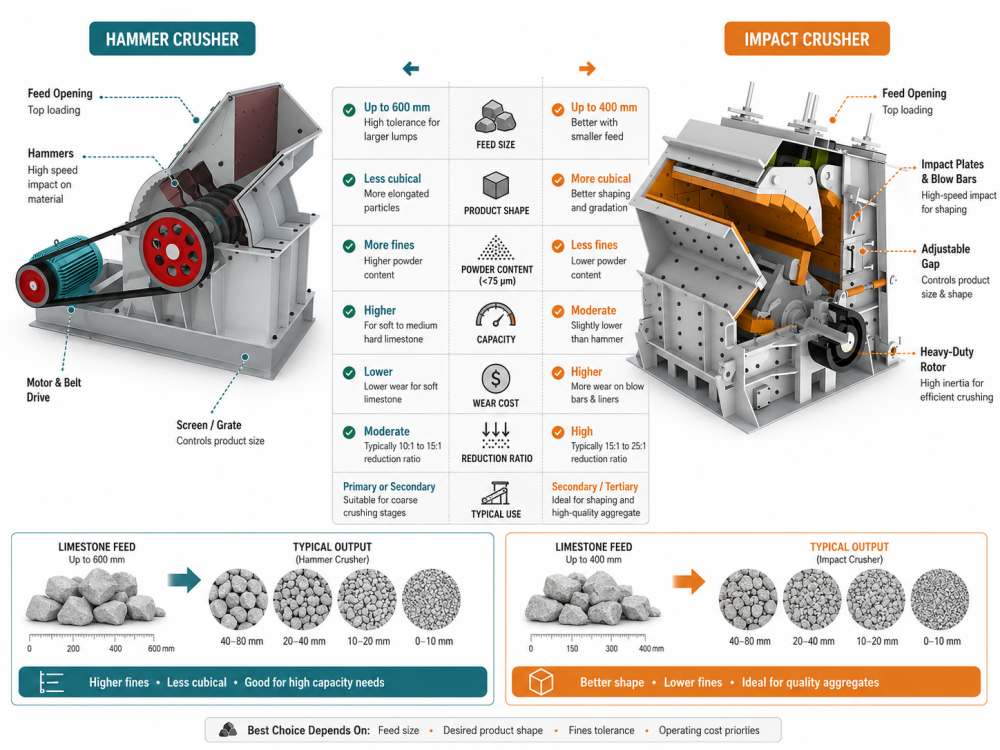
A heavy hammer crusher is often considered when buyers want larger feed handling and stronger crushing capacity in limestone projects. In some cases, it can reduce the need for multiple crushing stages and simplify the plant layout.
It may be suitable when the limestone is appropriate for hammer crushing, the feed size and capacity match the machine, and the site can handle discharge, screening, and conveying properly. It is not a universal replacement for all primary and secondary crushing systems.
Limestone crushing is not only about reducing size. The buyer should also think about product shape and powder content.
If the final product is used as construction aggregate, shape and grading may be important. An impact crusher is often more useful when better particle shape is required. If the project mainly needs smaller crushed limestone for general use, a hammer crusher or heavy hammer crusher may be more practical.
If powder content is too high, the plant may need better screening, adjustment of crusher settings, or changes in process flow. Repeated crushing or excessive return material can increase fine powder. This is why the crusher should be selected together with the vibrating screen and conveyor arrangement.
Scenario 1: Standard aggregate plant. The raw limestone is large, and the buyer needs several aggregate sizes for construction. A jaw crusher, impact crusher, and vibrating screen combination may be suitable.
Scenario 2: Simple limestone crushing project. The material is not too large or too hard, and the buyer needs smaller crushed limestone without strict shape requirements. A hammer crusher may be considered if feed size and capacity match the equipment.
Scenario 3: Higher capacity simplified process. The buyer wants fewer crushing stages. If the material condition is suitable, a heavy hammer crusher may be considered. Screening and discharge handling still need to match the capacity.
A common mistake is choosing the crusher only by price. A cheaper machine may not produce the product shape or size stability required by the project. Another mistake is using one limestone case to judge all limestone projects. Limestone from different sites can have different hardness, moisture, clay content, and feed size.
Some buyers also ignore the vibrating screen. Even if the crusher is suitable, poor screening can create unstable finished products and excessive return material. Crusher selection should be connected with product use, not only with material name.
A useful limestone crusher discussion should follow a practical order. First, explain the raw material and provide limestone photos or videos, maximum feed size, moisture condition, and whether the material contains clay or hard impurities.
Second, explain the final product. Tell the supplier whether the target is aggregate, fine crushed material, sand, cement raw material, or mixed products. Third, confirm capacity and working hours. Fourth, discuss site condition, including power supply, foundation, space, discharge height, and stockpile arrangement.
Impact crushers, hammer crushers, and heavy hammer crushers can all be used in limestone crushing, but they fit different project conditions. An impact crusher is often better when product shape, aggregate quality, and screening control are important. A hammer crusher may fit simpler limestone crushing projects where the feed size and product requirement are suitable. A heavy hammer crusher can be considered when the project needs higher capacity and a simplified process under suitable material conditions.
For buyers, the useful question is not only "Which crusher is better for limestone?" The better question is "Which crushing process fits my limestone feed size, final product, capacity, and site condition?"
If you are comparing impact crusher, hammer crusher, and heavy hammer crusher for a limestone crushing project, Sentai Machinery can help review your raw material, feed size, capacity target, finished product requirement, and site layout.
Share your limestone photos or videos, maximum feed size, required output size, capacity, and final application. Our team can help recommend a suitable limestone crushing process and equipment combination.
1. Limestone, Granite, or River Stone: How Raw Material Changes Crushing Process Design
2. How Feed Size Affects the Performance of a Jaw Crusher
3. Why Does Jaw Crusher Discharge Size Become Unstable
4. A Practical Field Guide to Reducing Downtime in a Stone Crushing Plant
5. Why Return Material Ratio Matters in a Stone Crushing Plant
2. 80-100 tph Stone Crusher Plant
 WhatsApp
 Email
Email
 +86 15538010601