
STCrushers Is A Professional Minging Equipment Manufacturer since 2004, Providing High Quality Crushers, Sand Making Machines, Drying Equipment and more.
STCrushers Is A Professional Minging Equipment Manufacturer since 2004, Providing High Quality Crushers, Sand Making Machines, Drying Equipment and more.
A rotary kiln diameter and length may already be under discussion while the fuel line in the inquiry still says coal or gas. That uncertainty affects much more than the burner model.
Pulverized coal, natural gas, and fuel oil require different storage, preparation, metering, delivery, ignition, flame control, safety, and maintenance arrangements. They can also change the airflow, exhaust, dust, and automation scope around the kiln.
Fuel should therefore be treated as part of the kiln system design. Replacing one burner after manufacturing may not convert the complete plant into a reliable system for another fuel.
The first comparison should use real site conditions rather than a general fuel-price list. Confirm the guaranteed supply, lower heating value or agreed analysis basis, seasonal variation, delivery method, storage restrictions, and local environmental requirements.
For gas, pressure and maximum continuous flow are critical. For coal, moisture, ash, grindability, and particle condition affect preparation and feeding. For fuel oil, viscosity, impurities, storage temperature, and atomization requirements must be known.
A coal-fired kiln normally needs a controlled pulverized-fuel supply. Depending on the coal delivered to site, the project may include raw-coal storage, crushing, drying, pulverizing, a powder bin, weighing or metering, pneumatic conveying, and dust-control measures.
Coal quality affects both heat input and the non-combustible material entering the system. Moisture and particle-size variation can disturb powder feeding, while ash may influence dust loading or product contamination in processes where fuel ash matters.
The quotation must state whether it covers only the kiln burner or also the coal-preparation and delivery system. A low burner price does not represent the investment required to turn delivered coal into a stable kiln fuel.
Natural gas avoids solid-fuel grinding, powder storage, and fuel ash, but it still requires a complete gas train. Typical scope can include pressure regulation, filtration, metering, control valves, ignition, flame detection, purge logic, and emergency shutoff.
Pipeline availability alone is not enough. The supplier needs the normal pressure, minimum pressure, maximum continuous flow, gas composition, and any expected interruption or seasonal restriction.
An oil-fired kiln may require a bulk tank, day tank, pumps, filters, supply and return piping, leakage containment, and fire-protection provisions. High-viscosity oil may also need heating and insulated lines before it can be pumped and atomized consistently.
The burner nozzle must convert the oil into droplets that can mix with combustion air. Poor temperature control, pressure instability, blocked filters, or nozzle deposits can change atomization and flame behavior.
Burner rating is only one design input. The combustion system must also match fuel delivery range, turndown requirement, primary-air demand, secondary-air interaction, ignition method, flame supervision, burner position, and the required flame shape.
Coal particles, gas jets, and atomized oil do not mix with air in the same way. Burner channels, nozzle arrangements, air momentum, and control response are therefore selected around the fuel and the kiln process.
Kiln pressure and uncontrolled air leakage also affect combustion. The burner, seals, induced-draft fan, ducting, and exhaust system should be reviewed as one airflow system rather than adjusted independently.
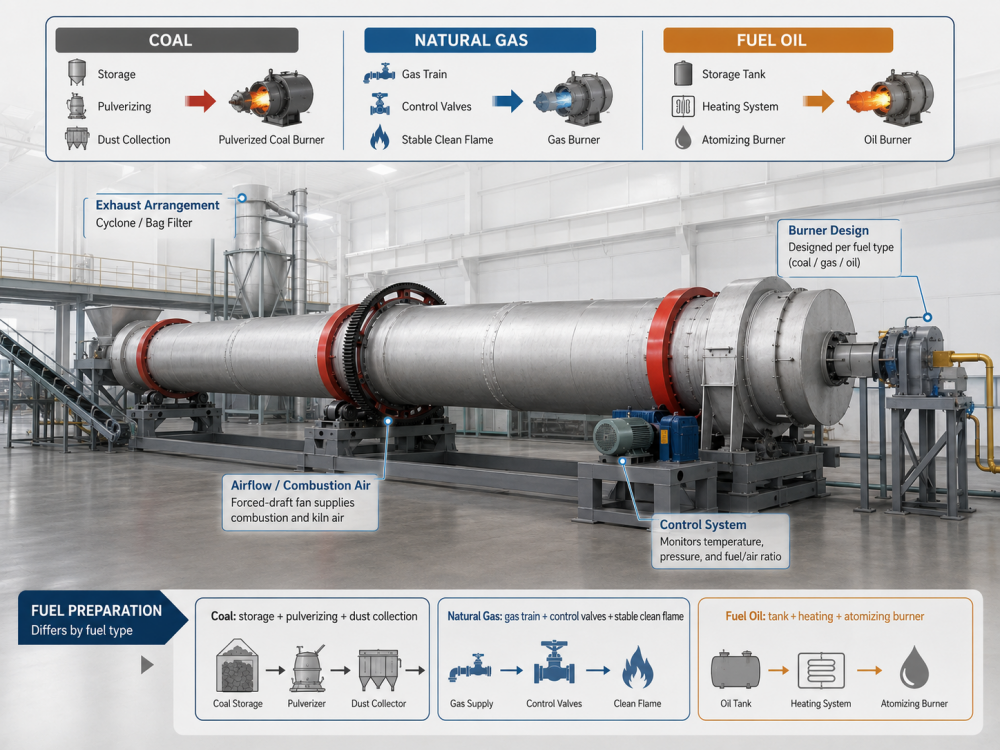
Two fuels can provide a similar calculated heat input while creating different flame length, intensity, and heat-release positions. A short concentrated flame may overheat one zone, while an excessively long or poorly mixed flame may move useful heat away from the required calcination area.
Material bed depth, kiln speed, feed rate, and residence time interact with the flame. Stable product quality therefore depends on heat distribution, not only on one kiln-head or kiln-tail temperature reading.
Coal handling generally creates more solid-fuel dust and adds fuel ash to the combustion system. Natural gas removes fuel ash but still requires safe gas detection, valve interlocks, and controlled purge and ignition sequences. Fuel oil introduces tank, leakage, heating, filtration, and nozzle-maintenance duties.
The quotation should identify whether the induced-draft fan, ducts, cyclone, bag filter, gas monitoring, and additional emission-control equipment are included or supplied by others.
A buyer may request coal as the main fuel and natural gas as backup. That can improve supply resilience, but it may require two storage or delivery systems, additional burner channels, more instruments, and a more complex control sequence.
The project must define whether the second fuel is used only for ignition, short emergency operation, routine production, or online changeover. A burner that can physically fire two fuels does not automatically provide a seamless switch at full load.
Project factor | Pulverized coal | Natural gas | Fuel oil |
Site storage | Coal yard plus powder-storage system | Pipeline or gas-station interface | Bulk and day tanks |
Fuel preparation | Crushing, drying, and pulverizing may be required | Pressure regulation and metering | Filtering, heating, and atomization may be required |
Fuel ash | Depends on coal ash content | Very low fuel ash | Depends on oil quality |
Control response | Depends on stable powder feeding | Generally responsive with stable pressure | Depends on pumping and atomization |
Main maintenance focus | Mill, feeder, conveying, dust, and deposits | Gas train, valves, detection, and interlocks | Pumps, heaters, filters, pipes, and nozzle |
Typical project risk | Variable coal quality or unstable powder feed | Insufficient pressure or interrupted supply | Viscosity, leakage, poor atomization, or storage issues |
Quotation boundary | Often extends far beyond the burner | Should include gas train and safety controls by scope | Should define both tank-side and burner-side equipment |
Fuel cost should be compared per unit of qualified product, not only per tonne of coal, cubic metre of gas, or tonne of oil. Useful heat value, preparation power, labor, maintenance, dust treatment, downtime, transport, storage loss, and product-quality variation all affect the result.
1.Raw material, target product, and required process temperature.
2.Capacity basis: wet feed, dry feed, or final product.
3.Available main and backup fuel types.
4.Fuel analysis, composition, and lower heating value.
5.Coal moisture, ash, grindability, and delivered particle condition.
6.Gas composition, normal and minimum pressure, and maximum supply rate.
7.Oil type, viscosity, impurities, and required storage temperature.
8.Expected operating hours and planned fuel-change procedure.
9.Local emission, storage, fire, and safety requirements.
10.Site layout and distance from fuel storage to the kiln.
11.Existing fans, ducts, tanks, mills, or control equipment.
12.Required automation, flame monitoring, and emergency interlocks.
13.Whether the quotation should include the complete fuel system or only the burner.
Coal, natural gas, and fuel oil change more than the burner. They create different requirements for storage, preparation, delivery, air supply, flame control, exhaust treatment, automation, safety, and maintenance.
Fuel quality and supply reliability can be as important as nominal heat value. A quotation should clearly define the boundary from site fuel reception to controlled combustion at the kiln head.
Sentai Machinery can review the material, target product, capacity, fuel analysis, site utilities, environmental requirements, and requested supply scope before configuring the rotary kiln and combustion system. The selected fuel should support stable calcination and a practical total operating cost, not only a low purchase price.
2. Why Rotary Kiln Output Is Not Only Decided by Kiln Size
3. What Affects Calcined Product Quality in a Rotary Kiln
4. Why Is Quicklime Quality Unstable After Rotary Kiln Calcination
5. Why Raw Material Preparation Matters Before Rotary Kiln Calcination
1. Rotary Kiln
1. Lime Rotary Kiln Production Plant;
 WhatsApp
 Email
Email
 +86 15538010601