
STCrushers Is A Professional Minging Equipment Manufacturer since 2004, Providing High Quality Crushers, Sand Making Machines, Drying Equipment and more.
STCrushers Is A Professional Minging Equipment Manufacturer since 2004, Providing High Quality Crushers, Sand Making Machines, Drying Equipment and more.
The inlet gas temperature is normal, the burner is stable, and the drum keeps rotating. Even so, some discharged material remains wetter than required.
Adding more heat may not solve the problem when most material rolls along the bottom instead of being lifted into the hot gas stream. A rotary dryer needs heat, airflow, residence time, and material movement to work together.
Flights, also called lifting plates or material lifters, pick up material from the bed as the drum rotates. They carry it upward and release it through the gas stream, creating a falling curtain across part of the drum section.
This action increases the exposed surface area and renews the material surface repeatedly. The objective is not simply to throw material as high as possible. The flights should load, carry, and release the material at positions that create useful contact without causing excessive buildup, attrition, or dust carryover.
Flight geometry and arrangement therefore need to match the material, feed volume, drum speed, gas flow, and required drying duty.
The same flight can behave differently when moisture, bulk density, or particle size changes. A design that carries dry sand well may overload with wet clay-rich feed or release light biomass too early. Flight selection should therefore be based on the full operating range, not one sample taken under ideal conditions.
A useful curtain is distributed across the drum rather than concentrated in one thick stream. Material should fall from different heights while gas passes through the particles instead of bypassing them.
The curtain may change along the drum as wet feed becomes lighter and drier. A very dense curtain is not automatically better because particles can shield each other; the target is controlled exposure.
Low feed rate, insufficient bed depth, unsuitable flight geometry, or rapid material movement can leave the flights partly empty.
Hot gas then follows the unoccupied area. Exhaust temperature may stay high while useful heat transfer remains weak. Compare the actual feed rate with the design load before changing the burner.
When feed rate or internal hold-up becomes too high, flights can spill material early while a thick bed remains at the bottom.
More wet feed then does not create proportional dry output. Material rolls and shields lower layers while gas passes above the bed, causing uneven discharge moisture and lower practical evaporation efficiency.
Coal slime, sludge, and wet mineral fines may be lifted but still fall as compact lumps. The outside dries first while moisture remains inside, and buildup can change carrying volume and release position.
Flight changes may help, but blending, return-material mixing, preliminary breaking, chains, drainage, or steadier inlet moisture may also be required. Sticky feed should not be treated like free-flowing sand.
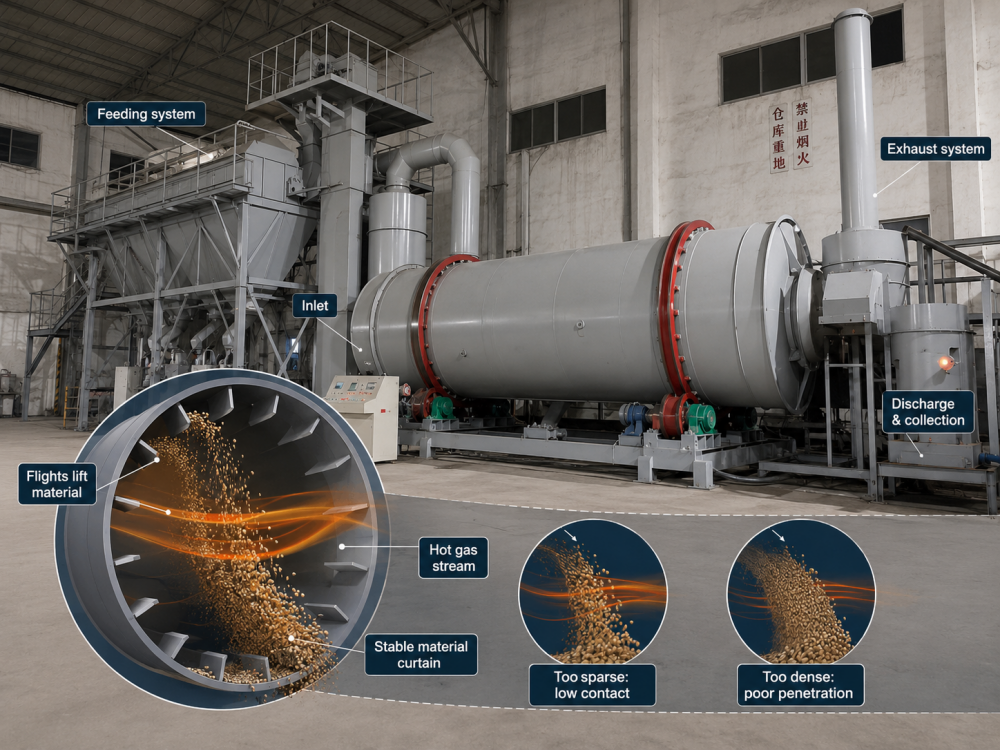
At low speed, flights may release material too early and leave a shallow curtain. At unsuitable high speed, material may release from an unfavorable position, experience more attrition, or become easier to entrain.
Speed also affects residence time, so changes should be made gradually and reviewed with feed rate, outlet moisture, exhaust condition, and dust collection.
The feed zone, main drying zone, and discharge zone do not perform the same task. Near the inlet, internal structures may need to move wet material forward and reduce accumulation.
The main zone prioritizes lifting and showering, while drier material near the outlet may need another release pattern. Zoned design becomes important when stickiness, density, or particle condition changes during drying.
Worn edges, bending, cracked welds, missing sections, and buildup can reduce carrying volume or change the release point before a flight fails completely.
Fuel use may rise and moisture stability may decline gradually. A shutdown inspection should compare all drum zones because local damage can weaken only part of the curtain.
Low gas flow can weaken heat and moisture removal. High gas velocity can entrain fine or light particles, increase dust-collection load, and alter residence behavior.
Flight design must therefore be reviewed with fan capacity, duct resistance, gas direction, sealing, and allowable carryover. More airflow cannot compensate for weak lifting if it only moves heat through empty space.
Observed condition | Possible cause | Likely result |
Large empty area in the drum section | Low loading or unsuitable flight fill | Hot gas bypass and weak heat use |
Material remains mainly at the bottom | Overloading, low lifting action, or poor release | Uneven drying and lower practical capacity |
Thick lumps fall together | Sticky feed or insufficient dispersion | Dry surface with wet material inside |
Material releases from an unstable position | Unsuitable drum speed or flight condition | Irregular curtain and variable residence behavior |
Curtain weakens over time | Flight wear, bending, loss, or buildup | Gradual rise in fuel use or moisture variation |
Fine material enters the exhaust | High gas velocity or weak particle control | Product loss and higher dust load |
Wet material accumulates near the inlet | Insufficient advancing action or unstable feeding | Leakage, blockage, and delayed movement |
Begin with stable operation and record feed rate, inlet moisture, temperatures, fuel use, fan condition, discharge moisture, and product rate.
After safe shutdown and lockout, inspect loading marks, buildup, wear, deformation, and differences between drum zones. Change one major variable at a time and wait for a complete process response before judging the result.
1.Material name and final application.
2.Minimum, normal, and maximum feed moisture.
3.Required final moisture and acceptable variation.
4.Particle-size distribution and wet lump condition.
5.Bulk density, flowability, stickiness, and angle of repose where available.
6.Wet feed capacity and daily operating hours.
7.Drum diameter, length, slope, and current speed.
8.Existing flight dimensions, layout, material, and condition.
9.Hot-gas direction, temperature range, and airflow information.
10.Current fuel consumption and practical output.
11.Discharge-moisture trend and dust carryover condition.
12.Photos or video from a safe internal shutdown inspection.
Drum volume provides room for processing, the heat source supplies energy, and the fan moves gas through the system. The flights decide how the wet material enters that gas stream.
Underfilled flights, overloading, sticky lumps, unsuitable speed, internal wear, and unbalanced airflow can all reduce the useful material curtain. In these conditions, increasing temperature alone may raise fuel use without correcting uneven exposure.
Sentai Machinery can review the material, moisture range, feed load, drum dimensions, internal-flight condition, airflow, fuel use, and discharge-moisture trend before recommending a new rotary dryer or an internal-structure modification.
1. Why Wet Material Condition Matters More Than Dryer Model Alone
2. How Different Materials Change Rotary Dryer Design
3. Why Is My Rotary Dryer Output Lower Than Expected
4. Rotary Dryer Feed Moisture Fluctuation: Why Fuel Use and Discharge Moisture Become Unstable




 WhatsApp
 Email
Email
 +86 15538010601