
STCrushers Is A Professional Minging Equipment Manufacturer since 2004, Providing High Quality Crushers, Sand Making Machines, Drying Equipment and more.
STCrushers Is A Professional Minging Equipment Manufacturer since 2004, Providing High Quality Crushers, Sand Making Machines, Drying Equipment and more.
A buyer may request 0-5 mm, 5-10 mm, 10-20 mm, and 20-30 mm aggregate and conclude that the plant needs a four-deck vibrating screen.
That conclusion can be wrong because deck count, product count, and material-stream count are related but are not always the same number. If material above 30 mm returns to the crusher, the screen must create five separate streams: four finished products and one oversize return.
The screen should therefore be planned from the destination of every material stream.
List every outlet before selecting the screen. The list may include saleable products, oversize return, rejected fines, bypass material, or a fraction that will be washed, reshaped, or sent to another crusher.
For each stream, confirm the size range, destination, expected percentage, and whether it creates revenue or remains inside the process. A stream that returns to the crusher is not a finished product, but it still requires a chute, conveyor, transfer point, and enough crusher capacity.
In a simple dry-screening arrangement, each deck creates one additional cut. The material retained on a deck leaves as an oversize fraction, while smaller particles pass to the deck below.
Screen decks | Maximum streams in a simple circuit | Typical interpretation |
1 deck | 2 streams | One retained fraction and one undersize fraction |
2 decks | 3 streams | Two retained fractions and one bottom undersize |
3 decks | 4 streams | Three retained fractions and one bottom undersize |
4 decks | 5 streams | Four retained fractions and one bottom undersize |
These are theoretical size streams, not guaranteed saleable products. A three-deck screen can produce three marketable aggregate sizes while the fourth stream returns to the crusher. In another plant, all four streams may be sold and no return loop is required.
The top-size stream may be stockpiled as coarse aggregate, returned to the same crusher, or sent to another crushing stage. Each choice creates a different plant layout.
Returning oversize forms a closed circuit. The return conveyor and crusher must handle fresh feed plus circulating material. A high return ratio can consume crushing and screening capacity without increasing finished-product output in the same proportion.
If the oversize can be sold, the circuit becomes simpler, but the product plan changes. This commercial decision should be made before the chutes and conveyors are finalized.
Adding a deck mainly creates another size cut. It does not automatically increase the feed rate that the screen body, drive, supports, and screening area can handle.
The top deck receives the full feed and usually carries the highest impact and mass load. Lower decks receive less total material, but they often make finer and more difficult separations.
Capacity should therefore be checked for the complete deck arrangement, feed gradation, moisture, and required efficiency. A catalogue capacity from another deck configuration should not be transferred directly.
The top deck removes the largest particles and protects the lower media from direct impact. Its opening size, panel strength, and wear resistance are important because every ton of feed reaches it first.
Middle decks usually form the main saleable aggregate fractions. Their performance can become sensitive when much of the feed is close to the opening size.
The bottom deck handles the finest cut. Wet fines, clay, and powder can cover or plug small openings, allowing undersize to contaminate a coarser product or causing qualified material to leave through the wrong outlet.
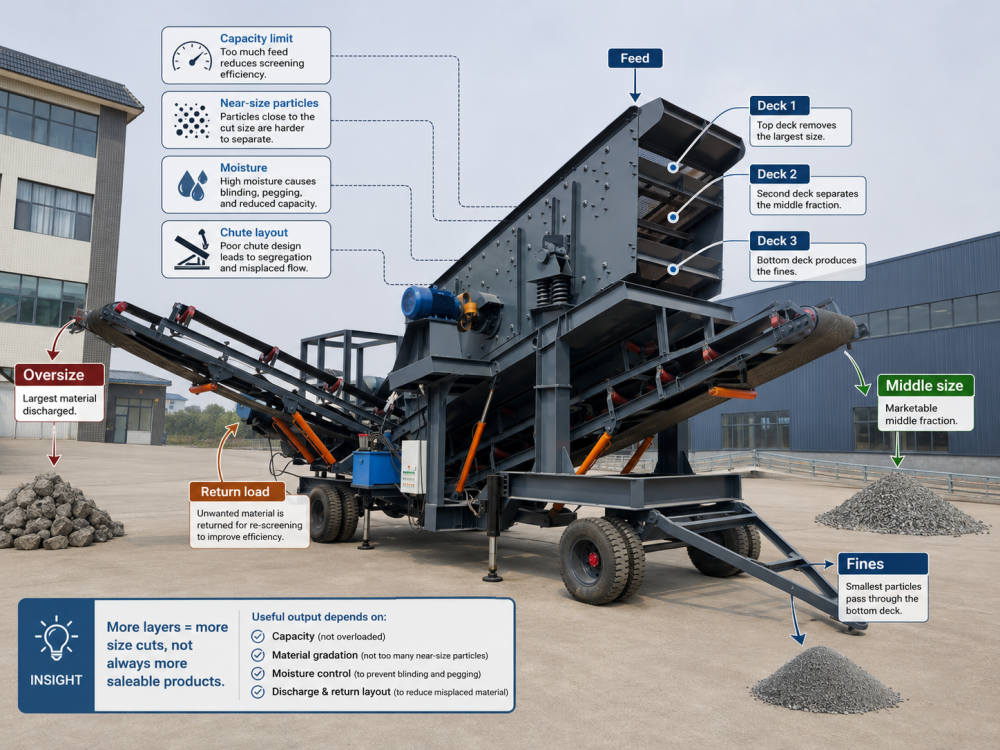
Particles far smaller than an opening usually pass quickly, while particles far larger remain on the deck. Material close to the opening size requires more presentation opportunities before it passes or discharges.
A feed containing a high percentage of near-size particles can require more effective area or a lower loading rate even when total tonnage appears moderate. Complete feed gradation is therefore more useful than maximum feed size alone.
Moisture can make fines adhere to screen media, while near-size particles can wedge in the openings. The upper deck may continue to look normal while the lower deck gradually loses open area.
The screen should be selected for the most difficult expected condition, not only for dry-season material. When rainy-season feed is sticky, the project may need different media, cleaning devices, washing, reduced loading, or a revised product plan.
Screen width affects how much material can spread across the machine and is closely related to feed capacity. Screen length provides more time and opportunities for particles to contact the openings. Deck count determines how many size cuts are created.
Increasing deck count cannot replace insufficient effective area. Likewise, selecting a larger screen does not correct a mesh sequence that creates unnecessary recirculation or separates products the market does not need.
Every additional material stream may require a discharge chute, belt conveyor, support structure, stockpile area, dust cover, and maintenance access.
A four-deck screen may be technically capable of five streams, but the site may not have space for five conveyors and stockpiles.
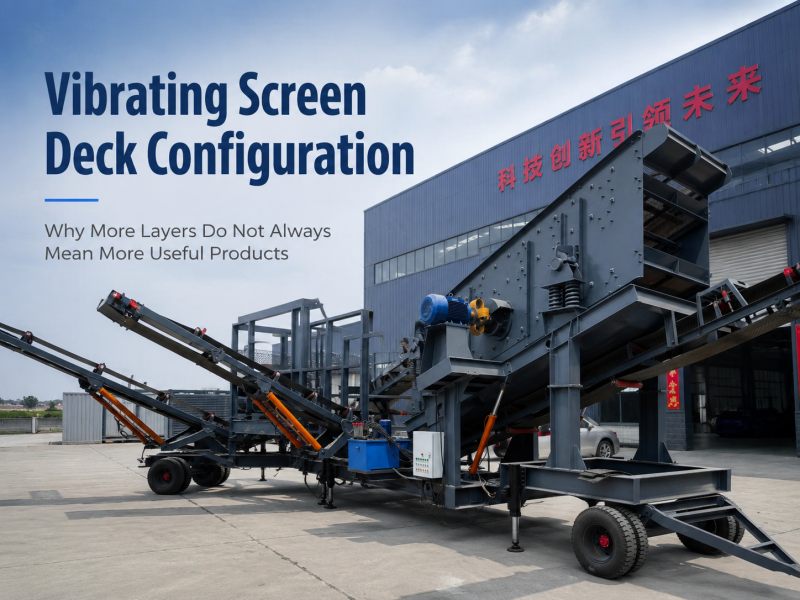
On a mobile plant, each added deck and discharge conveyor affects transport height, folded dimensions, frame load, power demand, setup time, and working clearance.
A low-demand product size may not justify a taller and heavier mobile unit. The commercial value of the extra fraction should be compared with transport, maintenance, and site-layout complexity.
Project condition | Likely configuration issue | First question |
Three saleable products plus oversize return | Three decks may be required | Is the top stream a product or return material? |
Four product sizes with no return | Three decks may be sufficient | Are all four streams marketable? |
High percentage near an opening | Separation may need more area | What is the complete feed gradation? |
Wet fine material | Lower-deck blockage risk | What is the rainy-season moisture and clay content? |
High return load | Internal circuit may overload | Can the crusher and return belt carry the circulation? |
Limited mobile layout | Too many discharge conveyors | Is every product size commercially necessary? |
Large screen but mixed products | Distribution or media problem | Is the full width and open area being used? |
1Raw material and its hardness or abrasiveness.
2Maximum feed size and complete feed-size distribution.
3Required total feed capacity under actual material conditions.
4Required finished product sizes and acceptable contamination between fractions.
5Which streams are saleable products and which remain inside the process.
6Oversize handling method: stockpile, return, or additional crushing stage.
7Moisture, clay, powder, and seasonal feed changes.
8Upstream crusher type, setting, and actual discharge distribution.
9Expected return-material ratio and destination.
10Stationary or mobile installation.
11Available layout height, width, and maintenance clearance.
12Required conveyors, stockpile locations, and truck-loading plan.
13Local power, dust-control, and washing conditions.
14Whether future products or capacity expansion are expected.
The number of decks determines how many size cuts a vibrating screen can create, but it does not by itself define useful products or plant capacity.
Saleable fractions, oversize return, fines, near-size loading, moisture, effective screening area, chutes, conveyors, and stockpile space must be planned together. A simpler screen can be more productive when it matches the real product market and process route.
Sentai Machinery can review the raw material, feed gradation, required products, capacity, moisture, return plan, and site layout before recommending a screen size, deck number, mesh sequence, and discharge arrangement.
1. What Buyers Often Ignore When Choosing a Vibrating Screen
2. How to Match Jaw Crusher and Vibrating Screen in a Stone Crushing Plant
3. Why Return Material Ratio Matters in a Stone Crushing Plant
4. Typical 20-30 TPH Mobile Limestone Crushing and Screening Setup for Remote Sites
5. Why Finished Sand Quality Depends on More Than the Sand Maker
2. Jaw Crushers
 WhatsApp
 Email
Email
 +86 15538010601