
STCrushers Is A Professional Minging Equipment Manufacturer since 2004, Providing High Quality Crushers, Sand Making Machines, Drying Equipment and more.
STCrushers Is A Professional Minging Equipment Manufacturer since 2004, Providing High Quality Crushers, Sand Making Machines, Drying Equipment and more.
Suppose a buyer has enough calcined-product orders for daytime production and asks whether the kiln can shut down every evening. For an industrial continuous rotary kiln, daily cold starts are generally a poor default. Heating the system, establishing the required reaction conditions, and managing shutdown all take time and resources. A workable schedule depends on the material, kiln construction, and available operating support.
The buyer can begin by separating the hours when material is prepared or packed from the hours when the kiln operates. This discussion concerns continuous calcining lines; equipment specifically designed for batch treatment needs a separate assessment.
Stopping fresh feed leaves hot equipment and material already inside the system. That remaining material still needs controlled treatment and discharge. An instruction to stop feeding therefore does not define when the entire line can finish operating.
Hot standby, where the design permits it, retains heat between production periods. It consumes energy and requires operating supervision. Its suitability depends on the material remaining in the system, atmosphere requirements, burner controls, and supporting equipment. It cannot be assumed to make an unattended night shift acceptable.
A full shutdown allows the system to cool under the manufacturer's procedure. Restarting then requires reheating. The quotation should identify which operating state is intended between shifts, with the associated staffing and utility requirements. These choices need a plant-specific plan rather than a universal daily stopping routine.
During heating, energy goes into the equipment and, where fitted, its refractory lining before the plant reaches stable production. A temperature indication alone cannot show that every particle has received the required treatment. Feed rate, heat distribution, atmosphere, and residence time must return to suitable conditions together.
Material discharged during a transition needs assessment against the product specification. Depending on the process, some may require segregation or reprocessing. This makes the period of qualified production shorter than the period when the burner or drive is running. The existing discussion of calcined product quality explains why stable process conditions matter.
Repeated heating and cooling also expand and contract refractory linings. Frequent cycling can increase stress and contribute to cracking. The effect varies with lining design and operating practice, so neither a fixed life reduction nor a standard restart duration belongs in a general budget estimate.
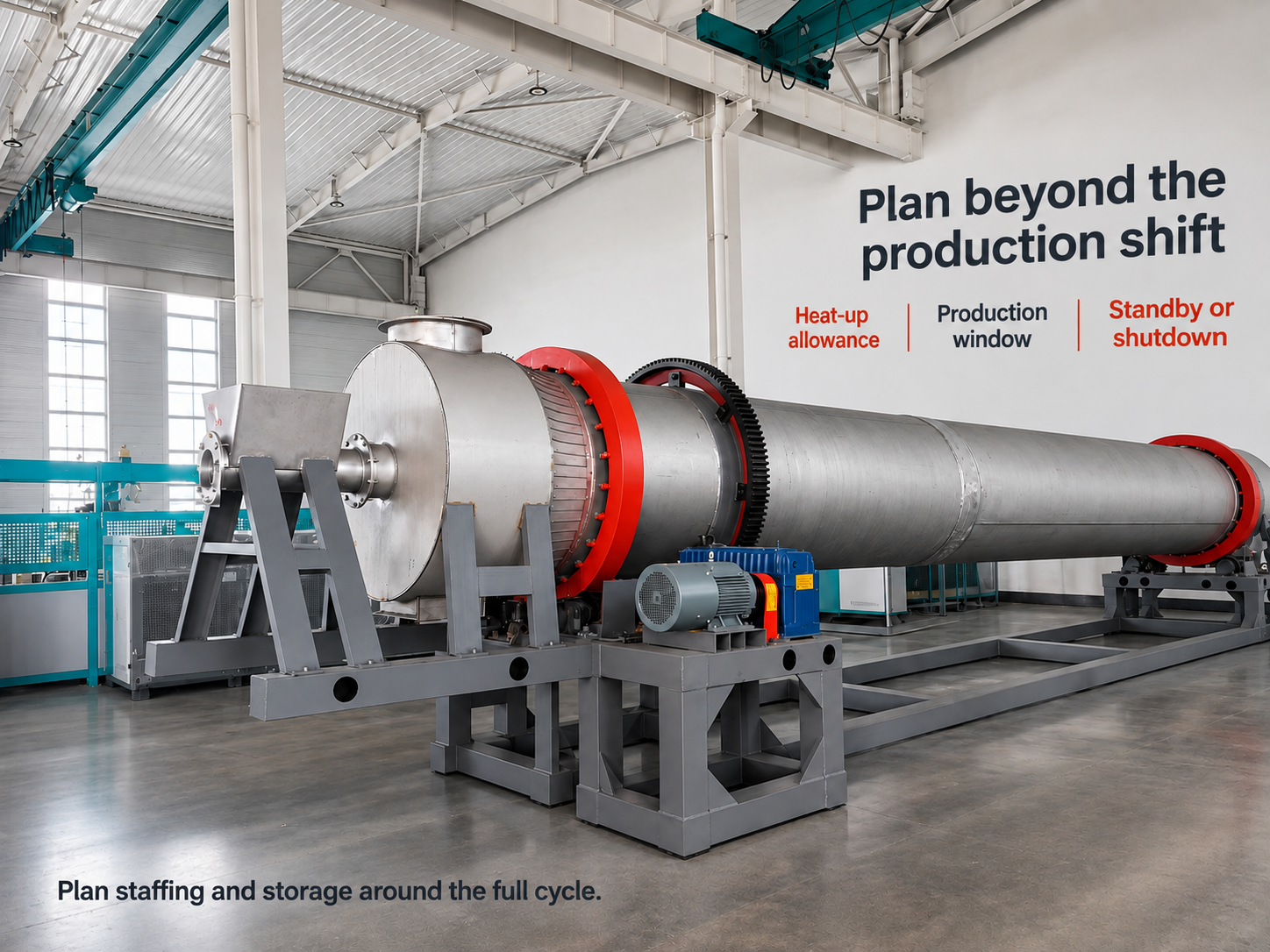
Return to the buyer's original plan. If daytime labor is needed mainly for raw material preparation and loading trucks, the kiln may not need to follow those activities hour for hour. A suitably designed feed buffer could supply prepared material outside the preparation shift, while cooled product storage could separate kiln discharge from packing and dispatch.
Those buffers must actually work with the material. A feed bin needs reliable discharge and enough usable capacity for the intended interval. Finished-product storage needs suitable temperature, moisture protection, and segregation. For a lime rotary kiln production plant, storage conditions must protect the quicklime quality required by the customer.
The kiln and its supporting systems still need appropriate supervision throughout operation. Automation can assist monitoring and control, but staffing must cover the operating plan and responses to abnormal conditions. Separating shifts can change where labor is required; it does not eliminate that responsibility.
Buffers also need a plan for interruptions. If preparation stops unexpectedly or packing cannot clear finished stock, the kiln schedule may have to change. Storage capacity should therefore reflect credible supply and dispatch delays, as well as the nominal hours between shifts.
Where demand is irregular, grouping compatible orders into a longer run may reduce the frequency of heating and cooling. The buyer would accumulate suitable feed, produce for an agreed period, and use finished stock to serve later deliveries. A longer run can provide more time at stable conditions between transitions.
Whether this is practical depends on storage capacity, product stability, delivery dates, and the money tied up in inventory. Combining orders also requires compatible product specifications. A customer who needs frequent grade changes or fresh product may have limited scope to build stock.
Longer operating periods can also affect the case for kiln preheating and cooling equipment. Heat recovery must be evaluated against the actual schedule and process. It should not be assigned an assumed saving that automatically makes intermittent demand economical.
Some projects require small, infrequent batches. They may involve development work, specialized products, or orders that cannot be stored. Those requirements should trigger a review of the thermal process and equipment type before a continuous kiln is selected.
Equipment designed for batch duty may suit some applications, but its atmosphere, material movement, heating method, and product quality must be evaluated separately. A small continuous rotary kiln does not become a batch furnace simply because less material is fed into it.
Likewise, reducing the feed rate on an oversized kiln needs validation. The process must retain a suitable operating range. Buying extra capacity for future orders can complicate the early production schedule if present demand is too low for the proposed system.
Give each supplier the same target quantity of qualified product, working days, proposed run lengths, and expected shutdown frequency. Clarify whether capacity refers to incoming feed or finished product. As discussed in rotary kiln output planning, material and process conditions affect the usable capacity.
Ask how the proposal accommodates heating, transition material, standby where applicable, and planned maintenance. Compare fuel, electricity, supervision, and storage requirements across the complete production period. Allocating these costs to saleable product provides a more useful comparison than quoting fuel use only during stable operation.
Where production occupies only a few days each month, include the continuing costs of inspections, maintenance readiness, and idle assets. These costs remain part of the project even when the kiln is not producing.
The supplier should identify assumptions that need material testing or confirmation during commissioning. This makes the proposed schedule reviewable before staffing and delivery commitments are fixed.
A plan based on daytime orders can lead to several workable production arrangements. The right choice depends on how the kiln reaches and maintains product conditions, how orders are grouped, and what storage and operating support are available.
Send Sentai Machinery your material information, product specification, required output, delivery pattern, and proposed working hours. Include available fuel, staffing limits, and storage conditions so we can review the material calcining plant configuration against the schedule you intend to operate.
Does Every Rotary Kiln Need a Preheater and Cooler? How Heat Recovery Changes the Calcining System
What Affects Calcined Product Quality in a Rotary Kiln
Why Rotary Kiln Output Is Not Only Decided by Kiln Size




 WhatsApp
 Email
Email
 +86 15538010601