
STCrushers Is A Professional Minging Equipment Manufacturer since 2004, Providing High Quality Crushers, Sand Making Machines, Drying Equipment and more.
STCrushers Is A Professional Minging Equipment Manufacturer since 2004, Providing High Quality Crushers, Sand Making Machines, Drying Equipment and more.
A buyer asks for a 5 TPH gold processing plant, then asks how many grams of gold it will produce each day. The equipment quotation alone cannot supply that answer. That rating describes an ore-processing rate. The gold recovered from those tonnes depends on their grade, the hours actually worked, and the recovery achieved by the specified process.
A useful estimate connects these quantities while stating where the calculation ends. That makes the production target easier to assess before equipment is ordered.
A gravity circuit may produce a concentrate containing gold alongside other heavy minerals. A flotation circuit may produce a concentrate of gold-bearing minerals requiring further treatment. Neither concentrate weight nor visible yellow particles establish the mass of pure gold recovered.
For a gold gravity separation plant, define whether the target refers to gold contained in the final concentrate or metal obtained after additional processing. These are different measurement points. Concentrate gold content is calculated from its dry mass and representative assay. Subsequent treatment has its own recovery and product specification, so a concentrate estimate cannot automatically become a refined-gold production promise.
The following example uses invented inputs solely to demonstrate arithmetic. It is not a test result, typical performance claim, or forecast for a Sentai Machinery installation. All ore tonnes are metric tonnes on a dry basis, and grade is expressed as grams of gold per dry tonne.
Assumption or calculation | Value |
Assumed dry-ore processing rate | 5 t/h |
Assumed effective processing time | 8 h/day |
Calculated daily dry-ore feed | 40 t/day |
Assumed average feed grade | 3 g/t |
Calculated gold entering with feed | 120 g/day |
Assumed recovery to final concentrate | 60% |
Calculated gold contained in concentrate | 72 g/day |
The calculation is 40 t/day x 3 g/t x 0.60 = 72 g/day of gold contained in concentrate. It assumes the defined circuit achieves that recovery over a representative operating period, without a material change in its gold inventory. It does not mean that 72 g of pure gold will be collected or poured that day.
Each input now needs evidence. The table is a way to organise assumptions; multiplying them does not make them reliable.
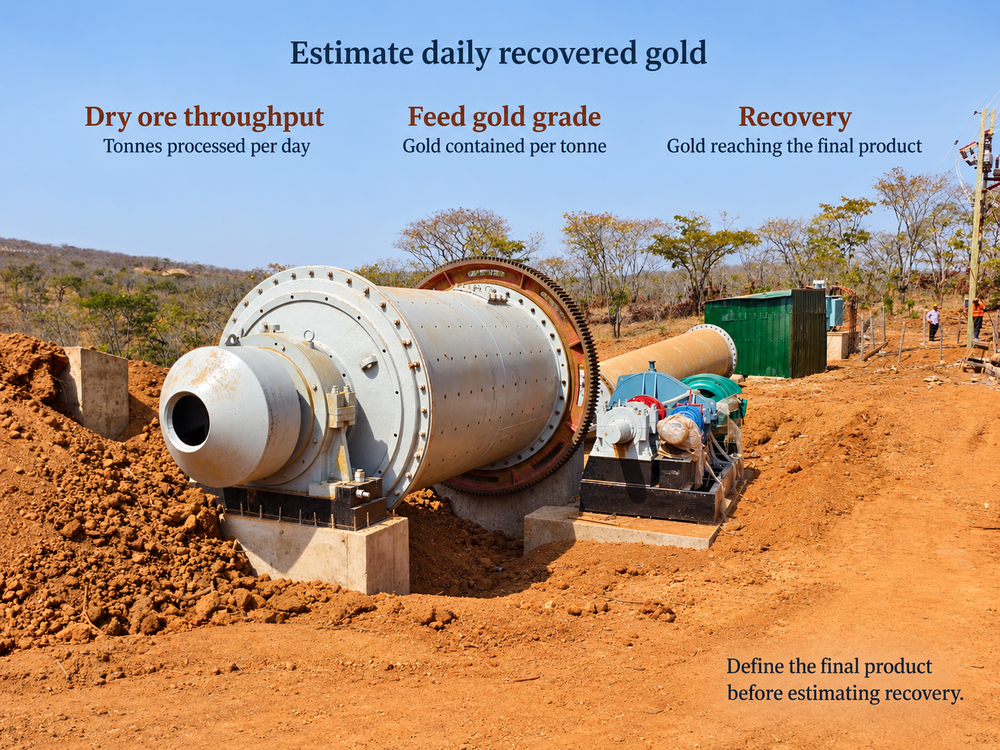
The feed grade should represent the ore actually entering the plant. A hand-picked rich specimen, a single exposed vein, or a photograph showing visible gold may differ substantially from the mixed material delivered to the hopper. Waste-rock dilution and changes between mining areas can lower or vary the feed grade.
Use a sampling and assay programme suited to the deposit and expected feed variability. Where ore batches have different grades, the combined grade must reflect their respective dry masses. An unweighted average of laboratory results can distort the estimate.
Moisture also matters. If the reported grade is on a dry basis, wet truck weights must be converted consistently before calculating contained gold. The guide to ore testwork before beneficiation plant design explains why sample representativeness and mineral behaviour belong in the design evidence.
The assumed 60% in the example represents the share of feed gold reporting to the specified final concentrate. It is not the percentage of ore mass becoming concentrate, nor the concentrate's gold purity. These distinctions prevent several very different percentages from being used interchangeably.
A recovery figure needs an ore description, test conditions, and clearly identified inlet and outlet streams. A single machine's recovery does not necessarily describe the complete plant. Nor can recoveries from successive stages simply be added: a downstream stage treats the gold remaining in, or transferred to, its own feed.
The appropriate route depends on gold occurrence, liberation, and separation response. Gold gravity separation or gold flotation discusses that choice. Testwork supports a planning estimate, while plant sampling must establish actual performance under operating conditions. A result obtained from one ore sample should not be applied unchanged to every future feed blend.
Increasing feed rate may shorten the time available for grinding or overload classification and separation. If gold-bearing particles remain insufficiently liberated, additional ore throughput may be accompanied by lower recovery. The recovered grams must therefore be recalculated using the performance expected at the proposed operating rate.
A ball mill and its classification stage influence the material reaching recovery equipment. Internal circulating material should not be counted again as fresh ore. The recent ball mill versus wet pan mill comparison also explains why grinding capacity requires a defined product fineness.
Operating hours need the same care. Eight effective processing hours means eight hours with material moving through the intended duty. A scheduled shift that includes stoppages, maintenance, or interrupted feed does not automatically provide eight productive hours.
Gold may remain within the circuit between collection events. Concentrate may be removed periodically, and product awaiting sampling or further treatment may represent several days of operation. Today's collection can therefore include gold introduced earlier, while some of today's feed gold remains in the system.
Reconcile a suitable accounting period using measured feed, products, tailings, and changes in material inventory. SGS describes metallurgical accounting as a process involving mass measurement, sampling, analysis, and metal-content accounting across those principal streams. Weighing and assay quality both affect the result.
If measured output differs from the estimate, investigate feed grade, actual dry tonnage, recovery, and inventory before attributing the gap to equipment capacity. Unmeasured flows or inconsistent sampling can obscure the cause. A stable, reconciled operating record provides a stronger basis for future production expectations than one unusually good collection day.
An enquiry becomes more useful when it states the proposed daily dry-ore tonnage, representative grade information, testwork, effective operating hours, and intended final product. Separate measured inputs from assumptions so the supplier can see what remains uncertain.
For a complete beneficiation plant, the quotation should describe the process boundary and capacity basis. Ask how the proposed grinding and recovery stages support that duty, and what evidence is needed to validate the expected gold output.
Tonnes of ore become a meaningful gold-output estimate only when the grade, recovery, operating time, and product boundary are defined consistently. Keep the calculation transparent and revise it as better evidence becomes available. This gives buyers a practical production target to discuss with equipment suppliers.
Send Sentai Machinery your ore assay, available processing tests, feed size, daily dry-ore target, working hours, and intended product. Our team can review the equipment scope and identify the information needed to assess expected output before recommending a small gold processing line.
Ball Mill vs Wet Pan Mill for Gold Ore: Which Fits a Small Processing Plant?
What Ore Test Work Is Needed Before Designing a Beneficiation Plant?
Gold Gravity Separation or Gold Flotation: Which Process Fits Your Ore Better?
What Buyers Should Know Before Choosing Equipment for a Small Gold Ore Processing Plant


 WhatsApp
 Email
Email
 +86 15538010601