
STCrushers Is A Professional Minging Equipment Manufacturer since 2004, Providing High Quality Crushers, Sand Making Machines, Drying Equipment and more.
STCrushers Is A Professional Minging Equipment Manufacturer since 2004, Providing High Quality Crushers, Sand Making Machines, Drying Equipment and more.
If you are adding a dryer ahead of a wood pellet mill, begin with the condition of the material that the mill needs. Agree on the acceptable moisture range, particle size, and hourly feed requirement with the pellet equipment supplier. These requirements give the drying system a clear duty and help prevent a mismatch between two individually capable machines.
A sawdust rotary drum dryer removes moisture while conveying and mixing the material through a rotating cylinder. Its performance depends on the feed presented to it, the available heat, and the way material contacts the drying gas. Planning the line means matching these conditions to the required output. No single moisture target or catalogue capacity describes every wood pellet project.
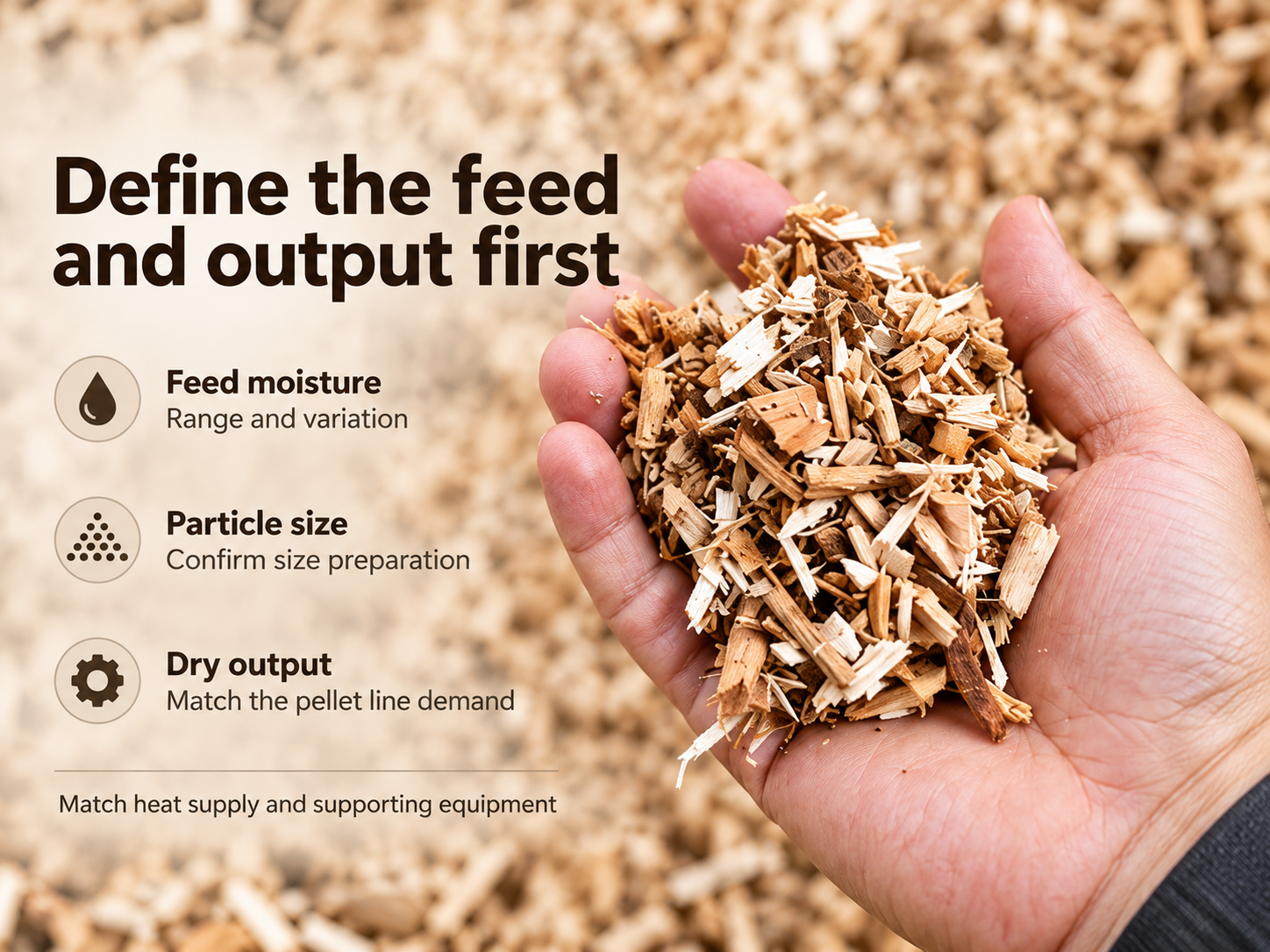
Fine sawdust, shavings, and coarse wood fragments behave differently during feeding and drying. A mixed pile can contain thin pieces that dry quickly alongside thicker particles that retain moisture longer. Record the size range and proportions, rather than describing everything simply as wood waste. Photographs help explain the material, while representative samples provide a better basis for assessment.
Check the source as well. Clean sawmill residues and mixed demolition wood raise different questions about contamination and suitability for the intended pellets. Soil, stones, metal, coatings, or treated timber need appropriate assessment and separation or exclusion. The dryer does not make unsuitable feedstock acceptable merely by removing its water.
Screening or size reduction may be needed to prepare oversized pieces, but the arrangement should follow the actual feed and pellet specification. A screen separates by size; it cannot reliably sort material according to moisture. The broader guide to how different materials change rotary dryer design explains why material identification belongs before equipment selection.
A request for a 5 TPH sawdust dryer needs a capacity basis. Does it mean five tonnes of incoming wet material, or five tonnes of dried material available to the next process? The distinction affects the evaporation duty and the amount of feed needed to supply the pellet line.
Consider a hypothetical water balance. Five tonnes per hour of sawdust at 50 percent moisture contains 2.5 tonnes of dry solids. At an assumed final moisture of 10 percent, those solids would form approximately 2.78 tonnes of dried material per hour, with about 2.22 tonnes of water removed. Both moisture figures are on a wet basis, and the calculation assumes no solids loss. The 10 percent figure is an illustration, not a universal pelletizing recommendation.
This calculation defines a duty; it does not select a dryer model or predict finished pellet output. Actual selection also considers particle behavior, heat losses, and operating conditions. State the normal and highest expected feed moisture in the inquiry. A wetter batch changes the load even when incoming tonnage stays constant, as discussed in rotary dryer feed moisture fluctuation.
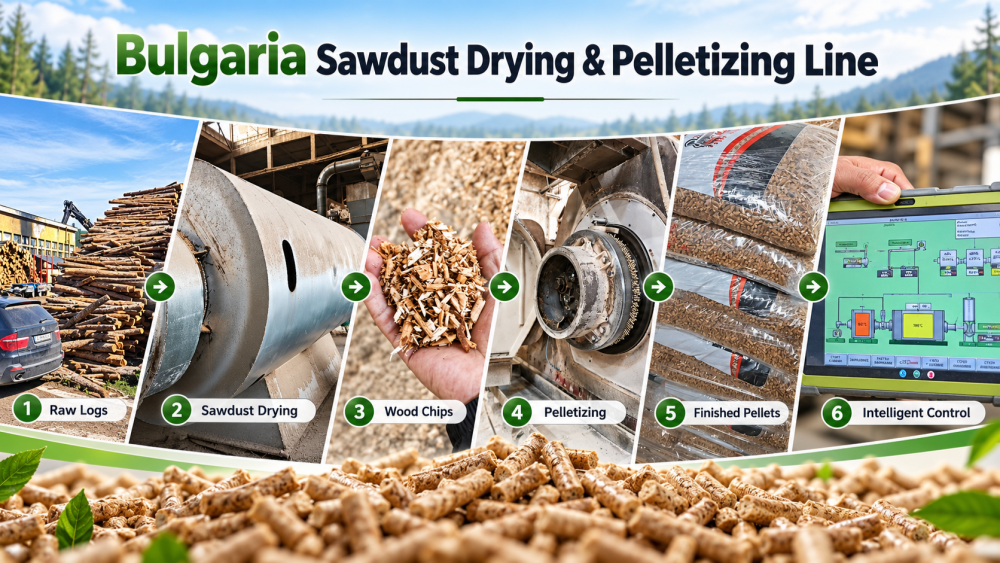
Start at the receiving hopper. Light, fibrous material can bridge or arrive in intermittent loader batches, so storage and feeding equipment need to suit its flow behavior. A buffer and controlled feeder can reduce interruptions, provided their design matches the material. A steady feeder setting still needs checking against the actual mass entering the dryer.
The rotary drum dryer works with a heating system, gas-handling equipment, material separation, and discharge conveyors. Inside the drum, suitable lifting arrangements expose material to the drying gas. The fan and collection system must handle the expected gas flow and entrained particles. Each part needs a defined place in the quotation so buyers can identify what the complete line includes.
Wood dust is combustible, which makes temperature control, ignition-source management, housekeeping access, and appropriate fire and explosion protection part of system design. A cyclone or bag filter alone does not establish that the installation is adequately protected. The proposed equipment and safeguards should be reviewed for the actual material and applicable site requirements.
Compare fuels that can be supplied consistently at the project location. If wood residues will fire the heating system, identify their moisture, size, and available quantity separately from the sawdust being dried. Wet or irregular fuel can affect feeding and combustion, adding another source of variation to the drying process.
The heating arrangement must also suit product cleanliness requirements. Discuss whether combustion gases contact the material and how ash or sparks are managed. Evaluate fuel handling, storage, maintenance, and the ability to maintain controlled heat input alongside purchase price. Our guide to using biomass fuel in a rotary dryer develops these fuel-selection questions in more detail.
Define acceptance conditions before comparing supplier promises. Record the agreed feed material, moisture range, particle size, wet throughput, and required discharge moisture. Specify how and where representative samples will be taken, how moisture will be measured, and the stable operating period over which performance will be assessed. Hand feel alone cannot establish compliance with a moisture specification.
Check the downstream connection too. Dried material may need buffering or further conditioning before pelletizing, depending on the pellet line. Conveying and storage should limit moisture pickup and contamination. Confirm dried output under the agreed conditions separately from finished pellet production, which also depends on the pellet mill and subsequent processing.
Send photographs and a description of the wood residues, their size distribution, and measured moisture variation. Identify both the available wet feed and the dried output required by the pellet line. Include the pellet supplier's feed requirements, local fuel options, operating hours, voltage, and a site sketch showing access and available space.
Explain any planned changes in raw material supply. A line designed for relatively uniform sawdust may need reassessment if larger chips or wetter residues are introduced later. Clear assumptions let suppliers explain configuration choices and quote against the same production duty.
A useful sawdust drying proposal connects the incoming material to a defined pellet-line feed requirement. Clear capacity figures, suitable material handling, and agreed acceptance conditions give buyers a practical basis for evaluating the complete installation.
Share your material details, moisture range, required dried output, fuel conditions, and pellet-line requirements with Sentai Machinery. We can review the drying duty and supporting equipment needed for a project-specific proposal.
How Different Materials Change Rotary Dryer Design
Rotary Dryer Feed Moisture Fluctuation: Why Fuel Use and Discharge Moisture Become Unstable
Can a Rotary Dryer Use Biomass Fuel? What Buyers Should Check Before Ordering





 WhatsApp
 Email
 +86 15538010601