
STCrushers Is A Professional Minging Equipment Manufacturer since 2004, Providing High Quality Crushers, Sand Making Machines, Drying Equipment and more.
STCrushers Is A Professional Minging Equipment Manufacturer since 2004, Providing High Quality Crushers, Sand Making Machines, Drying Equipment and more.
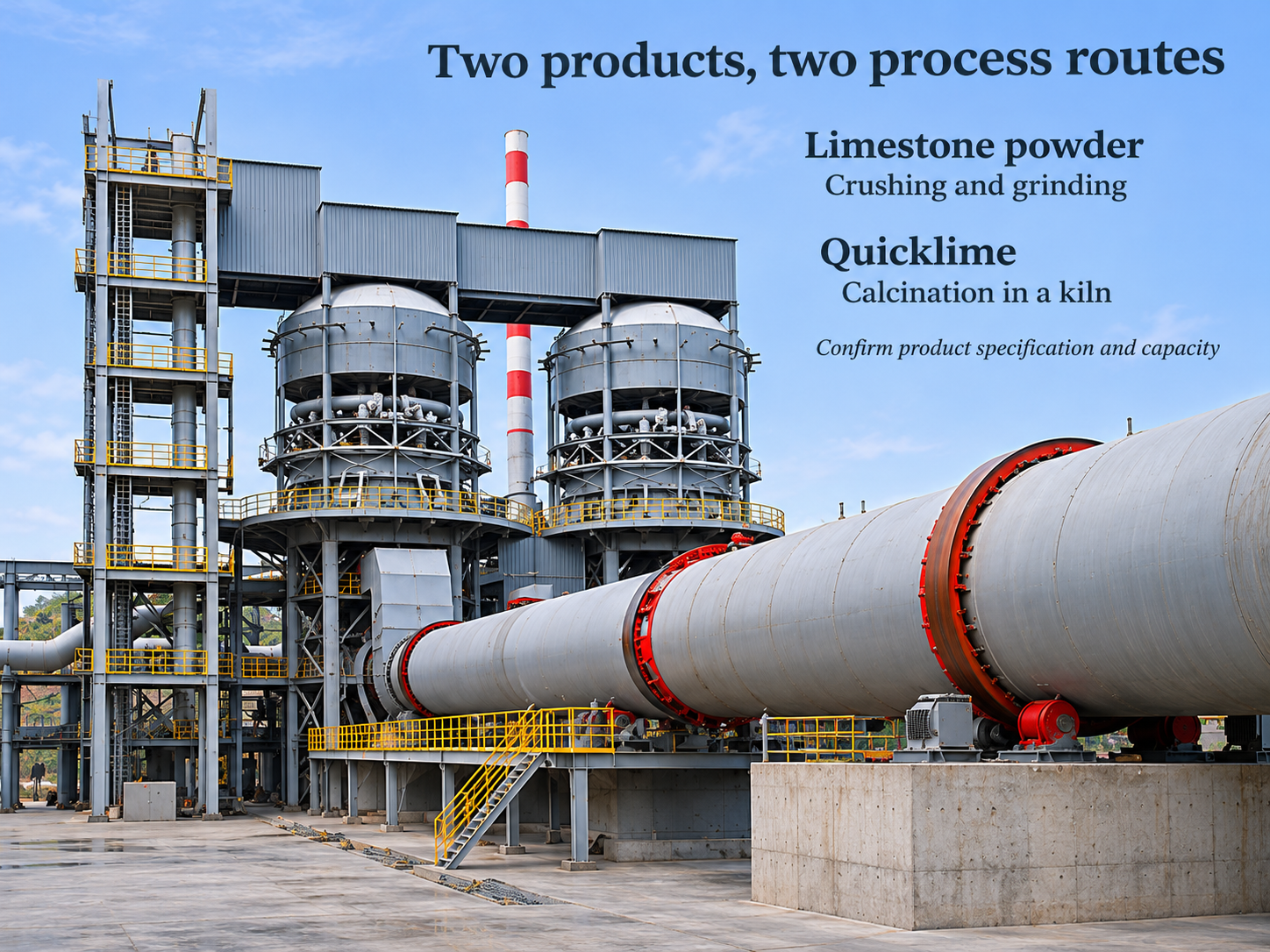
The difference between limestone powder and quicklime starts with what happens to the stone. Ordinary limestone grinding reduces particle size while largely retaining its carbonate composition. Calcination uses heat to convert suitable limestone into quicklime, releasing carbon dioxide. For high-calcium limestone, the main chemical distinction is calcium carbonate, CaCO3, versus calcium oxide, CaO. Natural impurities and magnesium content still matter.
For a buyer comparing limestone powder vs quicklime, the first question is therefore the required product. An illustrative request such as "We want to process limestone into powder" leaves the supplier uncertain. Does the customer need ground limestone for an industrial formulation, or powdered quicklime for a process requiring reactive lime?
That answer changes the equipment proposal. Making limestone powder does not inherently require a lime kiln, while grinding limestone alone does not produce quicklime.
Comparison | Limestone powder | Quicklime |
Main processing purpose | Reduce stone to the required fineness | Convert suitable limestone through calcination |
Core process equipment | Grinding system with suitable size control | Kiln system with heating and cooling |
Product checks | Fineness, composition, moisture and application-specific properties | Available lime, reactivity, residual carbonate and size, as specified |
Possible delivery form | Dry powder or slurry, depending on the project | Sized material or powder after further processing |
A limestone powder line generally starts by preparing feed that the grinding system can accept. Crushing may be needed when incoming stone is too large. Controlled feeding then helps the mill operate consistently, while classification separates acceptable particles from material needing further grinding where the selected circuit requires it.
A ball mill is one possible choice for limestone grinding equipment. Suitability depends on feed size, moisture, required particle size distribution, production rate and product contamination limits. A nominal mesh value alone is a weak basis for selection; the buyer should provide the required grading or test method and intended use.
The surrounding equipment also depends on the product form. Dry powder production may need dust collection, suitable storage and packing. A wet route requires slurry handling and water management. If the customer needs dry powder, selecting wet grinding introduces a further separation or drying duty that must be justified. These supporting duties should appear in the proposal rather than emerge after the mill is ordered.
Quicklime production equipment serves a different purpose. Feed preparation must deliver stone suitable for the chosen kiln system, including an appropriate size range and consistent composition. Limestone is then heated under controlled conditions, and the calcined product is cooled before subsequent handling.
A lime rotary kiln production plant therefore includes more than the rotating shell. Its scope may cover feeding, the heat supply, cooling, gas handling, dust collection, conveying and controls. Preheating or heat recovery arrangements depend on the design. The supplier should identify included equipment, optional items and interfaces with equipment supplied by others.
Raw material suitability remains important even when the required output is modest. Impurities, magnesium content and calcination behavior affect the product that can be made. The customer's specification should guide the proposal, supported by appropriate material analysis. Our lime production line guide explains the main stages once the quicklime route has been established.
One common assumption is that very fine limestone becomes equivalent to lime. Grinding increases fineness; it does not replace the chemical conversion required for quicklime. Equally, quicklime can be crushed or ground after calcination, so a powder's appearance does not establish its identity.
Ask for the exact product designation and acceptance specification instead of relying on the word "lime" in an inquiry or translated product name. Hydrated lime is another distinct product involving a further reaction with water. A quicklime equipment quotation should not silently include, or be mistaken for, a complete hydrated lime line.
Storage requirements also deserve separate attention. Powder handling must address dust and moisture control, while quicklime handling must account for its reaction with water. The proposed storage and dispatch arrangement should match the actual product and the site's operating conditions.
Two offers described as a "limestone processing plant" may cover different products and boundaries. A grinding quotation might cover a mill and classifier, while a calcination quotation might include a kiln, burner, cooler and gas treatment. Comparing only their total prices gives little useful information.
First confirm whether each price covers an individual machine, a process section or the agreed complete line. Then identify foundations, electrical installation, storage, packing, installation support and other responsibilities. Neither "complete plant" nor a main-machine model defines these boundaries adequately on its own.
Capacity needs the same care. Incoming limestone tonnage and saleable quicklime tonnage differ because calcination releases carbon dioxide, with moisture and process losses also affecting the balance. Grinding output depends on the specified fineness and material condition. Require each quotation to state what its capacity refers to, the feed assumptions and the product specification attached to it.
Use a short buyer checklist before requesting equipment. Confirm the intended product name and end use, then attach the customer's specification or available test report. State raw material composition, feed size, moisture range, required finished-product rate and planned operating hours.
For limestone powder, clarify fineness, dry or slurry delivery, and any application-specific purity or contamination limits. For quicklime, provide the required quality tests, delivery size, available fuel and site requirements for emissions control. Explain which crushing, storage or conveying equipment already exists.
Finally, include the project location, electrical supply, available space and intended supply boundary. These details allow the supplier to explain what can be retained, what needs adding and which assumptions still require confirmation.
The useful starting point is the product your customer will accept. Once that is clear, grinding and calcination become distinct process choices, and equipment quotations can be compared against a defined scope. A more detailed machine list cannot compensate for an undefined product.
Send Sentai Machinery your limestone analysis, target product specification, required output and site conditions. Our team can review the relevant grinding or calcining equipment with you and clarify the proposed supply scope before preparing a project-specific quotation.
Lime Production Line: Equipment and Working Process
Rotary Kiln for Limestone Calcination: Process and Equipment


 WhatsApp
 Email
 +86 15538010601