
STCrushers Is A Professional Minging Equipment Manufacturer since 2004, Providing High Quality Crushers, Sand Making Machines, Drying Equipment and more.
STCrushers Is A Professional Minging Equipment Manufacturer since 2004, Providing High Quality Crushers, Sand Making Machines, Drying Equipment and more.
In manufactured sand production, grain shape is one of the most important quality indicators. Good particle shape improves the performance of concrete, mortar, asphalt mixtures, and other construction materials. Poor grain shape, on the other hand, can reduce product value, increase cement consumption, and make it harder to meet market standards.
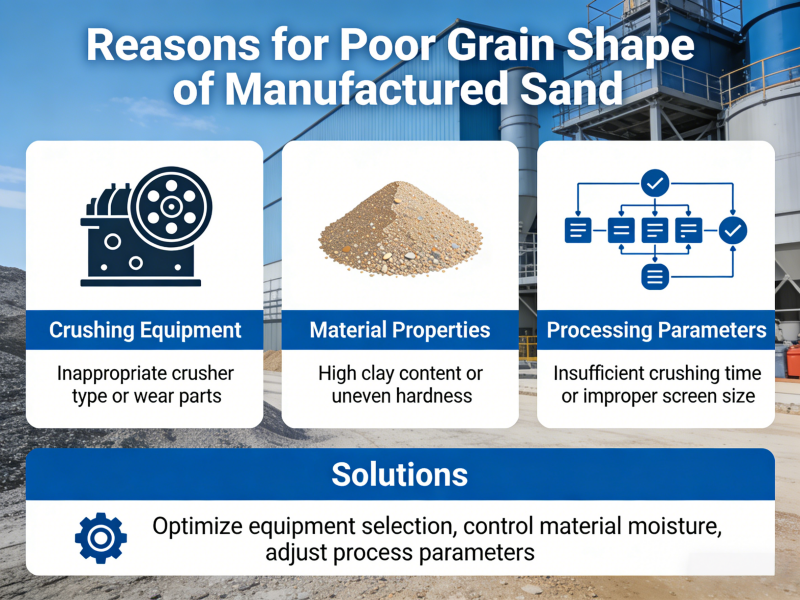
So why is manufactured sand grain shape sometimes poor? In most cases, the problem comes from a combination of raw material characteristics, process design, crusher selection, and machine adjustment.
The first factor is raw material type. Different stones naturally break in different ways. Some materials are easier to shape into more cubic particles, while others tend to produce flaky, elongated, or irregular particles. Hard rock such as granite or basalt may require a more carefully matched shaping stage than softer stone. Understanding the material is the first step in improving final sand quality.
The second factor is crusher and sand making equipment selection. If the crushing process stops too early, or if the line does not include a proper shaping stage, the final sand may contain too many irregular particles. In many manufactured sand plants, the sand making machine plays a decisive role in improving grain shape. Without suitable shaping and fine crushing, it is difficult to produce high-quality sand consistently.
The third factor is feed size control. If the material entering the sand making machine is too large or too inconsistent, the machine may not work under ideal conditions. This can reduce shaping efficiency and lead to unstable sand quality. Proper screening before the shaping stage helps maintain more uniform feed and supports better particle shape.
Another important reason is wear of internal parts. In sand making equipment, wear parts gradually lose their original design shape. When this happens, the crushing and shaping effect may weaken, and the final product becomes less consistent. If operators focus only on production volume and ignore wear conditions, sand quality often declines over time.
Excessive fines or improper circulation can also affect grain shape. If the process is not well balanced, the material may either be over-crushed or insufficiently shaped. Closed-circuit operation with a properly matched vibrating screen helps return oversized material for further processing while separating qualified sand efficiently.
The condition of the screening system also matters. If the vibrating screen does not classify material effectively, poorly shaped particles may remain in the final product or qualified particles may be unnecessarily returned for reprocessing. Good screening is not only about size control; it also affects process stability.
Another possible cause is poor process matching across the whole line. A manufactured sand plant is not just one machine. It is a coordinated system involving feeder, crusher, sand making machine, screen, conveyor, and sometimes washing equipment. If one part of the line is not properly matched, the final grain shape may suffer even if the main machine is good.
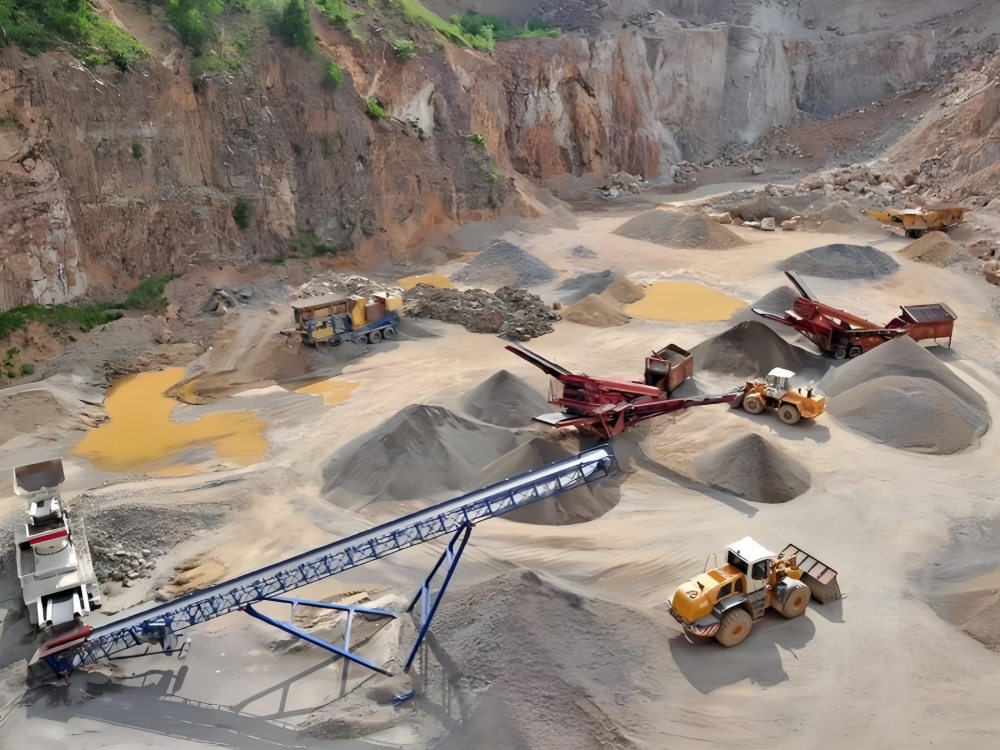
To improve manufactured sand grain shape, producers can take several practical steps:
1.Evaluate the raw material and its crushing characteristics.
2.Ensure the process includes a suitable shaping stage.
3.Control feed size before the sand making machine.
4.Inspect and replace worn internal parts regularly.
5.Optimize the screen and return circuit.
6.Check whether the line is overloading or underfeeding key machines.
7.Adjust the process according to final sand application requirements.
If the final product will be used in higher-grade concrete or asphalt, shape control becomes even more important. In those cases, a more carefully designed sand making and screening process is often worth the investment.
In summary, poor manufactured sand grain shape is usually not caused by a single issue. It is the result of material properties, machine condition, and process coordination. By improving equipment matching and controlling the shaping stage more carefully, producers can achieve more cubic and marketable manufactured sand.
At Sentai machinery, we help customers optimize sand production lines based on raw material, output requirement, and final product application. Better grain shape is not just a quality issue; it is also a profitability issue.
Need to improve your manufactured sand quality? Contact Sentai machinery with your raw material type, capacity, and current sand quality issue for a practical production suggestion.
Related Articles:
80-100 tph Stone Crusher Plant


 WhatsApp
 Email
Email
 +86 15538010601