
STCrushers Is A Professional Minging Equipment Manufacturer since 2004, Providing High Quality Crushers, Sand Making Machines, Drying Equipment and more.
STCrushers Is A Professional Minging Equipment Manufacturer since 2004, Providing High Quality Crushers, Sand Making Machines, Drying Equipment and more.
The quotation says "spare parts included," but the description stops there. Before ordering a stone crusher plant, ask what that line actually covers. It may refer to a small package of supplied extras, while the wear parts needed for the first production period are quoted separately. A clear initial order should identify both the parts supplied with the equipment and the additional stock recommended for your site.
Begin by separating installation accessories from replacement stock. Bolts used to assemble the machine, guards supplied loose for transport, and fittings needed to complete installation belong to the delivered equipment. They should not be counted as spare parts available for later repairs. Likewise, the jaw plates already fitted inside a crusher are installed components, not a spare set.
Request an itemized list showing installed parts, loose installation items, included replacements, and optional extras. This makes competing offers easier to compare. Our guide to stone crusher plant costs explains why differences in supply scope can change the apparent price advantage. Also ask how normal wear is treated under the warranty, rather than assuming replacement wear parts are covered.
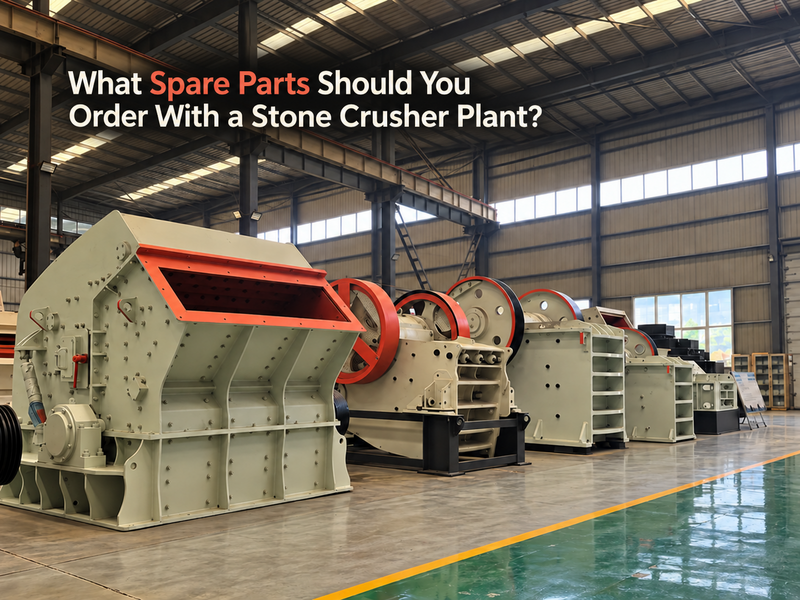
Build the list from the confirmed equipment configuration. For a jaw crusher, discuss fixed and moving jaw plates, cheek plates, and the associated fastening items. For an impact crusher, the discussion normally includes blow bars and impact or side liners. A hammer crusher has a different arrangement, so its hammer heads and any grate components must match that specific design.
Extend the review to the rest of the line. Screen media, conveyor components, and transfer-point liners can also affect production. A plant making several aggregate sizes may need different screen openings on different decks. Ordering only the correct panel dimensions is insufficient if the aperture or mounting arrangement is wrong.
Ask the manufacturer to identify the part numbers and recommended material grades. Similar-looking castings are not necessarily interchangeable. Where rotating wear parts require matched sets, confirm the ordering unit and balance requirements. The purchase list should reflect the manufacturer's replacement instructions.
Give priority to parts that combine expected consumption with difficult replenishment. A frequently used wear item deserves attention, especially when it is specific to the machine and unavailable nearby. A low-cost component can also justify early purchase if its absence would prevent the line from running.
Use the following categories as a purchasing framework. The examples are conditional, and each proposed item still needs checking against the actual machine and local supply situation.
Purchasing priority | Typical candidates | Basis for the decision |
Consider with the first shipment | Machine-specific wear sets and their fasteners | Expected wear and limited local availability |
Assess against site conditions | Bearings, drive components, sensors, or electrical spares | Failure impact, replacement lead time, and available support |
Consider local purchase after verification | Standard belts, fasteners, or conveyor rollers | Exact specifications and dependable local stock confirmed |
A costly motor, gearbox, or complete conveyor belt does not automatically belong in every initial package. Discuss the consequence of failure and the realistic replacement route before tying up money in large assemblies. Confirm whether any special tools are needed to use the spares you order.
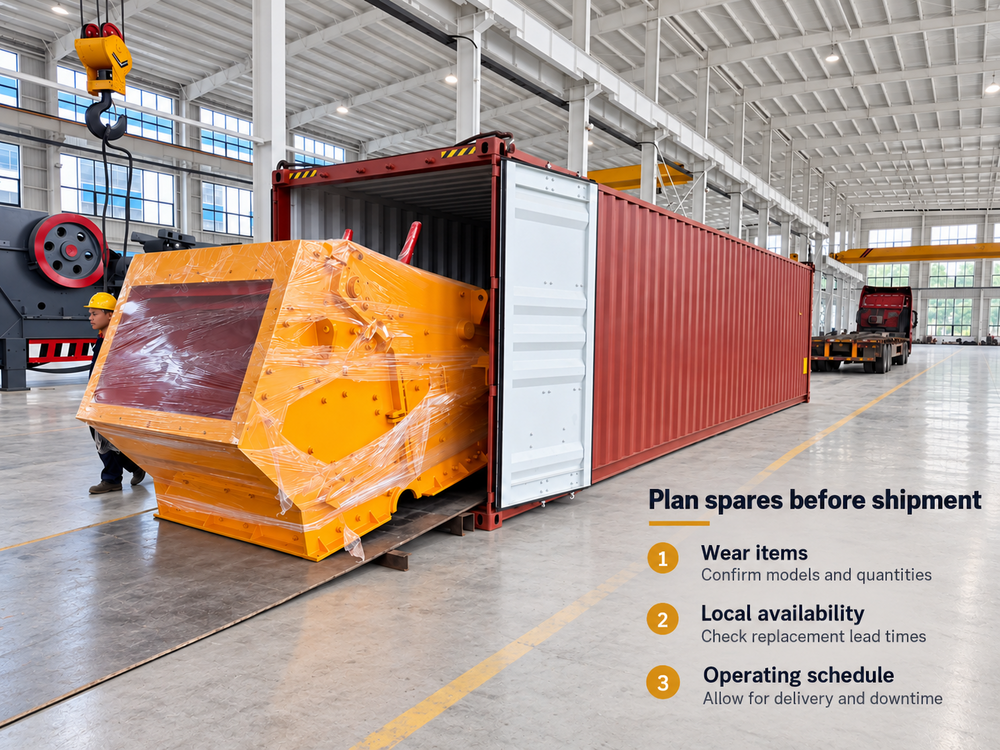
Ask the supplier to explain the assumptions behind the recommended quantity. Rock abrasiveness, feed conditions, crusher settings, and operating hours affect wear. Hardness alone cannot predict service life. A plant running one shift and a plant running continuously may consume identical parts at very different calendar intervals.
The replenishment period should include manufacture or stock release, packing, transport, customs clearance, and delivery to the quarry. A factory dispatch date is only one part of that period. For a remote project, allow for realistic transport uncertainty when agreeing an initial reserve.
For example, two hypothetical buyers could order the same crusher, but one has a verified local parts source while the other relies on overseas shipments. Their sensible starting inventories may differ. There is no universal "six-month package" without a stated workload and wear estimate. After commissioning, record operating hours, throughput, and observed wear, then use those records to adjust stock and reorder before the reserve is exhausted. Assign someone to maintain the stock record and place replenishment orders.
Local purchasing can reduce freight and shorten replenishment when a dependable supplier carries the exact item. Obtain specifications before deciding to leave it out of the overseas order. A description such as "bearing," "belt," or "roller" is too broad to establish a suitable replacement.
Bearing designations, clearances, and sealing arrangements may matter. Belts need the correct profile and length, while rollers need compatible dimensions and mounting details. Electrical items require the specified ratings and functions. Ask the equipment supplier to confirm proposed equivalents where compatibility is uncertain.
Check availability through a quotation or stock confirmation before relying on local supply. A component advertised in a catalogue may still need importing. For machine-specific castings, preserve the drawing reference, material specification, and equipment identification so a future order does not depend on a photograph alone.
Each quoted item should have a clear description, part number or drawing reference, applicable machine, quantity, and unit of supply. Clarify whether "one set" means a complete replacement set, one position, or a smaller assembly. Ask for unit prices, estimated replenishment lead times, and separate identification of included and optional items.
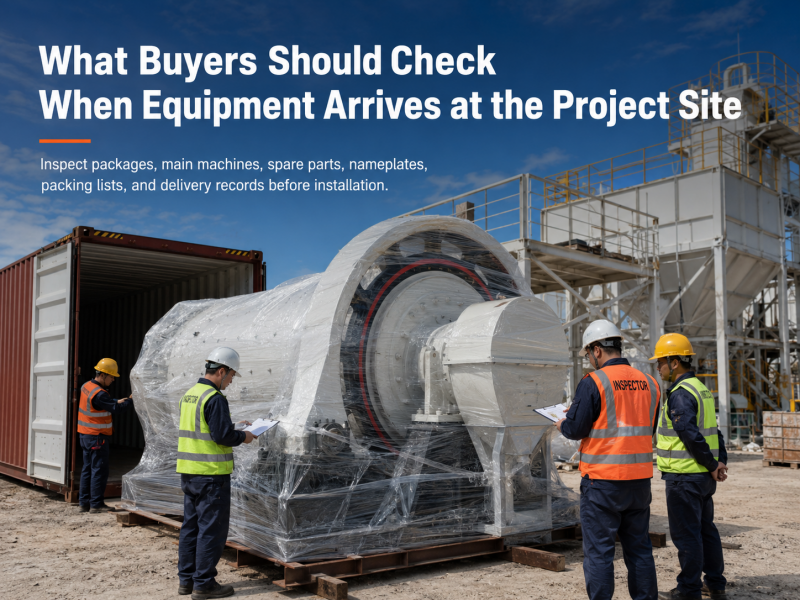
Once the order is agreed, connect the list to package labels and storage records. Keep replacement stock distinguishable from installation fittings. Our article on spare parts identification before overseas delivery covers this handover stage. At the site, follow the supplier's storage instructions so corrosion, moisture, or damaged packaging does not make a purchased spare unusable.
A useful spare parts package covers the likely needs of the actual plant and the time required to replenish them. Agree the identities, quantities, and supply routes before shipment, then refine the inventory using operating experience. That gives the buyer a clearer budget and a practical basis for future orders.
Planning a stone crusher plant, such as an 80-100 TPH crushing line? Send Sentai Machinery your proposed equipment, rock type, working hours, and project location. We can help review the initial spare parts scope alongside the plant quotation.
How Much Does a Stone Crusher Plant Cost? Build the Budget From Equipment Quote to First Production
How to Reduce Spare Parts Confusion Before Overseas Equipment Delivery
A Practical Field Guide to Reducing Downtime in a Stone Crushing Plant
 WhatsApp
 Email
Email
 +86 15538010601