
STCrushers Is A Professional Minging Equipment Manufacturer since 2004, Providing High Quality Crushers, Sand Making Machines, Drying Equipment and more.
STCrushers Is A Professional Minging Equipment Manufacturer since 2004, Providing High Quality Crushers, Sand Making Machines, Drying Equipment and more.
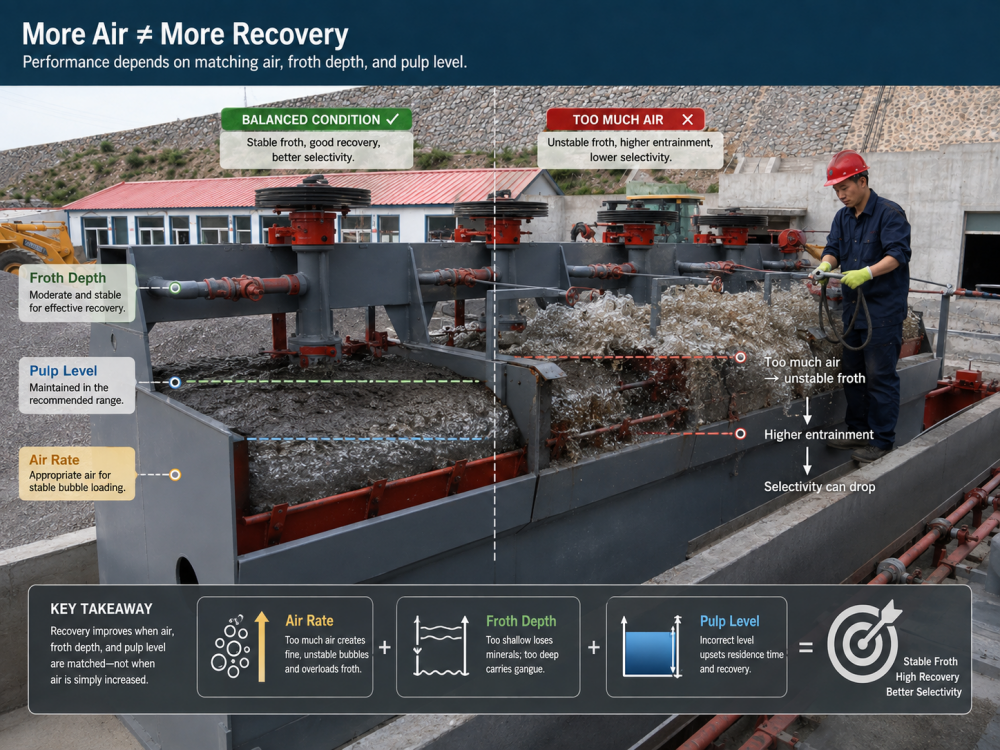
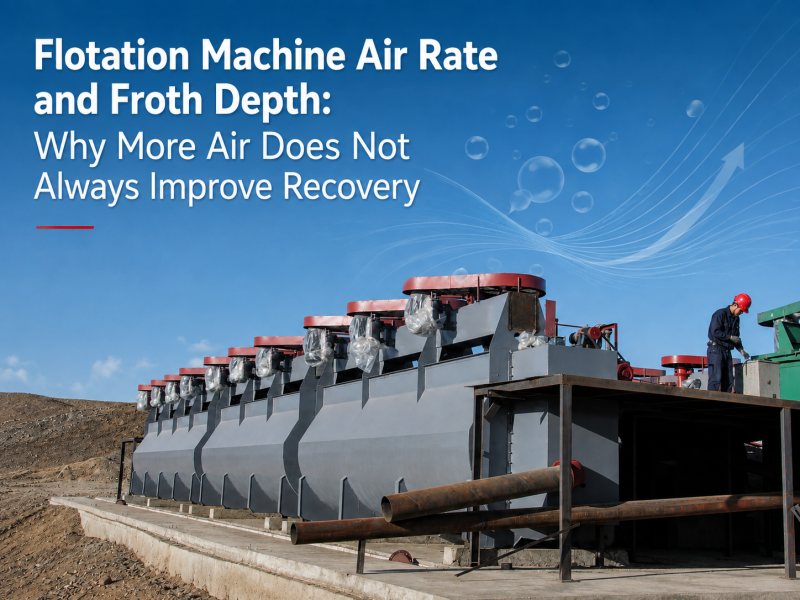
A flotation circuit begins to lose more valuable mineral to the tailings. The operator increases the air rate, and the cell surface becomes more active. Froth volume and concentrate flow rise, so the change appears to be working.
Later samples may show a different result. The concentrate can become more dilute, grade may fall, or the froth may become unstable and watery. More visible froth does not automatically mean more valuable mineral recovery.
Air rate must be judged with pulp level, froth depth, froth removal, reagent condition, particle size, and flotation-stage duty.
Air rate affects bubble generation, gas dispersion, bubble-particle contact, and the amount of material entering the froth. Pulp level sets the pulp-froth interface, while froth depth determines the distance mineralized froth travels before reaching the overflow lip or launder.
Changing one variable changes the meaning of the others. Increasing air at the same level loads the froth more heavily. Raising pulp level makes the froth shallower even when the air valve is unchanged. Operating records therefore need more than valve opening alone.
Within a suitable range, additional air can provide more bubbles and improve the opportunity for hydrophobic particles to attach and rise. The result also depends on bubble size, dispersion, mixing, and whether air reaches the full active cell volume.
Uneven air distribution may create violent activity in one area while another remains underused. If bubbles become too large or coalesce rapidly, more air may not provide equivalent useful bubble surface.
Judge air changes by froth response, mass pull, concentrate grade, tailings results, and cell stability rather than surface movement alone.
Possible signs include limited froth coverage, slow mineralized froth movement, low concentrate pull, and higher valuable-mineral loss in the tailings.
These signs do not prove that air is the only problem. Poor reagent conditioning, insufficient liberation, abnormal slurry density, blocked air passages, worn mechanisms, or unstable feed can produce similar symptoms.
Flotation response is not a straight line in which every increase in air produces more recovery. Once the froth becomes heavily loaded, additional air can accelerate mass pull without maintaining selectivity.
Water and fine gangue may enter the concentrate through entrainment. Froth can become fast, wet, and difficult to drain, while unstable bursting returns part of the mineralized froth to the pulp.
Higher concentrate flow can therefore hide lower grade. The correct comparison uses recovery, grade, mass pull, and tailings together.
With a shallow froth layer, mineralized bubbles travel a shorter distance before overflowing. Concentrate pull may rise, which can support recovery when valuable particles are easily lost from the froth.
The trade-off is less drainage and less opportunity for entrained water and gangue to return to the pulp. The concentrate may become wetter, slime entrainment may increase, and grade can decline.
A deeper froth layer provides a longer path for drainage and particle rejection. In cleaning duty, this can help reduce water and gangue entering the concentrate.
The same depth can allow weakly attached valuable particles to detach and fall back. Mass pull may decrease, and recovery can suffer. Air rate and froth depth should therefore be tested as a pair.
Rougher cells aim to recover most floatable valuable mineral from fresh feed. Cleaner cells place greater emphasis on concentrate grade and selectivity. Scavenger cells recover remaining value from rougher tailings.
The same air valve position or froth depth should not be copied across all stages. Each stage must be judged by its feed, objective, residence time, and downstream consequence.
The best air setting cannot stabilize a cell when pulp-level control is slow or froth cannot leave evenly. Check level-control elements, launder condition, overflow-lip loading, scraper operation, and interaction between adjacent cells.
Froth piling up before the launder may indicate insufficient removal capacity rather than insufficient air. One side being more active can point to uneven air distribution, feed entry, or mechanism condition.
Observed condition | Possible interpretation | First check |
Little froth and high tailings loss | Air may be insufficient | Air supply, dispersion mechanism, reagent condition, and feed stability |
Large or uneven bubbles | Poor dispersion or unstable froth chemistry | Air distribution, mechanism condition, and frother dosage |
Fast, watery froth overflow | Froth may be shallow or heavily loaded | Pulp level, froth depth, mass pull, and entrained water |
Deep stable froth but low concentrate pull | Excessive cleaning or particle dropback | Froth depth, air rate, and mineral loading |
Froth piles up before the launder | Removal capacity may be limiting | Launder, overflow lip, scraper, and froth travel distance |
One side is more active | Air or slurry distribution may be uneven | Feed entry, air lines, impeller, stator, and cell condition |
More air lowers concentrate grade | Entrainment or excessive mass pull may be increasing | Grade, recovery, mass pull, water recovery, and froth depth |
Begin with stable grinding fineness, slurry concentration, feed rate, and reagent addition. Record air rate or valve position, pulp level, froth depth, mass pull, concentrate grade, and tailings grade.
Make a small air adjustment and allow enough time for the full circuit response. Collect comparable samples. Only after the new condition is understood should pulp level or froth depth be changed.
Simultaneous large changes to air, reagents, level, and scraper speed make the result difficult to interpret. Rougher, cleaner, and scavenger stages should each develop their own stable operating range.
Ore type, valuable mineral, and flotation stage.
Flotation-machine model, cell volume, and mechanism type.
Feed rate, solids concentration, and particle-size distribution.
Airflow measurement or repeatable valve-position record.
Pulp level and measured froth depth.
Reagent types, addition points, and dosing rates.
Froth photos or video under stable operating conditions.
Bubble size, surface coverage, speed, and stability.
Concentrate mass pull and slurry flow.
Concentrate grade, tailings grade, and calculated recovery.
Launder, overflow lip, and scraper condition.
mpeller, stator, air pipe, and level-control condition.
Recent changes in ore, grinding, water, or reagent supply.
Time allowed between adjustment and sample collection.
Too little air can limit bubble-particle contact, but too much can overload the froth, increase entrainment, and reduce concentrate selectivity. Shallow and deep froth layers create different recovery and grade trade-offs.
The correct operating range depends on ore response, grinding, reagents, cell duty, level control, and froth removal. More surface activity is useful only when concentrate and tailings results improve together.
Sentai Machinery can review flotation-stage duty, feed condition, air and level records, froth video, mass pull, grade, and tailings results before recommending equipment checks or operating adjustments.
1. Flotation Machine Selection: Why Ore Type and Slurry Condition Matter Before Cell Configuration
2. What Affects Flotation Recovery in a Copper Ore Processing Plant
3. What Buyers Often Miss When Choosing Flotation Reagents for Copper Ore
5. What Buyers Often Miss When Matching a Ball Mill and Spiral Classifier
2. Ball Mill


 WhatsApp
 Email
Email
 +86 15538010601