
STCrushers Is A Professional Minging Equipment Manufacturer since 2004, Providing High Quality Crushers, Sand Making Machines, Drying Equipment and more.
STCrushers Is A Professional Minging Equipment Manufacturer since 2004, Providing High Quality Crushers, Sand Making Machines, Drying Equipment and more.
The mobile crusher arrived with a diesel power package because the buyer believed that a mobile machine should be independent from the grid. Eight months later, the unit was still working in the same corner of the recycling yard. Diesel was delivered every week, engine service was added to the maintenance plan, and the nearest industrial power connection was visible from the site entrance.
The mobile chassis was still useful. Installation had been quick and the plant could still be repositioned. What had changed was the meaning of mobility. The machine needed to remain transportable, but it did not need to produce its own power every day.
This distinction is central to mobile crusher power selection. Mobility describes how the plant is installed and relocated. Power independence describes whether it can operate without external electricity. Some projects need both. Others need only one.
Now place the same crushing concept at a temporary limestone quarry far from a stable transformer. The working face will change as extraction advances, the access road is basic, and the contractor expects to relocate after several months. Waiting for a permanent grid connection would delay production and create infrastructure that may be abandoned soon.
In this setting, diesel power is not chosen because it is automatically cheaper. It is chosen because the plant can arrive, unfold, complete safety checks, and begin production without depending on a new electrical installation. The crusher can follow the material source, and the power system moves with it.
That advantage also brings work that is easy to underestimate during quotation. Fuel must reach the site reliably, and storage and refueling need safe procedures. Cooling systems, filters, lubricants, and engine hours become part of daily production management. Poor fuel quality or delayed service can stop the crushing line even when the crusher itself is mechanically sound.
At a construction-waste recycling yard, the mobile plant may remain on one site for a year or longer. The chassis still reduces foundation work and leaves the buyer free to move later, but the daily operating pattern is close to a stationary installation. Feed material arrives by truck, product piles remain in fixed positions, and the screen and conveyors follow a repeated layout.
When reliable grid power is available, an electric process drive may fit this pattern better. The site avoids daily fuel handling for the crushing process and removes some engine-related maintenance from routine production. Electric motors can also make it easier to distribute power to the crusher, feeder, screen, and conveyors through one coordinated electrical system.
The grid option is not simply a cable connected to the machine. The site must confirm available capacity, voltage, frequency, transformer condition, starting method, cable route, earthing, protection, and safe isolation. If the local supply is unstable, the plant may still need a generator or another plan for controlled shutdown and restart.
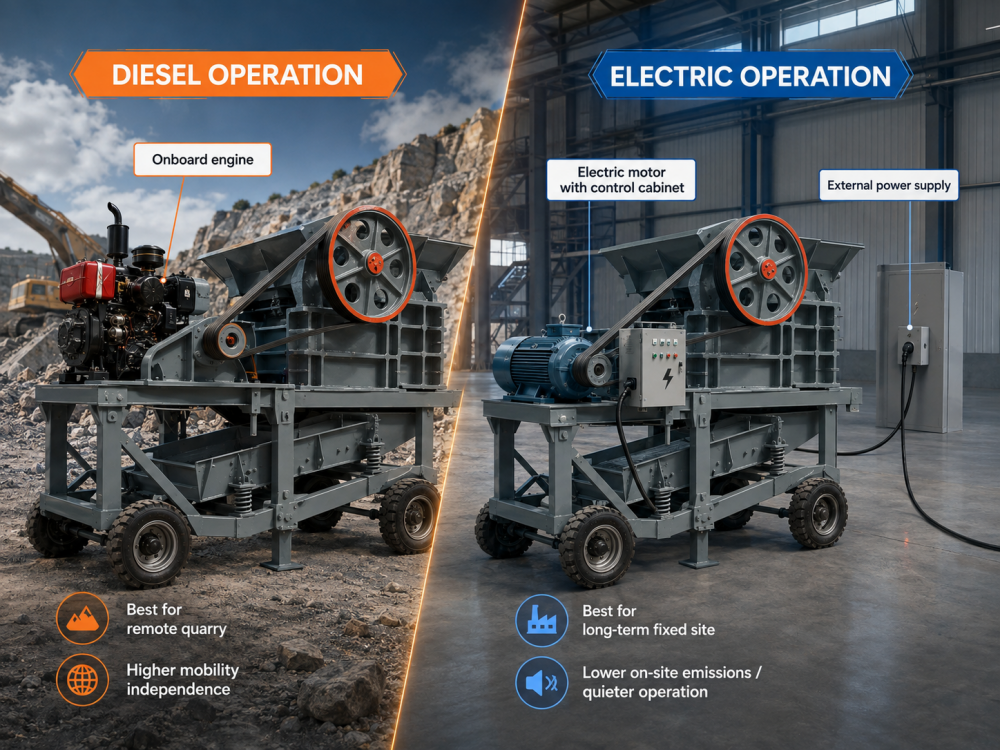
A buyer asking for a diesel mobile crusher may be describing several different systems. In a direct mechanical or hydraulic arrangement, the diesel engine provides the main machine power through the selected transmission system. In a diesel-electric arrangement, the engine drives a generator and the crushing process is powered by electric motors. In a plug-in arrangement, those electric process functions can use external grid power when it is available.
These systems do not create the same maintenance boundary or operating behavior. A diesel-electric plant can retain off-grid capability while allowing electrically driven process equipment. A grid-connected plant may still use diesel for tracking or relocation, depending on the design. A dual-source machine may offer both choices, but that does not mean every power-source change is instant or can be made without a shutdown procedure.
The quotation should therefore identify what the engine drives, what the generator supplies, which functions are electric, how the tracks are powered, and whether external grid connection is included in the control design.
Before delivery, the cost comparison often starts with the local diesel price and electricity tariff. After the first month, the buyer usually sees a wider picture. The important number is not only the price of each energy unit. It is the energy and maintenance cost attached to each ton of qualified product.
A generator that spends long periods at light load may not use fuel in the same way as a plant working steadily near its intended duty. Irregular feeding, screen blockage, waiting for trucks, and high return material can keep the engine running while finished-product output remains low. The same process losses would also waste electricity, but the fuel delivery and engine-service burden make them more visible on a diesel site.
At the electric site, transformer losses, cable distance, start-up current, outages, and temporary electrical work may change the calculation. At the remote quarry, the ability to start work without waiting for grid construction may be worth more than a lower theoretical energy price.
A plant that moves every few weeks should avoid infrastructure that takes longer to disconnect and rebuild than the relocation itself. Self-contained power, compact cable runs, folding conveyors, and fast site preparation carry real value.
A plant that moves only once or twice during a long contract can accept more developed electrical infrastructure. The buyer may use grid power for normal production and prepare a controlled method for disconnection and reconnection during relocation.
A plant expected to stay in one place for years should be evaluated almost like a long-term production asset, even when it remains wheel-mounted or track-mounted. The mobile frame still supports future flexibility, but the daily power decision should follow the long operating period rather than the rare relocation event.
The supplier should not begin with a single question such as whether the buyer wants diesel or electric power. The useful conversation starts with how long the unit will remain at each location, how many hours it will run each day, whether the grid is reliable, how fuel reaches the site, and what must move during relocation.
The discussion should also clarify whether the crusher will work alone or with a screen and several conveyors. A complete mobile crushing and screening train may require a different generator and power-distribution plan from one compact crusher. Future expansion matters as well because an additional screen or conveyor changes the electrical load and connection scope.
Once the work pattern is clear, the drive arrangement can be quoted with a defined boundary. That boundary should cover the engine or grid interface, generator where applicable, process motors, control cabinet, cables within the supplier scope, starting method, protection devices, and any external equipment the buyer must prepare.
At a remote quarry that relocates frequently, diesel independence may be more valuable than the lowest local energy tariff. At a recycling yard with stable power and a long operating period, an electric process drive may reduce the reasons for running a diesel engine every production hour.
Neither option is correct simply because the machine is mobile. The decisive issue is how the plant will work through the full project cycle.
Sentai Machinery can review the site power condition, relocation frequency, daily operating hours, crusher and screen configuration, local fuel supply, voltage, frequency, and backup requirement before defining the mobile crusher power package.
Mobile Crusher Project Planning: When a Portable Crushing Setup Makes More Sense
Typical 20-30 TPH Mobile Limestone Crushing and Screening Setup for Remote Sites
What Site Information Should Buyers Provide Before Plant Layout Design
A Practical Field Guide to Reducing Downtime in a Stone Crushing Plant
What We Usually Confirm Before Production Starts


 WhatsApp
 Email
Email
 +86 15538010601